
The idolization of the creator economy has captivated Gen Z, Alpha, and Beta. This is a direct reflection of the rapid evolution of technology and the role it plays in our lives daily. These younger generations see opportunity, influence, and prosperity when using technology, social media, and AI. Brands have followed suit by investing more in blogs, podcasts, social media campaigns, and newsletters to meet their audiences where they are at any given point.
It doesn’t stop here. Search behaviors are changing, content ecosystems are expanding, and AI is blurring the lines of ethics and creativity, reshaping how we create and consume content. Regardless of these shifts, one principle remains the same: content without purpose is just noise.
Let’s explore how these tools have changed over decades and how, despite these changes, content strategy remains a north star to ensure the value of content serves both its audience and the organization or individual creating it.
Combining Curation & Creation is The Secret Sauce
To avoid the easy pitfall of just publishing content arbitrarily with no goal in mind, you need to take a step back to stop chasing the trends and likes and look at the bigger picture. Successful content strategists aim to complete this set of steps.
- Identify problems and opportunities
- Convince leaders and get the resources
- Get stakeholders on board
- Set and align on project objectives
- Execute the project
Let’s look at the specifics when it comes to project objectives. A great way to think about this is that you need to “set the table.” Meghan Casey, author of The Content Strategy Toolkit, explains the importance of setting the table perfectly.
“Preparation is the key to a successful alignment session. Preparation means a few things here. First, it means getting the right people in the room. Second, it means planning how you’ll get from “what are we doing here?” to “let’s move forward.” And, third, it’s helping your stakeholders be engaged, thoughtful participants.
Executing these five steps combined with tasteful curation unlocks the “secret sauce,” aka a compelling content strategy that inspires a group of people to buy, attend, subscribe, or participate.
Image Source: Medium
When It Started. How It’s Going
The accelerated rate at which content has evolved over the years makes people feel overwhelmed trying to keep up. Although these shifts have changed the way we search, purchase, and connect with information, the fundamental purpose of content strategy hasn’t changed: helping people learn and make informed decisions that support their goals or an organization’s goals. That is content strategy at its core. That’s what remains the same. You might be asking yourself, what has changed then?
What’s changed is the complexity of the ecosystem content strategists are now navigating. When you look at content strategy historically, it started as simply managing one-dimensional channels and pieces of content. Now, content strategists are forced to think bigger, move faster, and manage entire ecosystems that span a digital footprint that’s never-ending. This includes, but is not limited to, websites, social media, podcasts, newsletters, search engines, videos, and even AI-powered digital experiences. Publishing is no longer enough. Scalability, discoverability, and moving the organization’s goals are the expectation.
In 1995, one of the biggest shifts happened. Access to the World Wide Web. Content transitioned from monolithic documents to hyperlinked pages. Rachel Ann Baillie poses an interesting argument related to this in her piece, An Uneven History of Content Strategy.
Baillie suggests that the rise of the World Wide Web shone a spotlight on the need for content strategy more than ever.
“The most logical conclusion is that the Web created new, exponentially complex challenges for content publishers. One anecdotal report from a large Silicon Valley hardware/software company talked about the mess that had ensued because of the organic growth of their online technical content, and the 100+ technical writing contractors they had to bring in to audit, categorise, and curate the over one million pages, to bring their corpus into some sort of usable form”
The beginning of generative AI and deep learning can be traced back to the 2010s. LLMs (large language models) are trained on a large amount of online data. This data includes, but is not limited to, content, topics, and various styles of writing. The biggest initial breakthrough with LLMs was their influence on search and understanding how to recognize patterns in information.
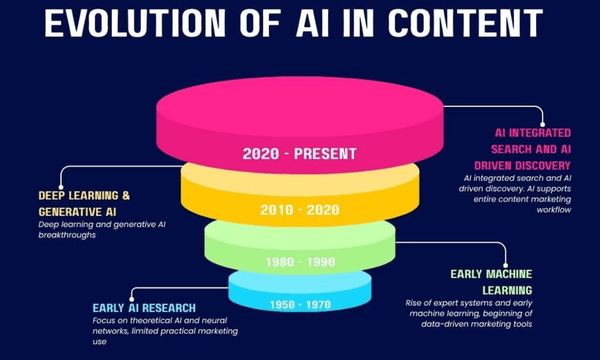
Image Source: Quibble
Fast forward 10+ years to the 2020s and AI’s role has shifted dramatically. Here’s how Anna Morrish, the author of the article, “The evolution of AI in content strategy,” explains it.
“AI is no longer just supporting data analysis or automating smaller tasks; it is now directly involved in creating content itself. As a result, the way we work has evolved. Tasks like ideation, outlining, and drafting can now be completed much faster.”
Now more than ever, there’s this corporate pressure telling Content Strategists, Content Marketers, and Creators it’s all about volume. In reality, that’s never been the case. We can’t stop the fact that AI technology and platforms are reshaping how content is created and distributed, but we can focus an equal amount of time and energy on creating a strategy that gives your content purpose. Understanding your audience, aligning all your stakeholders, and building systems that create value instead of distractions and noise.
Works Cited
Bailie, R. A. (2021, February 5). An uneven history of content strategy. Medium. https://rahelab.medium.com/an-uneven-history-of-content-strategy-d514cfd7eee5
Morrish, A. (2026, June 8). The evolution of AI in Content Strategy. Quibble. https://quibble.digital/insights/the-evolution-of-ai-in-content-strategy/
Casey, M. (2015). The Content Strategy Toolkit. New Riders. 2026, http://www.newriders.com


Leave a Reply