Tag: music

  • Designing the Daily Ritual: Wordle’s Quiet Joy

    Designing the Daily Ritual: Wordle’s Quiet Joy

    One of the most powerful ideas to unlock as a storyteller who uses animation is to understand the right animation technique to express. Developing the most clever and creative idea ever is one feat, but being able to share that idea with the world in a compelling, impactful way is a completely different feat. With saturation of content and more digital distractions than ever, it’s so difficult for any artist or brand to stand out in the “sea of sameness.” That’s why I believe the riches are in the niches, and knowing how to capitalize on this in two easy steps will get you further.

    Liz Blazer, author of Animated Storytelling, advises motion designers and artists to embrace “Show and Tell.” Package your project in a cohesive way that includes all the essentials like Title, Logo, Synopsis, Bio, and Story. Once you’ve packaged your project, Blazer suggests shifting your focus to creating a network. This will compound and help you find relatable connections, inspiration, and create interest in the work you’re doing.

    Animated Storytelling by Liz Blazer and seven weeks of Motion Design tutorials and projects forced me to leave my comfort zone. I am very used to writing, curating, and researching in my current job, but this course brought me out of that comfort zone and taught me how to really embrace experimentation and become more comfortable in the unknown through creating.


    Research


    ADVANCED MOGRAPH/MOTION GRAPHICS IDEAS ON ALIGHT MOTION [+free preset and xml file]


    This energetic compilation video has plenty of micro-interaction ideas that influenced me when it came to creating some of the pacing and rhythm in my Wordle animation. Principles, including snappy scaling, fast transitions, bold colors, and “pop” animations, were all aspects I considered creating in After Effects after watching this video.

    Google Logo Animation Series Teaser – Motion Pro Exclusive:


    This video caught my attention with its super clean timing and shape‑layer-driven animation. Both aspects directly inspired parts of my Wordle animation. This piece showcases how simple geometrics can create visual impact when they’re paired with contrasting colors, bold fonts, and intentional animations, including smooth easing and scaling.

    Building a Stunning Edge of Tomorrow-Inspired Title Sequence:


    This tutorial dives into the nitty-gritty details of techniques like fractal noise, displacement maps, VHS textures, and more. I am not at this advanced level of Motion Design yet, but its elegant typographic motion, visual polish, pacing, and atmosphere inspired me to create this project. Specifically, my text card outro animation.


    Create

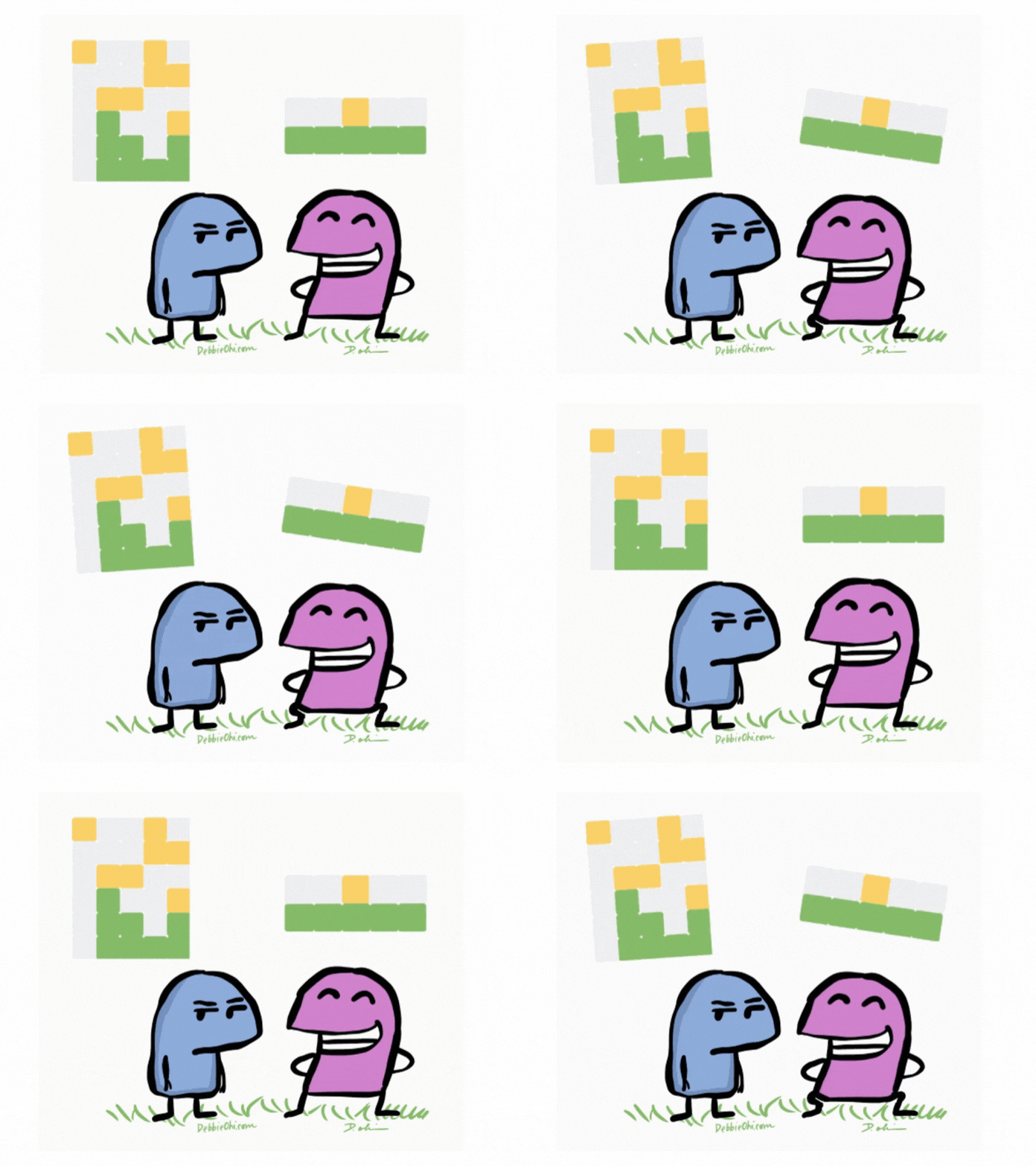
    Wordle Daily Ritual: Motion Design Sequence!


    After learning the basics of Motion Design over a brief seven-week period, I wanted to challenge myself by creating a motion-graphics sequence inspired by the New York Times Games, specifically focusing on Wordle.

    The goal was to capture the satisfying, clean, logical interaction patterns that create this everyday ritual millions of people love.

    I created this 5×6 Wordle Grid entirely in After Effects using shape layers and repeaters. Creating this entirely in AE compared to Illustrator, and importing any files, enabled me to create this scalable layout that I could easily manipulate with duplications and animations.

    The toughest part about this project was creating the Y-rotation tile flip animation. I knew Wordle tiles needed to flip in 3D to reveal a color change at a midpoint 90-degree rotation. After many hours of experimentation plus trial and error, I figured out that I need to meticulously isolate each tile by converting it into its own layer, zero out all internal transformations, center anchor points to each tile, and proceed with creating animations using keyframing on all 60 layers (each tile and letter).

    The letters were added as separate text layers to parent link each one to a corresponding tile. The animation on the letter is opacity so each one is revealed exactly at the midpoint flip.

    I tackled sound as the next component of this project. I knew subtle click and flip sounds would elevate this motion graphics sequence and make it look more professional. This particular sound really brought the motion to life, and helped emphasize the importance of the timing where each word guess happened at a five-second increment, totaling 30 seconds to guess the last word correctly.

    To complete the animation, I created an outro card with text reading “THANK YOU FOR WATCHING.” This fades in on a white background and has a gentle camera push effect using a null object. I did this to create a cinematic polish.

    This project helped me explore After Effects on a much deeper technical level, especially with shape-layer animation, 3D rotation, anchor-point management, and timing logic.

    I’m really happy with how this came out and look forward to deepening my skillset in Motion Design.

    Works Cited


    Blazer, Liz. Animated Storytelling: Simple Steps for Creating Animation & Motion Graphics. Peachpit Press, 2020.
  • Lights Out: Crafting a Logo Stinger Through Technique

    Lights Out: Crafting a Logo Stinger Through Technique

    One of the most powerful ideas to unlock as a storyteller who uses animation is to understand the right animation technique to express a big idea and be the very soul of your story. To find this “perfect match,” you must start by considering the format in which the content is viewed. It used to be as simple as film was watched in theaters and commercials on TV, but the evolution of technology brought content to tablets, phones, and watches. Now, you need to choose a technique that suits the format you believe makes the most sense.

    Animated Storytelling by Liz Blazer details several animation and motion graphic styles and techniques that are used to tell compelling stories. This list includes:

    1. Hand Drawn
    2. Stop Motion (2D and 3D)
    3. CGI (2D and 3D)
    4. Fluid Transitions
    5. 2D/Vector/Kinetic Type
    6. Handmade
    7. Collage
    8. Film & Type
    9. 3D

    All of these styles and techniques have their own unique look and feel that immerses a viewer in a way that creates its own unique emotional connection. Understanding the heart of your project to discern what style conveys the tone you are trying to express will enable you to use animation that enhances your storytelling.

    I’d also like to note that the research and Logo Stinger I created below draw inspiration and utilize the 12 Principles of Animation!


    Research


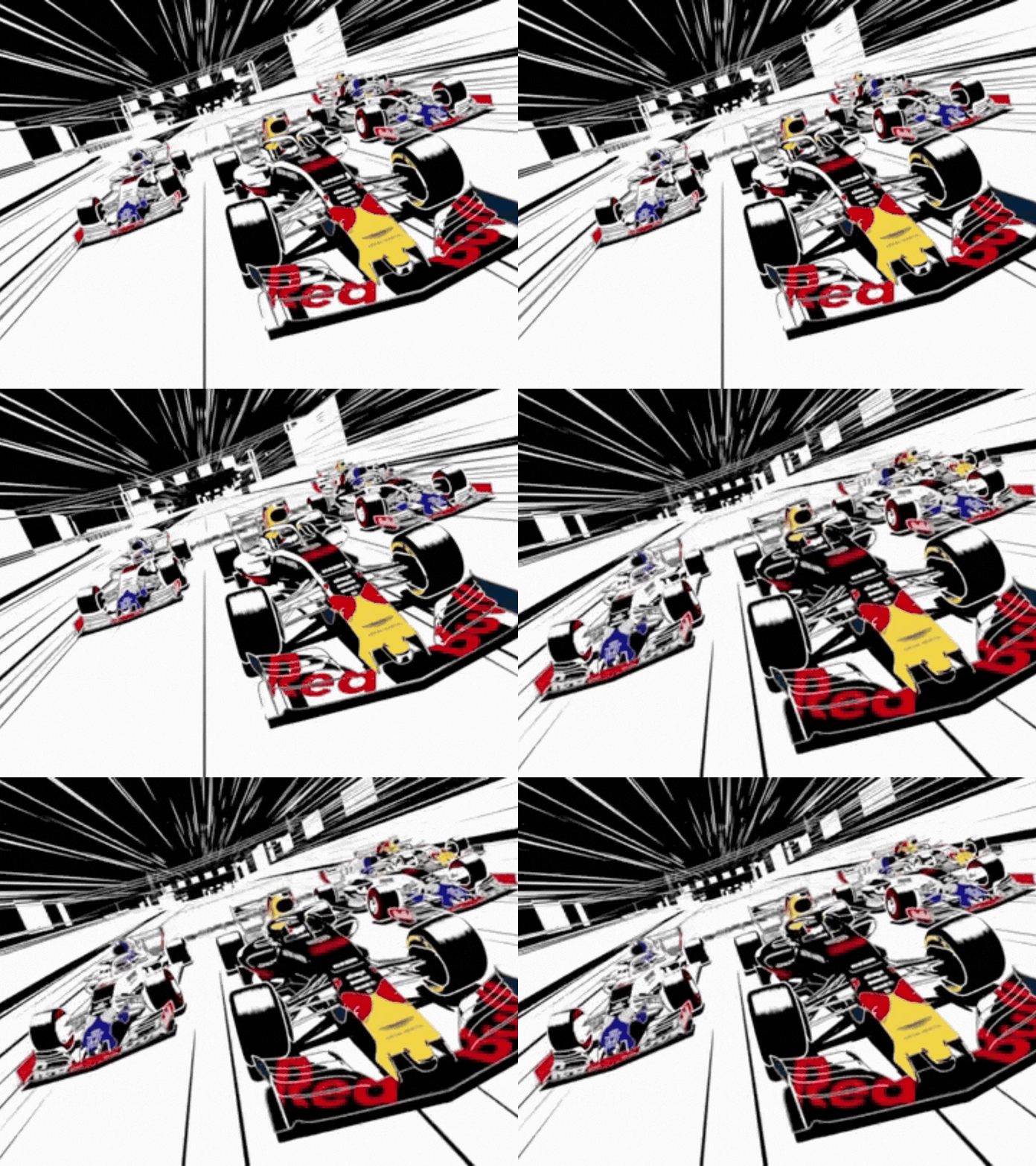
    Formula 1 2026 Opening Titles (Staging)


    Every year at the beginning of a new season, Formula 1 Racing releases a new title intro sequence to debut the driver line-up in a fun and dynamic way. This title sequence has lots of motion design elements. One specific principle it uses that I want to highlight is Staging. From lighting and camera angles to background and foreground composition, the drivers are directed to make specific poses, stand tall, or sit down, and showcase themselves and their team in a specific way. You see this with drivers like Valtteri Bottas running his fingers through his mustache, grinning, Kimi Antonelli shaking his hands and fingers to do the “Shakra bro” sign, and plenty of other drivers holding their helmets doing different things.  

    Mulan (Follow Through and Overlapping Action)


    This principle is used to create fluid and realistic movement. These two techniques are unique because they entail parts of the character in motion even after the character is done moving and is still. The beginning of this scene from Mulan, when the characters break out into the “Honor to Us All” song, is a great demonstration of follow-through. When Mulan rides into town on a horse, jumps off, and stops, she’s still, but her hair still moves and flows with the wind.

    Elsa and Anna’s Magical Moments | Frozen (Appeal)


    Creating or curating a thoughtfully designed character that’s consistent and emotionally resonates with viewers is no easy feat. This is done by best-in-class animators who are meticulous with character design, take the time to develop personality nuances, and even go the extra mile by giving characters subtle facial expressions. Elsa from Disney’s movie Frozen is a great example of a character who has all of this.


    Sabrina laughing with Haunter | Pokémon anime (Exaggeration):


    A majority of the 12 principles of animation are grounded in realism. However, avoiding a principle like exaggeration risks your animation looking too real and dull. This is on full display in this scene from the popular anime Pokémon, when, after the gym leader Sabrina loses, her Haunter is seen laughing and making exaggerated facial expressions with its mouth wide open.


    Animation Assignment – Squash and Stretch (Squash & Stretch):


    This short animation showcases the ability to change objects as they move to convey a variety of weights and flexibility. You see the rubber band being stretched and shot off the character’s fingers to move fast, and then it gets squashed on impact and turns into a tie for a box, and eventually becomes the rubber band for a slingshot.


    Create

    Logo Stinger: Lights Out and Away We Go


    Creating a Logo Stinger was equally challenging and fun. I didn’t have a professionally finalized personal logo, so I started by creating one that would be good enough to use as a Logo Stinger. My wordmark logo consists of three elements: KA letterform, starting race lights, and my full name spelled out. The goal was to create something that’s modern, smooth, and F1-inspired.

    The idea behind the Logo Stinger is a simple concept. Lights out → Go → KA reveal. I prepared my assets by separating the layers in Illustrator that I knew I wanted to animate, including each set of two circles that represent stoplights, the traffic light structure, and the KA wordmark. To animate each stop light, I used keyframing to change the opacity of the lights to create a hard cut that matches the race start of Formula 1.

    For the KA wordmark,  I revealed it right when the lights turned off by using the Animate Scale function in After Effects. I also added easy ease to these keyframes to make the animation feel snappy and intentional to match the “start your engine” energy of F1.

    I decided to challenge myself and add an optional camera shake to the wordmark by creating a null object with a wiggle effect that’s linked to the wordmark through the Parent & Link feature.

    I experienced difficulty figuring out had to get the null object and wiggle to only happen for a set period of time compared to the entire animation. After lots of experimentation, I decided to make multiple layers of the wordmark for different sections of the Logo Stinger to solve the issue.

    Lastly, I decided to add my full name spelled out and gave it a micro letter tracking ease animation. I thought the subtle, calm reveal would complement the boldness of my wordmark. To tie everything together, I added the Formula 1 race start noise to the lights animation and a radio sound to my wordmark reveal. The radio is meant to be ironic and slightly dramatic compared to a race start.

    I’m looking forward to iterating on this in the future so it’s more polished and portfolio-worthy.

    Works Cited


    Blazer, Liz. Animated Storytelling: Simple Steps for Creating Animation & Motion Graphics. Peachpit Press, 2020.

  • Ideas Are Worth Nothing Without Execution

    Ideas Are Worth Nothing Without Execution

    The beauty of Motion Design and Animation? It’s a limitless medium that uses structures to turn visual elements into a cohesive story that creates an emotional impact. Defining a consistent theme and taking time with the storyboard process are two of the most foolproof ways to create a memorable animated story.

    Animated Storytelling by Liz Blazer taught me how to plan out “beats,” moments, or active steps in your story that move the plot forward. Blazer also does an excellent job of breaking down the differences between linear and non-linear story structures and offers storytellers four different types of non-linear structures to use: Book Ending, The Countdown, The Puzzle, and The Beaded Necklace. Understanding all this helped me immensely with storyboarding for a personal animated introduction video I created.

    After I was confident with my storyboard and curation of audio and visual files, I followed Blazer’s advice by creating an animatic, a video version of my storyboard laid out in sequence on a timeline in After Effects with a soundtrack aligned to the video.

    Learning about specific aspects of storytelling and storyboarding enabled me to transform an idea into an executed animated video with a clear beginning, middle, and ending.


    Research


    IKEA, Together


    This video captures the limitless possibilities of customization and the beauty of “DIY,” something IKEA became globally recognized for. The transitions from room to room with bright colors are inclusive, and the upbeat pop song spliced together with tasteful, high-pitched sounds of fingers snapping to signal transitions is catchy. This motion graphics video makes the viewer want to visit the closest IKEA store to get lost in possibilities and dream up the next room to create in their home.

    Introducing Google Vids:


    This piece by Google is energetic, imaginative, and creates a perception for viewers that they can create anything. Between its pretty liquid glass search bars, cozy keyboarding typing noises, and captivating floating icons, you watch this video, enamored by the “shiny” possibilities of AI technology.

    Porsche Holiday | The Coded Love Letter


    We are in the middle of the next digital renaissance with the advent of AI. As a result of this new era, imagery and videos are all starting to look eerily similar, and there’s a resistance to this technology. The iconic car manufacturer, Porsche, went against the grain by creating this hand-drawn animated commercial for the 2025 holidays called “The Coded Love Letter.”  Its focus on Porsche’s design and history with hidden easter eggs, including the first license plate number of a Porsche, the tractor created by the founder, and the iconic race car, the pink pig, captured the brand’s human spirit.


    Create

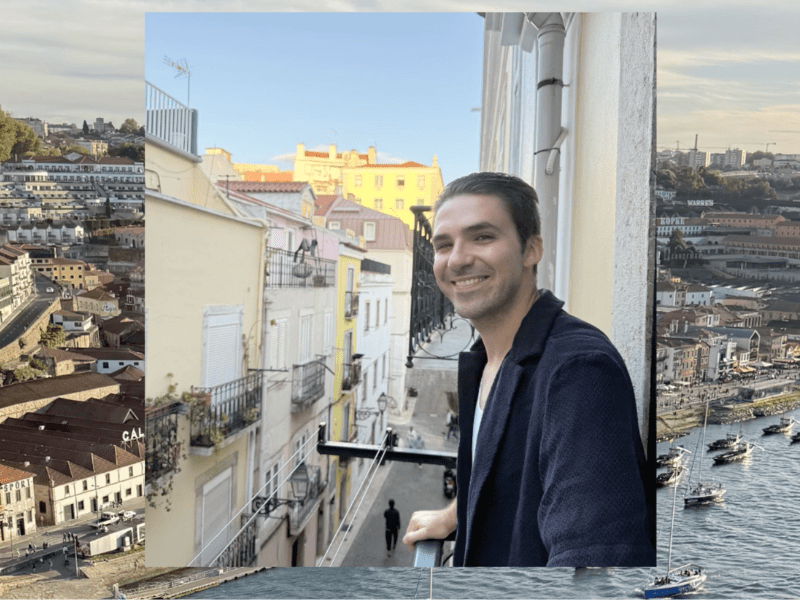
    Meet Kyle Adams! Personal Intro Animation Video


    For this project, I created an animated introduction using the programs Audacity and After Effects! I started with storyboarding to create a clear structure of what this video would dive into. I knew I needed several scenes to introduce myself, briefly explain what I do for work, showcase a hobby or two, and highlight what I am striving to learn.

    After I created six storyboards and decided what type of media each scene would have (pictures, videos, or b-roll photography/footage), I moved on to Audacity. I wrote my script in a Word document, practiced two takes, and then nailed a final take where I said exactly what I wanted to. I edited the wave audio file slightly in Audacity to bump up the gain of the volume levels to land in a range of -12 through -6 to get as close as possible to maxing my narration out without distorting it.

    After I curated all of my audio files (narration and music), images, and videos, I brought them into After Effects to create the animated intro! For the first scene introducing me, because I was using two photos from a vacation I took to Portugal, I wanted my introduction text to animate in a way that complemented a cinematic and travel-documentary vibe. I landed on using a Playfair Display font that evokes an elegant, modern, editorial energy, and created a directional mask reveal to animate the text.

    Adding transitions to fade in and out for various audio tracks and the song I chose for this video, as well as keyframing different scenes to tie the whole video together, was quite challenging, but very rewarding! I’m excited to continue learning about Motion Design.

    Works Cited


    Blazer, Liz. Animated Storytelling: Simple Steps for Creating Animation & Motion Graphics. Peachpit Press, 2020.