Tag: artificial-intelligence

  • Finding Your Content North Star in The Age of AI

    Finding Your Content North Star in The Age of AI

    The idolization of the creator economy has captivated Gen Z, Alpha, and Beta. This is a direct reflection of the rapid evolution of technology and the role it plays in our lives daily. These younger generations see opportunity, influence, and prosperity when using technology, social media, and AI. Brands have followed suit by investing more in blogs, podcasts, social media campaigns, and newsletters to meet their audiences where they are at any given point.

    It doesn’t stop here. Search behaviors are changing, content ecosystems are expanding, and AI is blurring the lines of ethics and creativity, reshaping how we create and consume content. Regardless of these shifts, one principle remains the same: content without purpose is just noise.

    Let’s explore how these tools have changed over decades and how, despite these changes, content strategy remains a north star to ensure the value of content serves both its audience and the organization or individual creating it.

    Combining Curation & Creation is The Secret Sauce

    To avoid the easy pitfall of just publishing content arbitrarily with no goal in mind, you need to take a step back to stop chasing the trends and likes and look at the bigger picture. Successful content strategists aim to complete this set of steps.

    • Identify problems and opportunities
    • Convince leaders and get the resources
    • Get stakeholders on board
    • Set and align on project objectives
    • Execute the project


    Let’s look at the specifics when it comes to project objectives. A great way to think about this is that you need to “set the table.” Meghan Casey, author of The Content Strategy Toolkit, explains the importance of setting the table perfectly.

    “Preparation is the key to a successful alignment session. Preparation means a few things here. First, it means getting the right people in the room. Second, it means planning how you’ll get from “what are we doing here?” to “let’s move forward.” And, third, it’s helping your stakeholders be engaged, thoughtful participants.


    Executing these five steps combined with tasteful curation unlocks the “secret sauce,” aka a compelling content strategy that inspires a group of people to buy, attend, subscribe, or participate.
    Image Source: Medium

    When It Started. How It’s Going

    The accelerated rate at which content has evolved over the years makes people feel overwhelmed trying to keep up. Although these shifts have changed the way we search, purchase, and connect with information, the fundamental purpose of content strategy hasn’t changed: helping people learn and make informed decisions that support their goals or an organization’s goals. That is content strategy at its core. That’s what remains the same. You might be asking yourself, what has changed then?


    What’s changed is the complexity of the ecosystem content strategists are now navigating. When you look at content strategy historically, it started as simply managing one-dimensional channels and pieces of content. Now, content strategists are forced to think bigger, move faster, and manage entire ecosystems that span a digital footprint that’s never-ending. This includes, but is not limited to, websites, social media, podcasts, newsletters, search engines, videos, and even AI-powered digital experiences. Publishing is no longer enough. Scalability, discoverability, and moving the organization’s goals are the expectation.


    In 1995, one of the biggest shifts happened. Access to the World Wide Web. Content transitioned from monolithic documents to hyperlinked pages. Rachel Ann Baillie poses an interesting argument related to this in her piece, An Uneven History of Content Strategy.


    Baillie suggests that the rise of the World Wide Web shone a spotlight on the need for content strategy more than ever.

    “The most logical conclusion is that the Web created new, exponentially complex challenges for content publishers. One anecdotal report from a large Silicon Valley hardware/software company talked about the mess that had ensued because of the organic growth of their online technical content, and the 100+ technical writing contractors they had to bring in to audit, categorise, and curate the over one million pages, to bring their corpus into some sort of usable form”


    The beginning of generative AI and deep learning can be traced back to the 2010s. LLMs (large language models) are trained on a large amount of online data. This data includes, but is not limited to, content, topics, and various styles of writing. The biggest initial breakthrough with LLMs was their influence on search and understanding how to recognize patterns in information.
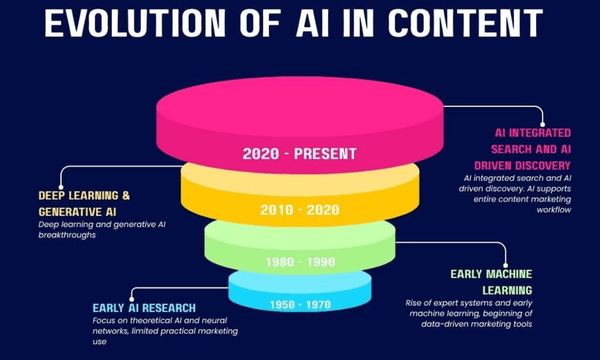
    Image Source: Quibble


    Fast forward 10+ years to the 2020s and AI’s role has shifted dramatically. Here’s how Anna Morrish, the author of the article, “The evolution of AI in content strategy,” explains it.

    “AI is no longer just supporting data analysis or automating smaller tasks; it is now directly involved in creating content itself. As a result, the way we work has evolved. Tasks like ideation, outlining, and drafting can now be completed much faster.”


    Now more than ever, there’s this corporate pressure telling Content Strategists, Content Marketers, and Creators it’s all about volume. In reality, that’s never been the case. We can’t stop the fact that AI technology and platforms are reshaping how content is created and distributed, but we can focus an equal amount of time and energy on creating a strategy that gives your content purpose. Understanding your audience, aligning all your stakeholders, and building systems that create value instead of distractions and noise.

    Works Cited


    Bailie, R. A. (2021, February 5). An uneven history of content strategy. Medium. https://rahelab.medium.com/an-uneven-history-of-content-strategy-d514cfd7eee5

    Morrish, A. (2026, June 8). The evolution of AI in Content Strategy. Quibble. https://quibble.digital/insights/the-evolution-of-ai-in-content-strategy/

    Casey, M. (2015). The Content Strategy Toolkit. New Riders. 2026, http://www.newriders.com
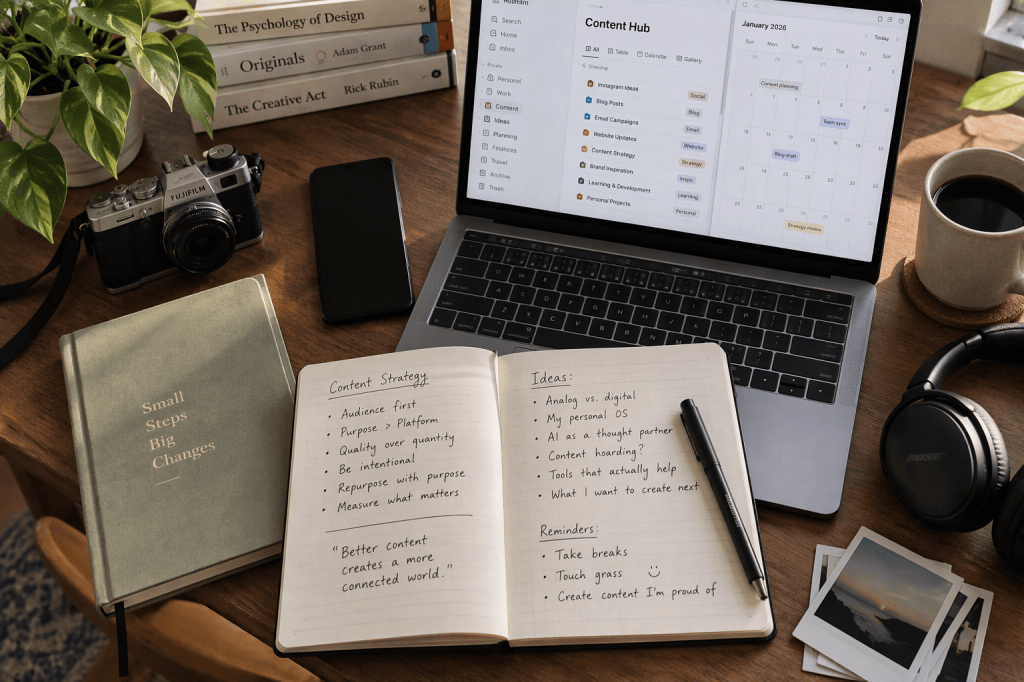
  • Content is Everywhere. Intention is Everything

    Content is Everywhere. Intention is Everything

    The evolution of digital technology, the integration of social media in daily life, and pressure to focus on quantity over quality by leveraging AI have commoditized content. You might be asking yourself, what defines content?

    Content is the packaging of information to convey an idea or argument to a specific target audience. Typically, content is tied to a business objective. The most common forms people interact with daily include videos, photos, graphics, podcasts, case studies, and memes. Understanding your experience with content to discern the form it assumes (digital or physical), define how you catalog and index it, and decide whether AI is a superpower or hindrance will enrich your life, educationally and emotionally.

    The Push and Pull of the Content Seesaw: Digital vs. Analog

    The saturation of digital social media platforms, coupled with an extreme pressure to lean into AI, is going to create an explosion in analog. Analog forms of media were never extinct, but the shift started in 2007 when the first iPhone was released. It gained more traction in 2010 when Instagram launched, and then grabbed the world’s attention in 2020 when TikTok took off because of the COVID-19 pandemic. To ground these time stamps with some perspective, according to The evolution of AI in content strategy, a blog published by Quibble, “People, especially younger generations, are no longer relying on Google, and 74% of Gen Z’s use TikTok as their primary search engine.”

    Fast-forward to 2026, and within less than a decade there’s already a new noticeable shift happening: the explosion of analog.

    People are starting to struggle with how much digital there is. People are anxious. People are self-regulating their digital consumption. People are opting into “touching grass,” instead of growing their Rolodex of followers to send memes to while they doomscroll.

    Image Source: MemeAnalysis


    For the last decade or so, digital hasn’t pushed its feet up on the seesaw to balance out with analog. But now? It’s beginning to happen, and evident from the resurgence of analog technology including vinyl, wired headphones and point and shoot cameras from the 2000s.

    My relationship with analog starts and ends with consumption vs. creation. I have a sincere appreciation for physical media and always opt to buy video game cartridges instead of digital files. I also make a concerted effort to self-regulate my digital screen time using an app. ScreenZen overrides my iPhone’s screen limits and only allows me to check specific social media platforms a set number of times per day for a specific number of minutes. I highly recommend checking it out if you’re looking for a tool to help you self-regulate digital consumption.

    Once you understand how to balance this seesaw, the next step you can take to leverage content in a way that enriches your life is to define how you index and organize it.

    Creating a Personal OS

    Image Source: Created by Author


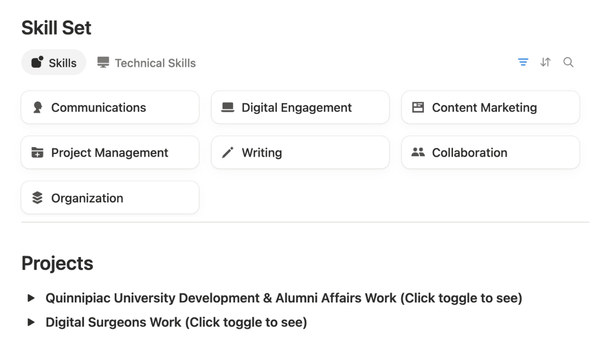
    Having an idea of how you’re going to get from point A to point B goes a long way. When it comes to working on a project with multiple people, you must create a single source of truth and lean into sharing bits and pieces of your personal operating system with your team. Meghan Casey, author of “The Content Strategy Toolkit,” explains how teams get on the same page by creating a project charter. This document contains components of a project, including a lexicon (a list of words or phrases with their definitions), a timeline, a budget, and a clear project team matrix that outlines roles and responsibilities. This connects directly to content strategy, specifically organization. SAAS tools like Monday.com, Airtable, and Asana are some of the most robust options that lean into flexibility. Users can create project boards with tasks in any view you can think of, whether it’s a list, calendar, Gantt chart, or Kanban. Because my career is in content marketing, I use a combination of Microsoft OneDrive for file storage and Airtable for content management. This combination enables me to leverage Airtable to collaborate easily with various teams inside and outside my department. I can also reference OneDrive months later to find final files if I ever need to reuse a piece of content or repurpose it for a new project.

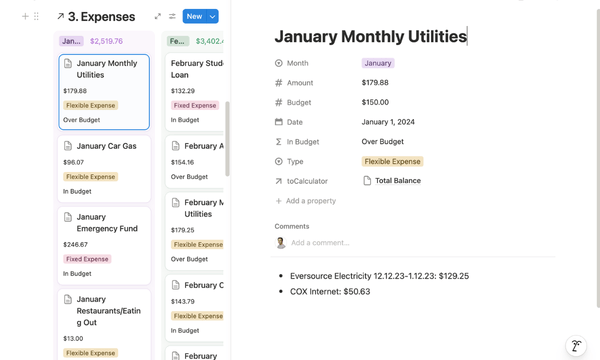
    In my personal life, I use the knowledge database management tool Notion to create a repository where I manage my finances, plan trips, and store content. I usually organize this content by the month it’s happening. So, when you dive into my finance tracker, for example, you’ll see months organized in color-coded columns and individual cards within each column. You click on a card to expand the details. I’ve included a screenshot below so you can see what I mean.

    Image Source: Created by Author


    In terms of what defines a content hoarder? A content hoarder, in my mind, is someone who holds on to a form of content (whether that’s pictures, videos, writing, or something else) and it no longer serves any purpose or is duplicative. However, I need to acknowledge a caveat to my previous statement. If we are talking about digital content, the phrase hoarding is subjective. If you have a clear system organizing everything by using a folder structure, and it’s not preventing you from doing your day-to-day work, more power to you for having a graphic you made in 2018 when you started your first job as a content marketer. Being able to see the progression of your work, understand its evolution, and unpack what you learned is a superpower in and of itself. Especially as we enter this new era of AI.


    Artificial Intelligence: The Good. The Bad. The Opportunity.

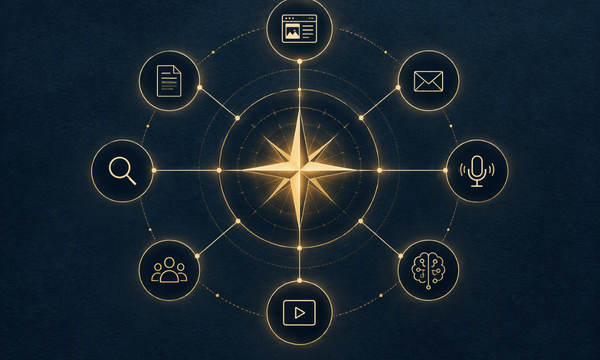
    Image Source: Pete Sena


    The role content strategy plays involves both project and operational frameworks. It helps to define, prioritize, integrate, systematize, and measure content. Brain Traffic, a marketing consultancy open for 25+ years, created a “Content Strategy” quad to split out the two core concepts and discern the different tactics that happen within each process.

    “More than anything else, effective content design requires knowing your audience—their needs, preferences, and expectations. Systems design is the process of defining the architecture, modules, interfaces, and data for a system to satisfy specified requirements.”

    AI plays a role in both content design and systems design. If you can understand and clearly define what its roles are, while still maintaining the integrity of the fundamentals of content marketing that demonstrate creativity, expertise, and clear strategic thinking, you’ll turn it into a superpower instead of a hindrance. The evolution of AI in content strategy, a blog published by Quibble, lists some great “Do’s and Don’ts” for AI, including the following.

    “Do’s: Use to speed up research and processes, create proper, detailed briefs, add your own insights and examples, keep content structured and clear. Don’ts: Publish AI content without reviewing it, rely on AI for strategy, ignore tone of voice, chase quantity over quality.”

    Using these recommendations as a starting point is exactly how I’ve tackled integrating AI into my professional and personal life. I often use AI as a thought partner to converse with. I have a conversation with it that spans anywhere from 2-4 prompts before I take the output it gives me and use it as a starting point for the piece of content I’m creating.

    The growing pressure companies have forced on their employees has exacerbated the public image of AI and led to a vast number of people using it as a crutch. This is why content has become commoditized.

    In my opinion, the problem isn’t AI. The problem is forgetting the fundamentals and using AI to replace them. The best content understands its audience, uses strategic thinking, creativity, and informed judgment. It has a human touch. Sure, AI can accelerate these processes, but it can’t replace them.

    I think about my relationship with content like a seesaw. I don’t have to choose between analog or digital. I have to learn how to be intentional with my choices and not lose sight of the fundamentals. Whether it’s organizing my info in Notion or using AI to brainstorm captions, the goal is and always will be to use content intentionally.

    Works Cited


    Blazer, Liz. Animated Storytelling: Simple Steps for Creating Animation & Motion Graphics. Peachpit Press, 2020.

    Sena, P. (2026, March 24). My chief chaos officer left. so I built one. My Chief Chaos Officer Left. So I Built One. https://petesena.substack.com/p/my-chief-chaos-officer-left-so-i

    Traffic, B., & Halvorson, K. (n.d.). New thinking: Brain traffic’s content strategy quad – brain traffic blog. Brain Traffic. https://www.braintraffic.com/blog/new-thinking-brain-traffics-content-strategy-quad

    Morrish, A. (2026, June 8). The evolution of AI in Content Strategy. Quibble. https://quibble.digital/insights/the-evolution-of-ai-in-content-strategy/

    Casey, M. (2015). The Content Strategy Toolkit. New Riders. 2026, http://www.newriders.com