Tag: writing

  • Why You Shouldn’t Underestimate the Power of Doing Nothing

    Image Source: Generated by Copilot


    The year is 2025. You wake up, immediately check your phone, rush to get to work, spend the day sitting at your desk typing away, scroll through your phone at lunch with your eyes glued to the screen, come home and unwind by watching Netflix while texting your friends, go to bed, and repeat it all over again the next day.


    When was the last time you started the morning with a walk without your phone? Or went to a nearby deli for lunch to enjoy a meal by yourself, sitting at the table outside, staring at the clouds.


    As pressure continues to pile up on all of us every day to stay connected with the world and stimulated by all the noise that comes with it, I would love to have just a few minutes of your time to explain to you why doing nothing can sometimes be the best reset for you.


    Decoding the Message & Deciphering the Medium


    We are regularly communicating with tons of people in several ways. Texting, phone calls, emails, social media direct messages and comments, Snapchat, to name a few. Johann Hari, author of “Stolen Focus: Why You Can’t Pay Attention – How to Think Deeply Again,” tries to make sense of this concept and provides a clear metaphor to understand how you can decode messages and decipher which mediums they’re coming from. “Every time a new medium comes along, whether it’s the invention of the printed book, TV, or Twitter, and you start to use it, it’s like you are putting on a new kind of goggles with their own special colors and lenses.” I believe Johann is right. Once you develop self-awareness and understanding of what someone is communicating to you and know why they chose to deliver it in that way, you will strengthen your relationships with others.  


      Image Source: Remark


      Haste Makes Waste: Mind Wander Instead


      There’s an overarching fear amongst most people that boredom is a waste of time and useless. What if I told you that’s wrong and there are clear benefits you are missing out on? One easy way to think about this is to look at the animal kingdom. Naturebang, a radio show by BCC, partnered with psychologists and professors to explain why we should be doing a whole lot more… nothing.  “The natural world seems like a busy place. But the truth is that most animals spend most of their time doing nothing. We’ve created a society where we fear boredom and we’re afraid of doing nothing. But in trying to avoid boredom, we miss out on its benefits. When we’re bored, we daydream, and that has been linked to creativity.”



      Whether you are an ant watching others in your colony forage, or you’re a 20-year-old in college studying for your physics final, something all forms of life have in common is the inability to create time. None of us should fear this; instead, we should embrace it by doing nothing and taking a step back to understand the different messages we receive, the mediums they go through, and let our minds wander.


      Image Source: BBC


      I’m excited to learn more about the data associations and specific techniques I can use to think deeply and regain my attention.

    1. Finding Your Flow: Uncovering Where Focus is Hiding From You

      Image Source: Generated by Copilot


      With peeling an onion, you realize how many layers there are until you reach its core. Just like an onion, when you consider the crises of our diminishing collective ability to hold attention, there are many layers to understand it. The concept of “stolen focus” goes far beyond an individual’s personal relationship with technology. It has been accelerated by the ecosystem of our world.


      Johann Hari, an accomplished author, explores this topic deeply in his book “Stolen Focus: Why You Can’t Pay Attention – How to Think Deeply Again.”  As Johann chronicles his pursuit of a digital detox and discusses what the first month is like, there are two core concepts that stand out to me as potential explanations as to why we can’t hold our attention anymore and what we can do to improve our focus.


      Why Your Word Means Everything


      A universal truth proven by social scientists is that whenever someone wants to overcome a destructive habit, one of the most effective methods is pre-commitment. According to Johann Hari, this is when “the you that exists in the present right now wants to pursue your deeper goals and wants to be a better person. But you know you’re fallible and likely to crack in the face of temptation. So, you bind the future version of you. You narrow your choices.” Pre-commitment manifests in several areas of my life, but one that comes most to mind is my connections, like my bond with my brother. When I make a promise to my brother or confirm I’ll do something with him, I mindfully create space in my calendar and organize my other social activities, career commitments, and personal chores using a calendar and planning system to pre-commit to him. Doing this with him and several of my other friends has greatly improved my relationships.


      Listen to Understand, Not to Reply


      It’s easier than you think to fall into the trap of conversing and connecting with people in a way that’s only self-serving. One of the most common ways this shows up is through narcissism, a corruption of attention where it’s turned in only on yourself and your ego. When I think about how listening with intention shows up for me in my life, especially at work, a few of these tips from Harvard Business Review are ideas I practice to do my best at becoming a better listener.


      1. Give 100% of your attention.
      2. Do not interrupt.
      3. Do not judge or evaluate.
      4. Do not impose your solutions.
      5. Ask more (good questions)

      Image Source: Harry Haysom Getty Images


      As I start to consider how I can strengthen my ability to focus, I have several ideas about simple lifestyle changes I can make, like setting app limits to reduce my screen time, minimizing distractions, and piloting learning methods like the Pomodoro technique to try to improve my focus and memory. I’m looking forward to learning more about what’s causing these diminishing returns and what other areas of life are most impacted.


      Image Source: verywellmind


    2. PennyPal: Case Study


      A team of product designers, researchers, and communication strategists assembled to create PennyPal, a personal finance app targeting Generation Z to empower individuals with knowledge and skills to confidently manage their money, learn how to budget, and plan for a long-term, successful financial future. Over six weeks, we created PennyPal using the Design Sprints frame­work founded by Jake Knapp, a Designer who worked for Google Ventures. We completed the five Design Sprint phases as weekly workshops over Zoom. Using the visual whiteboard tool Miro and the design platform Figma, five of us collaborated successfully to define Design Sprint questions and long-term goals, assess the landscape and source inspiration, come to a consensus as a group, build a prototype of PennyPal, and connect with our target users to determine its viability and an answer to our question(s).


      Sprint Overview


      The Design Sprint methodology we followed is the Google Ventures framework that I mentioned above. This process guided our team through the following five phases.


      1. Phase 1: Map & Sketch – Understanding and defining what the problem(s) are that we’re trying to solve.
      2. Phase 2: Decide & Storyboard – The transition of ideas becoming actionable plans to progress solving the previously identified problem(s).
      3. Phase 3: Prototype & Refine – The creation of a tangible, clickable form of an idea that functions for real-world testing.
      4. Phase 4: Test & Collect – The moment of “truth” to gather real feedback for the first time.
      5. Phase 5: Reflect & Report – Reviewing and charting a course forward after analyzing all the data.


      Problem Statement & Research


      A person categorized in Generation Z (Ages 13-28) should use the educational smartphone app PennyPal to discover the ins and outs of financial literacy, improve their long-term bud­geting habits, understand best practices for saving, and learn how to build an investing plan.


      Sprint Activities


      1). Map & Sketch


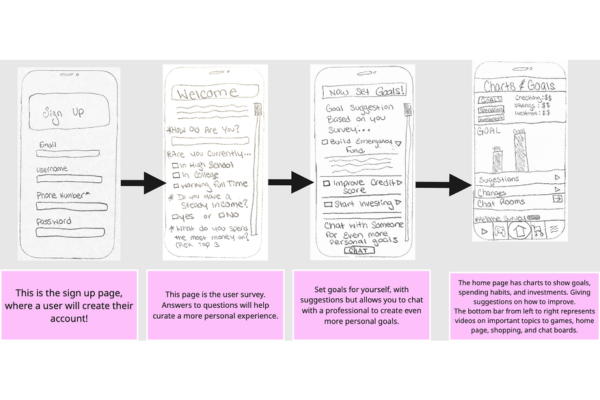
      Creating a user map was a stand-out moment in this phase. Designing this after we selected the Sprint questions and long-term goals we are focusing on enabled the team to create a shared understanding of what a typical user would experience using PennyPal.

      We focused on a couple major features like starting with a sur­vey about the user, having a fun learning system about finances, and rewards to encourage the user to continue consuming the content. Our goal for the map was to make sure that once the Gen Z user learned everything, they would be proficient and confident in managing their finances.


      2). Decide & Storyboard


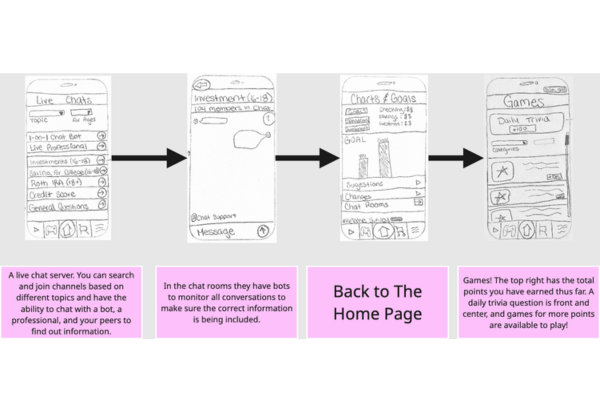
      With Storyboarding, you create a step-by-step visual plan that outlines what your prototype will look like and how a user will interact with it. Something that resonated with the team from Storyboarding is how going back to the home page is accounted for in the beginning, middle, and end of the Storyboard. That’s a very typical interaction to have with an app. It’s like a soft reset, where once a user has explored a specific feature of the app, they’re very likely to go back to the home page to see any new announcements and go to another feature. One more aspect of our Storyboard that the team thinks is strong is the overall singular focus and clarity. This process set our team up well for the next phase of the Design Sprint, prototype & refinement.


      3). Prototype & Refine


      After our team had a strong understanding of what the PennyPal app product breakdown is, knew their task assignments, and built wireframes, it was time to build a high-fidelity prototype. We chose to first create an “App Map” in a platform named Marvel to understand what the hierarchy of PennyPal would be, and then transitioned to using Figma to create a high-fidelity version of PennyPal. We built out five sections: Homepage, Video, Chat, Games, and Rewards. The features were each designed and worked on by two group members. Once completed, the prototype was ready for user testing.


      4). Test & Collect


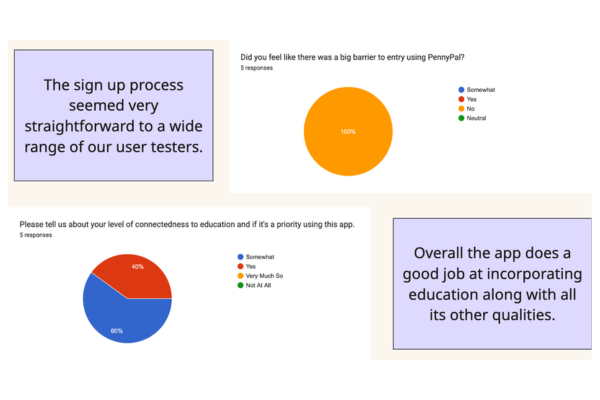
      To develop our insights, data was collected at the end of user testing. Each tester expressed their opinions and thoughts on the app throughout the survey and gave the team rich insights to inform PennyPal’s future development. A few of these insights were:

      • Overall, the app does a good job of incorporating education along with all its other qualities.
      • PennyPal’s core features, including Daily Trivia and Goal Setting, prioritize Gen Z’s key traits and needs.
      • There’s a resounding connectedness to education, but room for improvement on the entertainment side of things.


      These rich insights connect directly back to the Design Sprint questions and long-term goals we established at the beginning of the process.


      Results and Outcomes


      After completing the Design Sprint and having built the PennyPal prototype, which went through user testing with five participants, we learned several things. Users would love it if we refined core features to create a smoother experience. The goal tracking feature was one that multiple participants suggested. Our analysis of the feedback we received also revealed that potential future PennyPal users want more interactive, community-driven features focused on friends-first before they connect with strangers about personal finance. PennyPal is poised to grow with our users throughout their major life transitions and can become a trusted tool to take control of your finances.


      Learnings and Reflection


      The biggest overarching challenges during this Sprint were getting all team members on the same page about work allocation and everyone joining our weekly workshops consistently. By the fourth phase of the Sprint, we were able to adjust our task division and allocation to make the team dynamic smoother and still give key contributors the best opportunity to tap into their strengths to make this Design Sprint as impactful and enjoyable as possible. The most unexpected design insight we learned was the overall desire from users to have a “friend-first” emphasis in features like the chat room, and one of the largest takeaways from working with a team throughout this entire Design Sprint is not underestimate the power of “working together alone” and how putting effort into that can improve the overall phase of a Sprint exponentially.


      Conclusion and Next Steps


      This team of product designers, researchers, and communication strategists learned over seven weeks that the agility and definitive structure of a Design Sprint was exactly what we needed to create a MVP of a financial literacy app targeting Gen Z. Leveraging the Design Sprint framework by Google Ventures, we developed translated ideas into reality through planning, research, teamwork, design, and analysis. Based on the final feedback and key takeaways from external user testing, we have several ideas to implement to refine PennyPal and bring this app to market to transform the lives of users in a unique way that blends education and entertainment to improve anyone’s personal finance literacy.


    3. X is Where The Treasure Lies!

      Image Source: Generated by Copilot


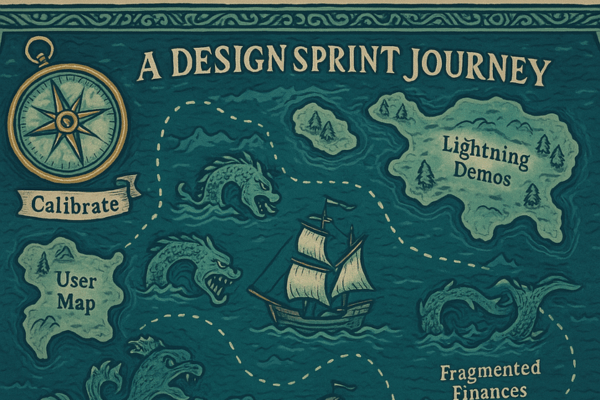
      The Design Sprint is officially underway. Before this journey continues, we must create a plan that outlines where we are headed and what we are trying to achieve. That’s why the first phase of the Design Sprint is Map & Sketch, a dedicated time for our team to calibrate our compass. We will assess the landscape to determine the problems and challenges we might run into building a personal finance education app for young Gen Z adults. This phase also creates the opportunity to chart our course to define aspects of our app, including a user map, visual brand, and run lightning demos to brainstorm. After all of this, we’ll be ready to set sail by selecting the app features we want to explore and creating 4-step sketches.


      Calibrating Our Compass


      A core component of success for this phase is taking time to assess the landscape by getting on the same page with your team about what problems and challenges users face in this industry. Outlining this as a team gave us perspective on what type of Design Sprint questions and long-term goals we’d have to create later. Trust and privacy, and market fit are two of the problems that our team believes act as a barrier to entry or pain point for Gen Z users when using personal finance apps. We also thought that these users typically have short attention spans and high UX expectations and understand they have a fragmented financial life, which will make it difficult to come up with features that can grow with our users through their life transitions.


      One of the most helpful mindset shifts our team had during this phase came from completing the “How Might We?” (HMW) exercise. This was dedicated time together to intentionally shift our perspective from viewing the challenges and problems we identified as pain points to thinking of them as opportunities we can capitalize on for our users. NN/g, a global team of UX experts, wrote five simple tips on how to create good how might we questions.


      1. Start with the problems or insights you’ve uncovered.
      2. Avoid suggesting a solution in your HMW question.
      3. Keep your HMW broad .
      4. Focus your HMW on the desired outcome.
      5. Phrase your HMW questions positively.


      Image Source: NN/g


      Now that we’ve calibrated our compass, it’s time to chart a course before we set sail.


      Charting a Course


      I believe the User Map exercise in this phase will be one of the most influential exercises later in the Design Sprint when it comes to creating our prototype. Similarly to charting a course before setting sail, creating a user map was a way for our team to see a visual and understand how our app users will interact with the app from start to finish. This exercise was valuable because it gave our team an understanding of the key moments we can focus on for the customer journey to determine what app features we want to prioritize. It also gave all of us perspective on the scope of the original problem and the challenges we identified at the beginning of this phase.


      After this, we moved on to lightning demos, a process where you assess the landscape within the personal finance industry and outside of it to source inspiration, spark creativity, and see what does and doesn’t work within various apps and products. This set us up well to organize ideas for app features into the following categories: user experience, safety and account management, and social and gamification. A few apps our team used for this exercise were Fetch, Bilt, Letterboxd, and Discord. It was a great mix of industries outside of personal finance and gave us inspiration for our 4-step sketches from a feature perspective.


      A principal designer at a digital agency based out of Melbourne describes the benefits of lightning demos perfectly in this Medium article they published.

      “The lightning demo is a fun way to ignite creativity, you can do it as a stand-alone exercise with your team. Its purpose is to share ideas, find a muse and spark everyone’s imagination in an efficient and productive manner – just like a good old show and tell sessions we used to have in schools.”


      Image Source: Medium


      Now that we’ve charted our course, our team is ready to set sail and wrap up the final exercise of this first phase of the Design Sprint.


      Setting Sail


      With a calibrated compass and a charted course, our team is ready to take all this prep work and start generating ideas and solutions for our app. The Design Sprint has a specific exercise in this phase that’s structured to do this, and it’s called the 4-step sketch. This exercise has four individual activities: notes, ideas, crazy 8’s, and solution sketching. Our team’s desirable outcome from the 4-step sketch is to have everyone contribute ideas based on the previous lightning demos and research that we conducted.


      Selecting an idea or two from the rapid ideation step in this exercise was tougher than we thought it’d be. Having only 20 minutes to take notes and draw out our ideas wasn’t too overwhelming, but facilitating the Crazy 8s proved quite challenging because we were all forced to work quickly, rely on intuition, and had to sift through an arrangement of diverse ideas.


      The fluidity and less rigid structure of 4-step sketching reminds me of my experience brainstorming content marketing for an annual event at my job. I work for Quinnipiac University’s Development and Advancement office. My role focuses on digital engagement and content marketing for alumni engagement events and annual giving initiatives across the entire university. Every summer, several months before the event, I get together with my peers to plan Bobcat Weekend, Quinnipiac’s annual alumni and families weekend.


      The brainstorming session for Bobcat Weekend has several parallels with the process of 4-step sketching. Everyone “works together alone” by taking time to create notes and ideas on their own, based on past Bobcat Weekends and inspiration from other universities. Before we do this, we also all have a mutual understanding of what our “problems” and “challenges” are heading into this Bobcat Weekend. The outcome? We each have several fleshed-out ideas and concepts for content marketing (social media posts, emails, print materials), and then we reconvene as a group to make decisions (just like designers do in a Design Sprint in the next phase).


      If you don’t want to take my word for it that the 4-step sketch is one of the best ideation exercises to yield you and your team great progress and results, here’s a brief excerpt from an article written by GitLab about how the process worked for them and how Crazy8’s created progress.


      “After thinking about the problem and potential solutions individually, we began solution-sketching through storyboards. This gave us the chance to further develop the details of a solution we chose through the crazy 8s. We started with a blank sheet of paper, placed three sticky notes on the page to represent three frames, and spent twenty minutes sketching more detailed wireframes. In the surrounding white space, we named our storyboard and wrote a brief explanation of the idea in order to ensure that the frame was understandable without verbal explanation. This helped us prepare for the next step, our silent critique.”


      Image Source: GitLab


      I’m excited to move on to the second phase of the Design Sprint to review everyone’s 4-step sketches in the art museums, create and vote on user flows, and begin storyboarding.

    4. How Purposeful Practice Produces Progress

      Image Source: Generated by Copilot


      We have reached a significant turning point in the Design Sprint; it’s time for the ultimate test. Our PennyPal prototype is ready to move through the test and collect phase. This phase of the Design Sprint is an opportunity for our team to determine if PennyPal is a viable app for Gen Z users to learn about personal finance through education and entertainment. The goal of this phase is to ensure we selected the right participants for user testing, created the right types of questions and scenarios, and can analyze the data in an actionable way.


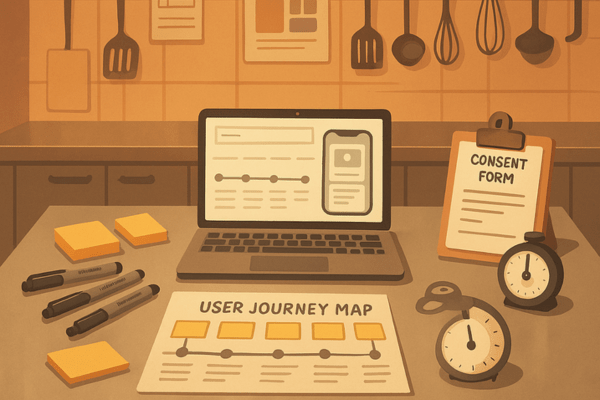
      The test and collect phase of the Design Sprint turned our concept into a reality and required all of us to go from the kitchen to the table by defining the ideal target audience and the ingredients to success, assemble and clearly brief the A-Team, and unpack the truth.


      From the Kitchen to the Table


      The amount of preparation, attention to detail, and speed that is in the kitchen behind closed doors to create that incredible meal and deliver it to a table successfully is not easy. It is the same case when creating a prototype in a Design Sprint and getting it to external user testing. To do this, you need to start by defining your ideal target audience. To define our target audience for PennyPal, we separated the large gamut of our potential Gen Z  users into three buckets: high school students 16-18, college students 18-22, and “early career starters” 22-28. For each of these audiences, we took time to learn their key traits and needs. Doing this led to successfully recruiting five participants, and then, we did what any good restaurant does: we sourced our ingredients for success. We created clear logistics, location, and duration for user testing and shared that with all five of our participants. Doing this eliminated any potential confusion, so they were ready to have a great experience that would give us rich data.


      To get this great meal to the table, aka get the prototype to the participants and begin user testing, we needed to “serve success,” which is making sure our team has created and can facilitate scenarios that reveal insights to define an actionable path forward for the following priorities: PennyPal’s growth, PennyPal’s strategy, PennyPal’s Brand DNA.


      This process reminds me a lot of the first step in the five steps to finding your target audience. According to this article by Adobe, audience targeting starts with a close look at your business’s products or service offerings and there are three steps to get your answer.

      1. Determine what problem your goods or service solve.
      2. Think about who’s most likely to benefit from your product or service solution.
      3. Define your unique selling proposition.


      Image Source: Adobe


      Assembling and Briefing the A-Team


      To set up your participants for successful external user testing, you can’t just put the bat signal out and hope for the best. If we wanted our participants to be the best version of an A-Team they could be, we needed to establish a recruitment plan and brief them on what user testing is. Explaining to our participants the value of user testing and that it’s important because it reveals underlying issues with the app, improves the user experience, and builds empathy helped make this experience enriching for everyone. One of my teammates also did a great job of establishing a recruitment plan by creating a consent form, communicating with participants via succinct emails, and sending out a calendar link to book a time to participate in the user test.


      Sprint: How to Solve Big Problems and Test New Ideas in Just Five Days by Jake Knapp talks about a concept called “The Five-Act Interview.” This is a structured conversation between the facilitator on the Design Sprint team and user testing participants to get comfortable and establish some background. Act 4: Tasks and Nudges, asking the user to do realistic tasks during an interview is the best way to simulate real-world experience. The facilitators on my team for the Design Sprint really leaned into this concept during all five of our user tests to create this atmosphere.


      Reflecting on the value of user testing also helped me realize that it really is priceless in the end. Many companies try to skip corners and take shortcuts by de-prioritizing user testing due to time, budget, or resource constraints. But skipping it altogether would be a massive shortcoming. If you don’t want to take my word for it, a research blog written by a revered prototyping app company named Marvel put it perfectly. “It’s a great chance to get to know your users. Learn who they are, what they want and why they need this product. How do they need it to function? How will it fit in to their day to day lives?”


      Image Source: Marvel


      Unpacking the Truth


      After we completed the external user testing with all five participants and they all finished a post-test survey we provided, we were left with rich data to dive into. Post-test survey questions revealed to our team great insights such as:


      • Overall, the app does a good job of incorporating education along with all its other qualities.
      • PennyPal’s core features prioritized Gen Z’s key traits and needs, with features like Daily Trivia and Goal Setting.
      • There’s a resounding connectedness to education, but room for improvement on the entertainment side of things.


      These rich insights connect directly back to the Design Sprint questions and long-term goals we established at the beginning of the process. Questions like, “Do our gamification features drive repeated engagement? And long-term goals, such as enabling users to set and achieve personalized financial goals.


      Identifying patterns and themes to connect these insights to decisions we can make about PennyPal, reminds me a lot of the reflection process we do at my job after one of our annual campaigns. I work with a team of development professionals at Quinnipiac University’s Development and Advancement office. My role is specifically focused on digital engagement (social media, email marketing, event registration webpage building). A team of eight people including myself held a retrospective after one of our annual fundraising campaigns and I brought to the group a few slides identifying a pattern of looking at our emails year-over-year and seeing how we changed the send address to use personal names instead of a general email alias, and the emails using personal names performed significantly better. This occurrence was me identifying a pattern to connect an insight for our group to react to and make a decision.


      This final stage of the test and collect phase of the Design Sprint reinforces why you should conduct a sprint early in the lifespan of your business or product launch. I came across an article by Fast Company that expands on this idea and explains the reasoning further in a very comprehensible way.

      “The ROI of customer research is greatest when the risk and cost of building the wrong product are high. But even when it’s easy to build an MVP to launch and learn, sunk cost fallacy can undermine a team’s objectivity and willingness to scrap their work. Why risk making a bad first impression when it’s easy to find and fix problems before launch?”


      Getting stakeholders to understand the truth behind this statement could make or break your Design Sprint.

      Image Source: Fast Company


      I’m looking forward to packaging all the work my team and I did over the last seven weeks to present the impact of a Design Sprint in a professional, understandable, and actionable way.

    5. Why it isn’t the Tools, it’s How We Use Them

      Image Source: Generated by Copilot


      The imaginative process of Storyboarding created progress for PennyPal. It enabled our team to think through “what if” possibilities for our app and set us up to transition to the next stage of the Design Sprint that will address our goals and define how we can meet the wants and needs of our users. This next stint of our Design Sprint explores how we leveraged these storyboards to create PennyPal’s blueprint, defines what conditions we carefully curated as we move into user testing, and gives our team more clarity on why change is the only constant.


      Creating the Blueprint


      It was time to move on to the most difficult phase so far: Prototyping and Refinement. We needed to divide and conquer tasks as a team and ultimately build a realistic and clickable version of PennyPal. The prototype will have several user flows to showcase how various features work, including account sign-up, goal tracking, daily trivia, and the chat room. Our two designers, Chloe and Andrea, chose the suite of software to use to build this prototype, selected fonts that capture the brand’s ethos, found simple iconography, and stuck with PennyPal’s color palette to make sure everything was on-brand.


      Being crystal clear about design decisions, what the product breakdown is for key features of a prototype, and delegating tasks for each person on your team reminds me of Gemma Lord’s (a Design Director at IDEO) reflections on how the changing nature of design has given designers a seat at the top table. One specific point Gemma makes that resonated with me during this phase of our Design Sprint is:


      “I wasn’t there to design a product. My role, instead, was to shape the conversation itself – to ensure these leaders understood the trade-offs they were making, to help them see the long-term implications of their choices, to make sure that, somewhere amid the graphs and growth projections, the people their business serves were not forgotten.”


      Image Source: Design Week


      I noticed that these exact same reflections and feelings were top of mind for my team and I during this phase of the Design Sprint.


      Carefully Curated Conditions


      After our designers completed the prototype, it was finally time to test PennyPal for the first time. PennyPal’s main goal is to improve Gen Z users’ personal finance literacy in a compelling way that makes them want to come back to the app because of its entertaining and educational features. Facilitating a user test simulation internally helped the team identify what to fix within the prototype, test our moderator script to make sure any user would understand the three scenarios we want them to go through, and ensure the testing results are actionable insights to move forward.


      For user testing, I was the internal user test subject because I didn’t participate in designing the PennyPal prototype. I tried my best to stick to the three scenarios and remember the “prototype mindset,” a concept introduced to me by the book Sprint: How to Solve Big Problems and Test New Ideas in Just Five Days.


      “Building a façade may be uncomfortable for you and your team. To prototype your solution, you’ll need a temporary change of philosophy: from perfect to just enough, from long-term quality to temporary simulation.”


      The prototype mindset is something I use at my job regularly as well. One of my responsibilities is analyzing digital engagement metrics for social media and email marketing to understand what is and isn’t working. I use these insights to make and implement recommendations on how to market more effectively. I created a report share-out using the prototype mindset that it didn’t need to be perfect, but built out just enough to share data insights with my extended team. Doing this helped my manager and me understand how we can create a long-term quality solution over time that will be useful for everyone.


      The prototyping phase of a Design Sprint and completing an internal user test reveals the importance of the role UX plays in building brand consistency. Don Norman, a pioneer in UX design, said it best in his book The Design of Everyday Things. “When you have to explain how something works, it is a failure of design.”


      Image Source: Forbes


      Change is the Only Constant


      After we completed internal user testing, it was time to take these insights and learnings from our trial run findings to external user testing. Our trial run findings created the opportunity to refine our three scenarios and informed our team on how to complete external user testing to validate the prototype, test our original hypothesis, and collect usable data. The process of internal user testing and the insights that surfaced afterwards reminded me that change is the only constant.


      The Design Sprint is structured so that all stakeholders who participate in it experience iterative learning. This makes the sprint agile and productive. You and a team of people can define a problem, establish an environment to sketch solutions to that problem, design a prototype to test these solutions, and connect with a user base to gather real-world data to decide if you have answers to that original problem and can move forward.


      This phase of the Design Sprint showed me how user interface design and human behavior are both multidimensional. Jakob Nielsen, an author and pioneer of UX, stated it perfectly in an article titled The Usability Scaling Law: Death of User Testing?: “The complexity is immense; think of all the variables: user goals, prior experience, cognitive load, cultural context, device characteristics, and the sheer variety of tasks and information domains.”


      Image Source: Jakob Nielsen on UX


      I’m looking forward to the rich data we’ll collect from our external user testing in the next day of the Design Sprint to answer some of our challenges and really see how usable PennyPal is.

    6. Walk Before You Sprint: The Overlooked Phase That Makes or Breaks Your Design Sprint

      Image Source: Generated by Google Gemini


      Where it all Started


      Before you and your team begin a Design Sprint, you need to take the necessary measures to make sure everyone is ready. With Design Sprints, there’s no such thing as overpreparation. Connecting with your team and client to onboard each person, define who is doing what, review the “run-of-show,” double check you have all the materials you need, and create several team agreements that are honored through the Sprint will guarantee its overall success.

      Let’s delve into a few of the steps I mentioned above to better understand the role each of these play in the preparation phase of the Sprint and how you and your teammates can contribute to each these tasks to get on the same page before beginning the Sprint itself!


      A Goal Without a Plan is a Wish


      If you want to achieve a certain outcome, you need to have an idea as to what your specific “challenge” is, and understand what and who it is going to take to solve it. With the Sprint process, you and your team use guard rails that serve as ground rules over the course of four days. Each day has several mini workshop sessions and the day itself has a theme, or an even better way to think about it is each day is broken out by one of the steps of the Design Thinking process. See the picture below to better understand what I am talking about.

      Image Source: Mindful Marks


      Why a Craftsman Needs to Sharpen Their Tools


      Before you, your team, and client begin the first day of the Sprint, make sure you have all the supplies all of you will need for the next four to five days. If you are running the sprint virtually and everyone is remote, you can rely on tools like Miro for digital whiteboarding, otter.ai to transcribe notes from each day of the workshop, and Zoom to host the meetings virtually and record all of them. If you are doing the workshop in-person instead, you’ll need to have lots of office supplies to whiteboard and brainstorm in-person including but not limited to stickie notes, sharpies/markers, masking tape, and time (to name a few).

      Image Source: AJ & Smart


      Roles & Responsibilities: Everyone Has One


      I’m sure you’ve heard the phrase teamwork, makes the dream work. As cliché as it may be, this is especially true when you’re working with a group to facilitate a sprint. Everyone’s role and the responsibilities that come with it need to be decided ahead of time for the Sprint to run smoothly. As explained in the Sprint Handbook: a step-by-step guide to planning and running innovation sprints, each of these roles play a unique and critical part in the success of a Sprint. See below for just a few!

      • Notetaker:  Captures essential information during interviews and discussions.
      • Lead Facilitator: Guides the overall direction and maintains focus of the sprint.
      • Sprint Host: Ensures a comfortable and productive environment for everyone.
      • Prototyper: Translates ideas into tangible prototypes.
      • Interviewer: Conducts user interviews to gain insights.


      Image Source: Workshopper


      There’s No “I” in Team: How to Compromise


      The most impactful concept I learned in this stage of Design Sprints is the importance of creating Team Agreements. During the mini workshop we conducted this week as a team, this was one of the three exercises we had to complete together. Doing this collaboratively, enabled each one of us to learn more about what each person in the group enjoys about teamwork, what they find challenging, and then create several agreements that we can all use to bring clarity, focus and good vibes for the next 6 weeks of work we will do together. Here’s a few of the agreements we made.


      Team Agreements

      1). Be on time to our weekly Friday meetings starting at 1 p.m. ET and let the group know by Wednesday if you can’t make it due to an extenuating circumstance.

      2). Keep phone on silent and/or do not disturb during our team meetings.

      3). Dedicate the first five minutes of the team meeting to “catching-up.”

      It’s not possible to over prepare for a Sprint Workshop. Preparing for a sprint Workshop is just like walking to warm up before running a race. Walking before running is often overlooked and an afterthought, but without it you’re ten times more likely to cramp up or maybe even pull a muscle. Metaphorically speaking, the same goes for preparing for a Sprint. Without all these layers of preparation you, your team, and client aren’t going to have a successful sprint. After preparation is complete, it’s time to move into the first phase of the sprint. Map + Sketch.

      Sources

      Belle Hastings, P. (n.d.). The Sprint Handbook: a step-by-step guide to planning and running innovation sprints.

      Knapp, J., Zeratsky, J., & Kowitz, B. (2016). Sprint: How to solve big problems and test new ideas in just five days. Bantam Press.

    7. The Infinite Iterative Loop

      Image Source: Generated by Google Gemini


      When it comes to problem-solving, regardless of the issue, you must think creatively to come up with a solution. Usually, your first step is to get a grasp of the situation. After that, you move on to creating a hypothesis. Once you’ve created a hypothesis, you start generating ideas. Next, you develop a demo of what you are trying to produce, and lastly, you release a version out into the world for a set audience to test and utilize.

      These steps I just listed are the core components of Design Thinking, a type of problem-solving that focuses on human-first design using an iterative process. To better understand Design Thinking, we are going to look at its origins, examine the guiding principles of the sprint process, and uncover what types of problems sprints are great at solving.


      Where it all Started


      The roots of Design Thinking go back to the 1960s. What started as a novel concept grew into a widely embraced strategy that could not stop accelerating. Design Thinking became mainstream and solidified as an approach to innovation in the late 20th century. Several people and institutions played a role in its mass adoption. David Kelley, the founder of IDEO, a global design company, is credited for shaping and promoting the version of Design Thinking that millions of people use today.

      This new movement sought to redefine the design process, including how interdisciplinary creatives collaborated, the emphasis on empathy, and shifted focus on iterative problem-solving. After Design Thinking had proven its value through popularization and widespread usage, companies and individuals at the cutting edge of technology and innovation created the “Sprint.”


      This Time it’s a Sprint, not a Marathon


      One of the biggest byproducts of Design Thinking is the Sprint, a method that solves problems quickly and validates ideas in a compressed timeline of five days instead of several months. A Sprint is comprised of four guiding principles.

      • Working Together Alone: Sketch, ideate, and create on your own, then come back together.
      • Tangible Things Over Discussion: Focus on discerning, deciding, and getting ideas into the world as tests.
      • Getting Started Over Being Right: Embrace ambiguity. Become risk-tolerant.
      • Don’t Rely on Creativity: Leverage time-based exercises that use frameworks to ideate and create.


      When at a Crossroad, Which Path to Take


      When it comes to developing innovation and solving problems, many companies struggle with deciding when to run a Sprint or if it’s even worth doing so from a timing and resources perspective. The best thing to do, is remind yourself that running a Sprint allows you and your team to test ideas and learn quickly while minimizing the risk.

      Here are a few examples of when it’s best to run a Sprint!

      1. When starting a new project.
      2. When seeking to improve an existing product or process.
      3. When seeking user validation.
      4. When fostering collaboration and team alignment.


      Design Thinking and the facilitation of a Sprint are iterative processes that are infinite, just like a loop. Even after you launch your product to market, even if you solved the original problem that was defined, it’s more likely than not you’ll have a new problem to solve or a specific thing your users want to see improved. Starting the Design Thinking and Sprint process all over again.


      Sources

      Belle Hastings, P. (n.d.). The Sprint Handbook: a step-by-step guide to planning and running innovation sprints.

      Knapp, J., Zeratsky, J., & Kowitz, B. (2016). Sprint: How to solve big problems and test new ideas in just five days. Bantam Press.

    8. Why Social Media is The Best Trailer for Writers

      Image Source: Generated by Google Gemini

      If a tree falls in the forest and no one is around to hear it, does it make a sound? This metaphor can also be applied to releasing a long-form article on your blog.

      All great writers build a reputation on social media to connect with their audience and promote their work. Social media is part of the marketing mix and a necessary level of the funnel to get your customer (reader) to land on your website and read your article.

      Here are three social media post mock-ups teasing my upcoming article, “Social Media’s Obsession With Caffeine: The Reality of Consumption & Its Effects.”


      Instagram


      As attention spans shrink and more people are interested in entertaining and educational content that will stop them in their scroll, it’s vital to have eye-catching visuals for your Instagram post.

      In addition to using a futuristic dramatic visual that’s almost dystopian in some ways, I focused on making my caption short and pithy to motivate my followers to engage with the content.

      I encouraged them to read the article through the link in my bio since you can not hyperlink websites in Instagram captions.

      Now, I want to show you how I will promote this content through X.


      X

      For this post on X, I kept the tone very conversational by asking my followers a relatable question to start the post. After I posed the question, I transitioned to making a bold claim that poses a statement I know people will have different opinions on.

      The end of this post has several emojis to add some emotion and keep it casual. I used a pointing down finger emoji to act as a clear CTA. My followers can click that to read the article or click on the asset, the header image pre-populating my article.


      LinkedIn


      When I went to create this post for LinkedIn, I knew the tone of my copy would have to be slightly more serious. I wanted to focus on educational content that adds value while creating a hook that is a personal and relatable experience many of us have gone through.

      This hook is intriguing. Most people have had this thought. And if they haven’t, they are immediately curious to figure out what I’m talking about.

      Quantifying your opinions and research is popular on LinkedIn. When you have a number attached to your post, it validates you as a thought leader and trusted source.

      Social media posts are one of the most effective tools in the marketing mix to lead readers to long-form articles.

      I hope this encouraged you to read my long-form article, and I look forward to hearing your thoughts about it!

    9. Don’t Look Into the Mirror For Too Long

      Don’t Look Into the Mirror For Too Long

      Image Source: Generated by Microsoft Copilot

      One of the easiest things to do is react before thinking. This goes for conversation, and even more so for writing.

      The words you say to someone or write in a communication must be chosen carefully. But there’s something equally important when it comes to writing.

      Understanding that if you write for yourself, there’s an inherent tradeoff.

      William Zinnser, author of On Writing Well, explores this and makes you ponder a complex contradiction. Zinnser argues that you need to simplify and shorten to remove clutter, but you also need to write in your own style that’s for yourself.

      Let us examine two issues he dives into that led me to my conclusion above.

      Zinnser says writers need to consider craft and attitude.

      Practice Makes Perfect

      Becoming a subject matter expert is important to build a foundation that turns into a reputation, but you need to have a realization first.

      Another article that explains this piece of this puzzle perfectly is The Source of Bad Writing by Steven Pinker.

      Pinker explains a concept called “The Curse of Knowledge.”  This is the belief that leads writers to assume readers know everything they know. He gives a great example of a speaker at a biology conference falling into this trap by giving a presentation packed with technical jargon geared to fellow scientists only.

      The speaker knew this presentation was being filmed and distributed to millions of people who aren’t scientists.

      Initial Impressions

      How you use a skill to express your personality defines how someone perceives you. In this case, it’s how your reader sees you as a writer.

      As a writer, an interesting and important consideration is giving the reader enough valuable information right away. Amy Schade, author of an article named, The Fold Manifesto: Why the Page Fold Still Matters, discusses the importance of this initial impression.

      “When users fail to see information of value, they stop scrolling. In usability testing, the occasional user does a “lay of the land” scroll to get a sense of what’s on a page before engaging, but this behavior is far from standard. Users scroll when there is reason to.”

      Writing for yourself has an inherent tradeoff if you don’t consider your craft and attitude as separate issues. Once you do and focus on reducing clutter, letting your style lead your writing, and following key principles, your writing will improve drastically.