Tag: wellness

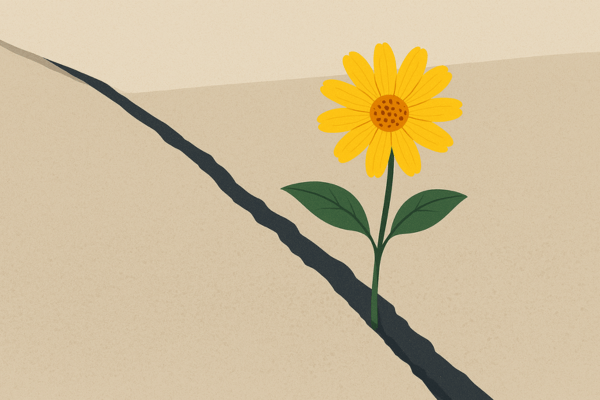
  • The Key to Becoming a Flower that Flourishes Through Concrete

    Image Source: Generated by Copilot


    When you gain enough self-awareness to realize that it’s your job to create an environment that meets your needs, it lights a new fire in you. Being imprisoned in a culture that pushes you to primarily interact with screens instead of using your imagination is ruining your attention.


    There’s a strong body of evidence that supports this claim as one of the biggest problems for children. I am going to spend a few minutes taking it one step further by explaining how this applies to anyone and why you need to demystify motivations and be wary of becoming a jack of many trades, but master of none.


    Demystifying Motivations


    Decades of research and thousands of studies have proven there are two types of primary motivation. Intrinsic and Extrinsic. Johann Hari, author of “Stolen Focus: Why You Can’t Pay Attention – How to Think Deeply, uses a great metaphor of a runner to explain the contrast of these two motivations.


    “If you go running in the morning because you love how it feels, the wind in your hair, the sense that your body is powerful, that’s an intrinsic motivation. Now, imagine you go running because you have a drill sergeant dad who forces you to go with him. Or you go running to post a shirtless video on Instagram for the likes. This is an extrinsic motivation. You are not doing it because the act itself gives you pleasure or fulfillment.”


    Image Source: NPR


    The author and researchers he’s interviewing about this concept conclude that it’s easier to focus and stick with it when your motivations are intrinsic.


    When I think about my extrinsic and intrinsic motivations, I couldn’t agree more. One of my intrinsic motivations is playing Pickleball. I play regularly, not to impress anyone specifically or get something out of it, but because I truly enjoy the game. I’ve noticed my attention on the court is very sharp, and I am steadily improving over time because I am focused. In contrast, one of my extrinsic motivations is going to the gym. I don’t go out of pure joy of working out; my main motivation to go is to get in better shape and stay healthy. During the digital detox experiment several weeks ago, I really noticed the contrast when I would find myself on my phone in the gym with minimal attention and focus on the exercises.


    I believe creating a balance of intrinsic and extrinsic motivations is one of the best ways to regain your attention and focus.  


    Jack of Many Trades, Master of None


    Throughout life, you’re exploring hobbies to develop passions, and just like how seasons come and go, so do your hobbies – especially throughout childhood as you’re establishing an identity.


    When thinking about how to regain focus and attention while reducing anxiety and stress, regardless of age, one thing comes to mind for me. Setting attainable goals. According to an article from NPR, practicing these skills can help build a reservoir of positive energy that you can draw on when it’s time to cope with challenges or annoyances.


    Image Source: NPR


    This article cites further evidence from neuroscience research that shows repeated practice of certain positive emotions can even change our brains.


    Although the idea of freedom and confinement mentally and physically is one of the biggest challenges children face today regarding their attention and focus, I believe it’s something impacting people of all ages.


    One of the best things you can do is take a step back and demystify intrinsic and extrinsic motivations to understand how to harness the positivity of both types in your life. Also, avoiding falling into the trap of letting an environment convince you that you’re a jack of many trades, master of none, will help you get one step closer to regaining your attention, deepening your focus, and not letting anyone or anything hinder your creativity, social bonds, or lust for life.
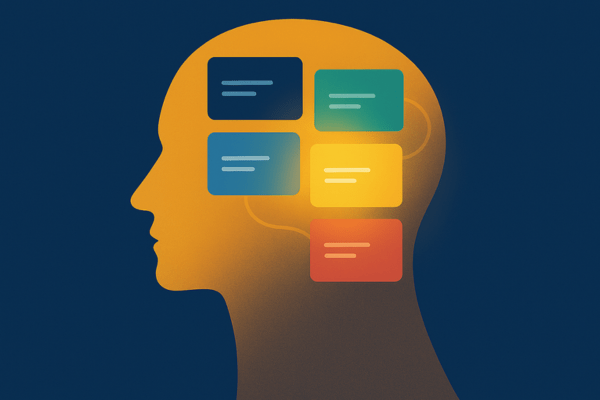

  • How Orchestrating Organized Chaos Frees up 99% of Your Headspace

    Image Source: Generated by Copilot


    Developing a process to capture your thoughts, turn them into actionable tactics, and streamline working with a team to achieve a shared outcome are a few of the backbone principles of project management. Regardless of your job, industry, and experience, good project management compared to poor project management can make or break the success of your work, and overall joy of a job or project.


    After learning about some of the history and methodologies, and creating a project management workspace for myself, I have two pieces of advice for how anyone can orchestrate organized chaos to overall improve processes and collaboration with others.


    Use Kanban to Implement K.I.S.S.


    One of my favorite concepts that my manager at my first full-time job taught me was the K.I.S.S. rule. Keep it simple, stupid. This is a cheeky reminder to avoid unnecessary complexity, whether you’re working with the CEO of your company or explaining to your 5-year-old son what you did at work during the day. It’s a fantastic design principle to remind you that simplicity is a key to success.


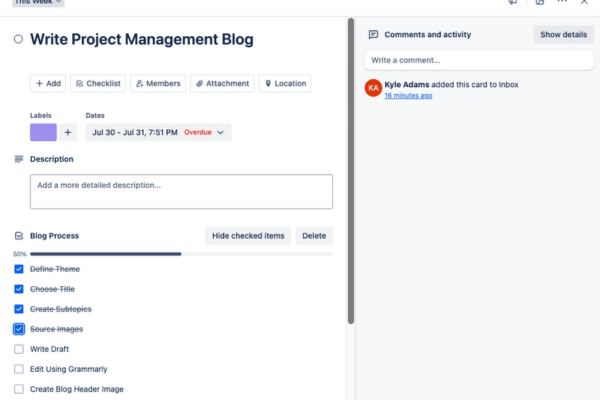
    Creating a Kanban with Trello and using it as a project management tool is one of the best ways to implement K.I.S.S.


    Image Source: Interaction Design Foundation


    As you can see in the two pictures below, I stayed true to the roots of a Kanban by designing a system with three stages that tracks how my tasks (parts) need to move through stages to completion (production within the factory).


    Image Source: Created by Author


    Image Source: Created by Author


    Reality is a Roller Coaster: How to Make the Ride Smoother


    One of the biggest upsides I found with creating this Trello board and learning about project management is that it’s not a linear process. Implementing Trello as a project management method is a low-effort, high-impact strategy. It enables you to quickly get organized and move through your work with minimal confusion, and creates more efficiency for yourself and your team.


    Something that stuck with me regarding the general and historical overview of project management is the fact that the common, clear indicators of a successful project are determined by factors like:


    • Completion on schedule.
    • Staying within budget.
    • Producing work aligned with agreed upon quality standards.


    Using a Kanban in Trello as an agile project management method gave me instant flexibility, was easy to control how much work is in progress and how granular I want to go with tasks so I could improve my overall focus and avoid overload, and has a visual display that uses colored labels to organize and create easy associations in my head for me to better remember and prioritize, almost like a version of a mind map in some ways.


    Whether you start using Trello for your project management, or another popular platform like Basecamp, learning about the history of project management, doubling down on a Kanban as an agile method, and implementing it to get organized, focused, and make your roller coaster ride smoother is one of the best ways you can free up headspace and orchestra whatever organized chaos is in your life.

  • Eyes Wide Shut: Why Technology is a Hidden Blindfold

    Image Source: Generated by Copilot


    The immediacy of access to information and connections with people is an expectation in 2025. Technology firms and parent holding companies creating these products are at a point where there are stakeholder demands and pressure to keep users’ attention, almost always putting profits over people. Yes, I won’t deny the fact that there are great outcomes made possible because of technology and social media connecting people, but after learning more about the humane aspects of technology from the Center for Humane Technology and additional research, my perspective has evolved.


    I’m going to take a few minutes to explain what persuasive technology is and unpack some of its implications on attention and cognition, as well as social relationships.


    Attention: The Most Precious Resource


    Society is moving at a pace where the “instant economy” is the new normal. Whether it’s getting an item only two days later thanks to Amazon Prime, no longer having to wait for the next episode of your favorite television show to air, and spending hours of your day after working your 9-5 scrolling an infinite feed watching short-form videos, our brains are being rewired to crave dopamine and immediate gratification through all these forms of entertainment powered by persuasive technology, devices that use tested design strategies to manipulate human behavior towards a desired goal.


    Nicholas Carr, author of the New York Times Bestseller, The Shallows: What the Internet is Doing to our Brains, describes this phenomenon perfectly.


    “What the net seems to be doing is chipping away my capacity for concentration and contemplation. My mind now expects to take in information the way the net distributes it: in a swiftly moving stream of particles.”


    Image Source: Full Focus


    According to Science News Today, research indicates that attention is deeply linked to emotional and spiritual well-being. If you have shallow attention, it fragments your emotional life. This article references studies that prove constant switching, especially during childhood and adolescence, is detrimental to brain functions such as impulse control, delayed gratification, and sustained attention.


    I notice myself struggling a ton with sustained attention, especially at work, when I am put into certain situations forcing me to multitask. If I am creating a website registration page for a new event my department is hosting, I can’t have my email window open to see a new message about an alumni profile I should add to our social media queue. Whiplash between tasks makes it tough for me to stay in flow state and puts unnecessary pressure and anxiety on myself to dive into non-urgent work that doesn’t have my sustained attention.


    Image Source: Science News Today


    The Paradigms Isolating Instead of Uniting Us


    To better understand why technology companies are under pressure to capture engagement and prioritize growth, we need to start by examining the negative implications on people, communities, and societies.


    The Center for Humane Technology created the Ledger of Harms, a report of facts supported by citations to explain what some of these paradigms are and how they are affecting all of us.


    One specific example that I believe will resonate with anyone, regardless of your profession, gender, ethnicity, or location, is social relationships. It’s important to acknowledge and not refute the fact that social networks do connect us, but they also distract us from connecting with the people right in front of us.


    The Center for Humane Technology references evidence of this from a long-term study of 11,000 people, with strong results concluding that people with higher social media use had a direct correlation with a higher level of neuroticism and anxiety only one year later.


    As I reconsider my habits, uses, and the time I spend on these platforms, I hope these insights provide some new perspectives on how to harness technology and leverage its positive attributes instead of the persuasive ones that create more harm than benefits.

  • The Devil is in the Details: How Data Offers Answers

    Image Source: Generated by Copilot


    For the first time in my life, I tried something new to think more clearly and gain time. I attempted to complete a digital detox. As I am reading “Stolen Focus: Why You Can’t Pay Attention – How to Think Deeply Again,” by Johann Hari, I’ve been challenged to change my perspective on attention, focus, and thinking deeply. So, I chose to give up the app Facebook Messenger for five days for this digital detox.


    Although I admittedly broke this digital detox several times during the five days, I felt a newfound sense of calm, clarity, and focus, whether it was more energy after I ate lunch at the office, or an increase in joy from focused time spent at the gym, not checking my phone in between sets.


    I’m going to explain two key lessons this experiment taught me, and why I recommend that anyone try doing one to improve their relationship with technology and social media.


    Creating Your Own Sunshine


    Almost all my days typically start with a blaring alarm, light flooding into my room, and rolling over to check messages I have from my friends. From a literal perspective, changing this routine to have my phone out of arm’s reach forced me to get up, turn the alarm off, and get ready for the day.  


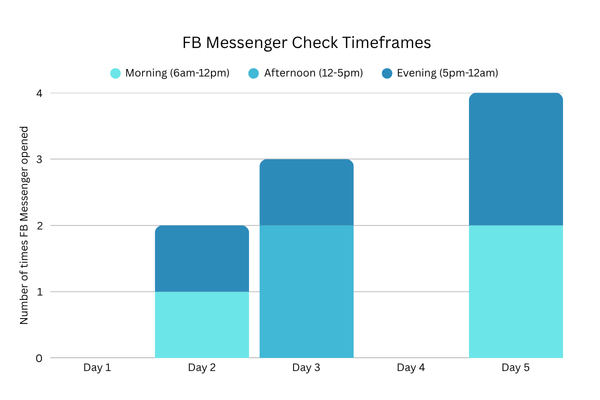
    The three out of five days of this experiment that I didn’t check Facebook Messenger in the morning resulted in:


    • Getting to work earlier.
    • Having fewer headaches from screen time after I immediately woke up.
    • Increased focus while building a to-do list.


    Image Source: Created by Author

    Image Source: Created by Author


    As seen in the two graphs pictured above, I checked Facebook Messenger on the second and the fifth day in the morning during this digital detox. Both mornings, I arrived at work around 9 am instead of 8:30 am and felt more fatigued earlier in the day.


    Johann Hari’s conversation with Google and Facebook data strategists about Send the Sunshine, an app to cure seasonal depression, was built on the belief that to shape behavior, you make sure users get hearts and likes right away.


    The immediacy of this dopamine is a psychological motivator for me to check Facebook Messenger. Breaking away from it was one of the best habits I could consider building at the start of each day.


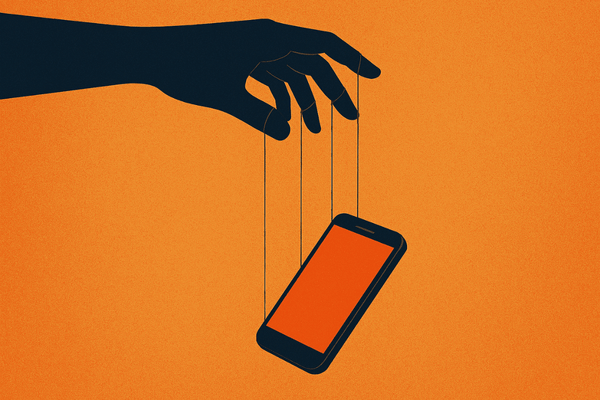
    The Invisible Force Pulling the Puppet Strings

    Social media algorithms are complex data formulas that keep us on our screens and create attention atrophy. This article from Science News Today explains the influence of algorithms well:


    “Algorithms are designed to keep you scrolling. They do this by identifying patterns in the content you engage with most – be it cat videos, political memes, or fitness tips, and showing you more of the same.”


    Image Source: Science News Today


    Although this isn’t directly applicable to my intrinsic motivation to check Facebook Messenger, explore pages on apps like Instagram and TikTok do this with their algorithms to keep me on their apps in an unproductive way.


    Setting app screen time limits, or using any of these third-party apps to help manage your digital wellbeing, have been great tactics for me to test and implement after this digital detox.


    If you are interested in doing a digital detox, I highly recommend you consider a short-term one. You’ll learn how to create sunshine and better understand how to not let algorithms pull your strings, making you a helpless puppet to these apps.