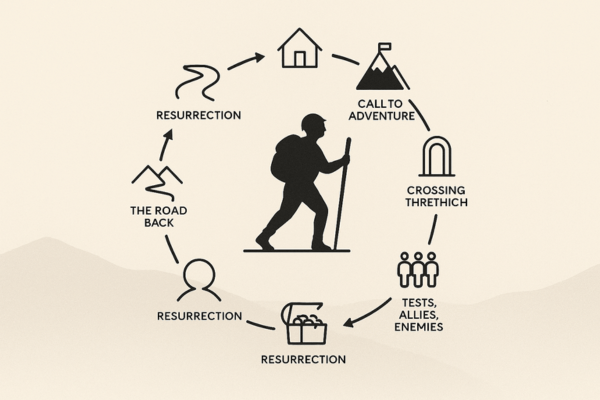
Image Source: Created by CoPilot
Storytelling is the most crucial component of visual design, captivating any audience. Leveraging the hero’s journey as a blueprint for visual design and storytelling is a tried-and-true method that we’ve seen succeed in cinema, novels, and advertising. Using the hero’s journey, you can win the hearts, minds, and wallets of anyone. Before diving into granular details like unpacking the psychology of narratives, explaining the applications in visual storytelling, covering use cases in UX and design thinking, examining a few brand case studies, and considering the future outlook of the role of the hero’s journey, let’s start with defining what this framework actually is.
Framework
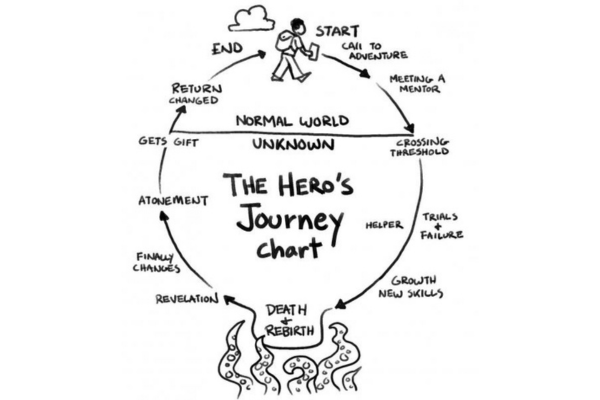
Source: USC Viterbi
The Hero’s Journey Framework can be traced back to “The Hero with a Thousand Faces,” a book published in 1949 by Joseph Campbell. This is a universal story structure found in myths across cultures spanning generations. The journey typically involves three stages:
1). Separation: The hero leaves their known world, called for adventure.
2). Initiation: The hero faces a series of challenges. Meeting allies, mentors, and enemies along the way.
3). Return: The hero comes back to their known world with a tangible treasure, new knowledge, or something to benefit their world.
How to Use the Hero’s Journey as a Design-Thinking + Foresight Tool articulates the power of the hero’s journey perfectly. “This circular pattern has proven time after time to fulfil a promise of a new and exciting world that challenges us and changes us at our core. It’s the type of adventure everyone dreams about.” (Zaidi – Module 2)
There’s a reason why the hero’s journey is one of the most popular storytelling formats, that is so prolific and exactly why we’ve seen it leveraged as a blueprint for visual design. Disney, one of the most valuable IPs globally, worth about $200 billion, has built a framework using the hero’s journey, which they’ve used for hundreds of films. It looks like this: “Once upon a time… And every day… Until one day… And because of that… And because of that… And because of that… Until finally… And since that day… The moral of the story is… (Shopify).
Now that we understand what the hero’s journey framework is and how it creates success, let’s examine the psychology of narratives to understand why humans respond to story arcs.
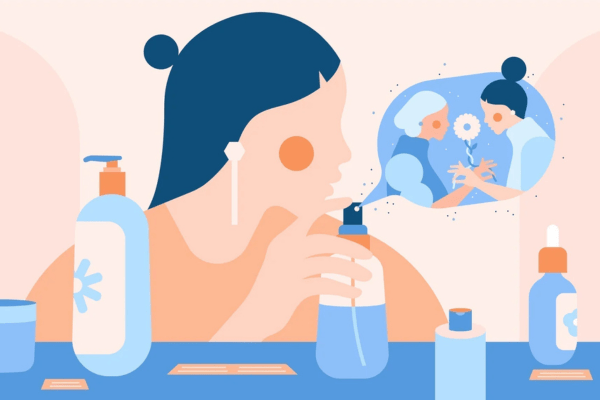
Image Source: Shopify
Psychology of Narrative Structure

Source: Lifehacker
Crafting narratives engages audiences through storytelling, emphasizing emotional engagement, cognitive biases, and reasoning, making people respond to story arcs far more than to raw data. The hero’s journey applies here because businesses frame their target audience as the “hero” and position themselves, the communicator, as the “mentor.” This is one of the best ways to bridge the gap between narrative psychology and design thinking. Crafting Compelling Narratives: Factors for Effective Message Delivery in Accounting published in the CPA Journal, proves this by unraveling the psychological impact of using a narrative structure that leverages the hero’s journey in the world of accounting.
“The accountant’s role as a mentor is to guide the audience through accepting this initial finding and leading them on the journey of discoveries. By the time rising insight #1 is presented, the audience (“hero”) is navigating unfamiliar territory, encountering allies and adversaries (e.g., those who supported and opposed the equipment upgrade).”
Stories go beyond entertainment. Stories are the backbone that builds emotional engagement and improves memory retention through the narrative structure and neural mechanisms. Reading fiction activates neural networks and emotion-processing regions of the brain, unlike other forms of visual design. The Science of Storytelling: How Fiction Shapes the Mind, an article by Psychology Today, explains this in the following way:
“For example, the brain’s mirror neuron system, which plays a key role in empathy, responds to characters’ experiences as if they were our own. This suggests that fiction is not merely make-believe—it is a kind of cognitive simulation that allows us to practice social and emotional skills in a low-risk environment.” (Psychology Today)
Designers, product managers, and marketers who understand the psychological impacts of the narrative arc are the ones who lead companies and brands that create products and services that leverage the hero’s journey to take storytelling a step further. Beyond understanding the psychological impacts, there are specific strategies people in these roles implement. Strategies within visual design that lean into metaphors and campaigns to personify brands.
Applications in Visual Storytelling (Advertising & Branding)
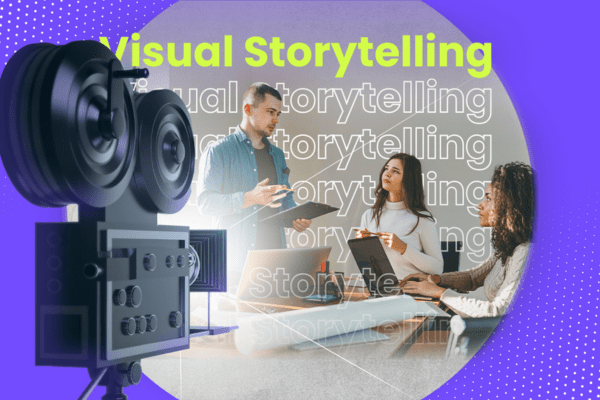
Image Source: amplifi
First impressions are everything. Before anyone speaks or reads something, we start forming an opinion based on what we see. Initial impressions play a big role in how we experience the world. So much so to the point that humans process visuals 60,000 times faster than text and 93% of communication is nonverbal. (ResearchGate – Module 6). The digital-first world and evolution of technology are dramatically shaping how people want to engage with all of this. Before we look at a few specific brands and how they apply visual storytelling to build narratives and tie back to the hero’s journey, it’s important to understand the four core principles of visual storytelling. (amplifi – Module 1)
1). Authenticity: Keep it real.
2). Sensory: Hit the feels
3). Relevancy: Bring it close to home.
4). Archetypes: Casting your characters.
All of this is to say that visual storytelling isn’t simply pretty pictures and text display. Visual storytelling is crafting a compelling narrative that connects with a core target audience emotionally and culturally. Best-in-class brands globally understand this and rely on emotional engagement to drive consumer decisions and build brand loyalty. For example, the beauty brand Dove celebrated its 60th anniversary by launching a campaign called #RaisetheBeautyBar, asking women to pledge to redefine beauty for themselves and young girls to challenge preconceived notions about attractiveness. (Time Magazine). This campaign, contrasted with typical beauty ads that rely on idealistic standards, exemplifies Dove’s commitment to authenticity and positioned the brand to succeed.

Image Source: Time
Another visual storytelling principle Dove used in this campaign is archetypes. As we know with the hero’s journey, consumers relate to characters they can see themselves as. The most memorable stories are the ones with characters the audience can identify with. For Dove, that was positioning itself as a caregiver archetype, empowering women, and being a proponent of self-esteem.
Brands that craft campaigns to position the four principles of visual storytelling at the forefront and understand how to build a narrative that ties back to the hero’s journey with archetypes, authenticity, relevancy, and by hitting you in your feelings, are what create a best-in-class brand that’s memorable and prolific globally. In addition to advertising, these brands also apply visual storytelling to their user experience and design thinking. Let’s see how.
Applications in UX & Design Thinking

Image Source: thoughtbot
The smoothest user experiences in design know how to bridge the gap between how people perceive and how designers communicate with intent to their target audience. Perception can be explained by Gestalt theory, the idea that the entirety of something is more important to our understanding than individual parts. Our mind interprets visual elements in principles including similarity, continuation, proximity, figure-ground, etc. (Thoughtbot – Module 4).
These Gestalt principles aren’t just to make interfaces prettier; they actually intentionally organize attention, influence user action, and give meaning to design in interactive systems. Examining evidence from minimal UI games, including Journey and Inside, supports this claim. Getting granular, you can choose specific Gestalt principles to better understand this.
“Moving on to Inside’s gameplay, the principle of similarity can be found in environmental elements such as crates, levers, or carts. They have a similar texture, shape, and contrast, and are often distinguished from the background by subtle lighting or edging. The player quickly recognizes that elements with this appearance can be moved or used to solve puzzles.” (ejournals)
Infusing storytelling in UX with brief human-centered narratives creates an opportunity to present designs in context. Following this method of screen-by-screen walkthroughs makes it easier to get stakeholder buy-in. Research company NN/g explains how to craft a UX story:

Image Source: UX Collective
1). Establish a character & goal (who, what they’re trying to do)
2). Context & constraints (environment, time pressure)
3). Conflict (pain points)
4). Design intervention (how the interface supports resolution)
5). Outcomes & metrics (desired behavior, success signals)
This six-step bulleted checklist enables designers to create a storyboard of an end-to-end task that demonstrates the UX decisions made and every Gestalt cue in each storyboard frame (NN/g).
After drafting these initial UX stories, there’s an opportunity to operationalize all of this with design thinking sprints. Following the iterative process of design thinking, designers can define and ideate to translate pain points into patterns that follow Gestalt principles, prototype mockups focused on proximity, similarity, etc., can complete validation by running task-based tests, and communicate any findings as a UX story that’s rooted in measurable outcomes.
Critical Analysis
Image Source: Medium
There are table stakes benefits for why you should use narrative frameworks. A few that come to the top of mind are the positive emotional engagement, seen when using the hero’s journey and visual storytelling, which improves memory and persuasion too; narrative frameworks create clarity and structure, which provides a clear arc for campaigns, and have interdisciplinary functionality, as seen in UX, advertising, and other areas of a brand.
Joseph Campbell’s hero’s journey is a prolific framework, but whether it’s universal for everything is up for debate. Looking at theme parks as an example, there are noticeable aspects that borrow stages of the hero’s journey but outgrow the 12-step arc. Star Wars: Galactic Starcruiser is a tangible example where guests create their own fragmented personalized stories instead.
Immersive protagonists – exploring the notion of the ‘hero’ in theme parks, an article published by Gröppel-Wegener, Alke, introduces a strong counterpoint to the assumption that the hero’s journey always applies. A woman named Margaret Kerrison, who has worked as a story lead on immersive projects around the world, proves that modern immersive storytelling prioritizes agency over passive observation. Kerrison offers an idea she calls emotional anchors instead of Campbell’s hero’s journey.
“These emotional anchors or ‘plot points’ keep the story moving forward in an emotionally engaging way. They keep the audience’s interest to discover and explore further. Like a movie or TV script, it propels the story forward, but unlike a movie or TV script, the protagonist is your audience. Your audience will choose what they want to experience next, so building these emotional anchors is vital to your experience.”
This is an interesting take to support the idea that the hero’s journey is a great starting point, but it isn’t a one-size-fits all solution for UX, branding, or immersive design.
Something we can’t lose sight of is the balance of narrative manipulation contrasted with authentic engagement. Ethical narratives need to balance emotion with honesty to build trust among target audiences. A first step to do this is to avoid imposing the hero role on audiences without consent. Narrative Spin, a content marketing consultancy, wrote a great article detailing the pitfalls of ethical marketing.
“The problem isn’t emotionally powerful stories but truthiness. When you write: a polished testimonial that skips the struggle, a founder origin story scrubbed too clean, a rags-to-riches narrative propped up by fantasy, not fact. These examples are about curating belief in a way that controls instead of resonates. In other words, these examples are not about connecting.” (Narrative Spin).
Narrative Frameworks in AR/VR and AI-Driven Design

Image Source: Visual Storytelling Institute
Visual storytelling is headed in a direction that goes beyond a one-dimensional campaign and static UX flows. Technology is creating capabilities with AR/VR and AI to introduce dynamic and adaptive narratives that are evolving traditional frameworks like the hero’s journey. AI specifically is creating personalized storytelling with content that changes based on user behaviors, the context of the environment, and predetermined preferences.
A study evaluating a visual narrated storytelling concept to improve users’ understanding of explanations from an AI assistant unravels how to make this type of decision-making more transparent. It focuses on how trust and understanding depend on how explanations are framed and delivered.
“In operational settings, explanations should be available only when the user actively seeks clarification about the AI system’s output. Findings from the study show that fixed-timing delivery, while useful for experimental control, may disrupt workflows and cognitive flow in real-world operations. Participants expressed a clear preference for being able to access explanations when needed, rather than having them appear automatically.”
This directly supports the idea that depth needs to adapt to user expertise, task urgency, and cognitive state. Personalization, especially with AI, isn’t just about the substance of the content. It’s about timing, modality, and the control people have as users. Personalization needs to clarify AI and amplify its capabilities if we are to harness it in a way that advances visual storytelling to resonate with people and use the hero’s journey framework in ways we never have before.
Conclusion
Image Source: ELM Learning
Humans crave narrative and visual storytelling that leverages the hero’s journey as a framework to improve engagement, comprehension, and trust for brands. The hero’s journey is just one framework that provides structure for UX flows, branding, and immersive experiences to position people as the hero themselves so they can take the relatability of storytelling to the next level.
In an era of AI personalization, and technology like AR/VR that can feel cold and emotionless, it’s more critical now than ever for designers, product managers, and marketers to guide people in a way that gives them agency and prioritizes emotional connection. Visual storytelling done right is a competitive advantage. Prioritizing it is a non-negotiable for brands if they want to cut through the noise in our world of fragmented attention.
The most challenging thing right now that’s currently stopping brands is emerging technology. Now more than ever, it’s necessary to use narrative mapping in UX sprints, apply archetypes and emotional anchors in branding, combine gestalt principles with story arcs for intuitive navigation, and explore adaptive storytelling using AI-driven personalization and new technology.
The future of visual storytelling will belong to the designers who understand how to create experiences that feel like stories worth living. Integrating narrative frameworks is no longer optional; it’s the next phase of human-centered design. Design as we know it is changing, but at its core, it will always be what separates mediocre brands from best-in-class companies.
Brands that lean into this technology and leverage the hero’s journey in their visual storytelling will win the hearts, minds, and wallets of their target audience. The future for brands is limitless if they keep a pulse on what’s coming next and what will never go out of style.
Works Cited
Winter, Dayna. “Storytelling in Branding: How to Craft a Story That Sells in 2025.” Shopify, 10 Mar. 2025, http://www.shopify.com/blog/brand-storytelling.
Subramaniam, Aditi. “The Science of Storytelling: How Fiction Shapes the Mind.” Psychology Today, Sussex Publishers, 17 Mar. 2025, http://www.psychologytoday.com/us/blog/parenting-from-a-neuroscience-perspective/202503/the-science-of-storytelling-how-fiction.
Cooney, Samantha. “Dove Wants Women to Redefine Beauty.” Time, Time, 10 Jan. 2017, time.com/4629671/dove-raise-the-beauty-bar/.
Gibbons, Sarah. “UX Stories Communicate Designs.” Nielsen Norman Group, 15 Jan. 2017, http://www.nngroup.com/articles/ux-stories/.
Matero, Johanna. “What Ethical Storytelling Really Means in Marketing.” Narrative Spin, 24 Aug. 2025, http://www.narrativespin.com/ethical-storytelling-in-marketing/.
Zaidi, Leah. How to Use the Hero’s Journey as a Design-Thinking + Foresight Tool | by Leah Zaidi | NYC Design | Medium, 4 Sept. 2018, medium.com/nyc-design/how-to-use-the-heros-journey-as-a-design-thinking-tool-c4901be5ce.
Montalto, Mike. “The Four Principles of Visual Storytelling.” Amplifi, 25 Jan. 2024, amplifinp.com/blog/4-principles-visual-storytelling/.
Bonner , Carolann. “Using Gestalt Principles for Natural Interactions.” Thoughtbot, 23 Mar. 2019, thoughtbot.com/blog/gestalt-principles.
Sidgman, Juergen, and Nathan V. Stuart. “Crafting Compelling Narratives.” CPA Journal, vol. 95, no. 7/8, July 2025, pp. 54–61. EBSCOhost, research.ebsco.com/linkprocessor/plink?id=5c24806e-8c3e-33f0-b54e-b20699915eb9.
Godek, Aleksandra. “Applying gestalt principles to User Experience Design in computer games.” Zarządzanie Mediami, vol. 13, no. 3, 20 July 2025, p. 183, https://doi.org/10.4467/23540214zm.25.017.22235.
Gröppel-Wegener, Alke. “Immersive protagonists – exploring the notion of the ‘hero’ in theme parks.” Media Practice and Education, vol. 25, no. 2, 2 Mar. 2024, pp. 137–148, https://doi.org/10.1080/25741136.2024.2324089.
Basjuka, Jekaterina, et al. “The Design and Evaluation of a Visual Narrated Storytelling Concept to Improve End Users Understanding of Explanations from a Conceptual Ai Assistant.” Behaviour & Information Technology, Dec. 2025. EBSCOhost, https://doi.org/10.1080/0144929X.2025.2596891.






 Kyle Adams POV