
The hot-topic conversations about AI focus on its output to put a value on how much automation is saving us time and money and creating opportunities for higher-order thinking instead of monotonous admin tasks. We all know AI can create content, but the next challenge at large is preserving human creativity, maintaining trust, respecting trademarks, and continuing to design around human needs. AI needs to be used as a strategic assistant, not replace the human touch. AI needs to be what Jarvis is to Iron Man.
Unpacking the Simultaneous Excitement and Fear Behind Embracing the Unknown
Millions of people have fallen in love with AI because it rewards our dopamine systems. What we see as a way to save time, eliminate repetitive work, and access information quickly has great inherent potential to be positive, but the time and energy AI saves doesn’t outweigh the concerns that consumers have about whether that’s misinformation, displacing people from their careers, or creating content that falls into the sea of sameness and is categorized as something called “AI Slop.”

Image Source: TechRadar
Technology has the potential to create substantial change for a brighter future, but without safeguards, the pressure to chase volume over creativity and fear of failure mean people will more likely continue to use it irresponsibly.
AI Creation Doesn’t Equate to Ownership
Tides are shifting, and lines are blurring to identify who created a piece of content, a human or a machine. The evolution of technology isn’t something we should fight or try to stop; instead, it should be something we embrace and let guide how we shift our priorities. Now that creation is becoming a widely available skill and losing its distinction as to what is or isn’t human, we can shift focus to the skills that will always be indisputably human. Audience understanding. Creativity. Judgment. Original perspective.
One of my core responsibilities at my job is email marketing. I use it daily to connect with a target audience (Quinnipiac alumni), promoting or encouraging them to give us their time (volunteer for something), talent (share information about themselves to tell stories), or treasure (attend an event or donate). AI software like Claude has helped my team and me with pattern recognition through a content audit. This audit generated insights like identifying that, out of our average alumni event email marketing, we have two top-performing emails: Registration Email #3 (the two weeks away email) and Registration Email #5 (last chance to register email). AI mined this insight, but human judgment helped us understand and take it a step further. We created a survey to collect real human feedback to uncover why alumni attend events. This data, along with conversations my team has with people at events, uncovers the type of events people want to attend, when they want to attend, etc.
AI helps us understand what resonates with people digitally and helps us understand content performance, but content strategy goes beyond surface-level information. Content strategy focuses on revealing motivations and helps us understand people. Transitioning from survival to thriving in this next era powered by AI tools will be determined by people who use AI to strengthen their ability to identify and leverage human insights, instead of trying to replace it.
Don’t Lost Sight: Prioritize Potential Not Volume
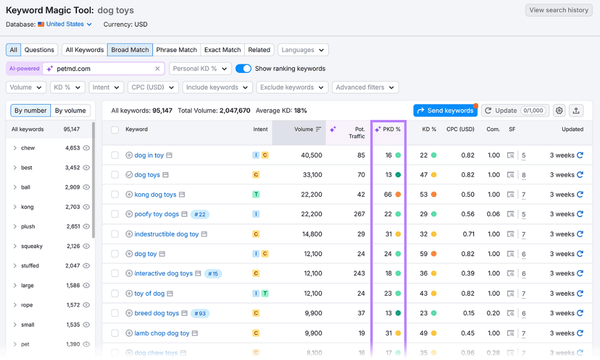
Image Source: SemRush
The barrier to entry has never been smaller to use AI in content marketing and strategy to streamline, standardize, and generate ideas. Regardless of your industry or profession, saving time and reducing costs are two priorities for everyone. Once you sign up for a chatbot like ChatGPT, Gemini, or Claude, there are several low-effort, high-impact ways you can harness the powers of AI to execute aspects of your content strategy. Semrush, a SaaS brand visibility management tool, published this article “How to use AI to execute Your Content Strategy,” which outlines the following tactics.
- Speed up Keyword Research
- Create content briefs
- Perfect SEO
An excellent example this article unpacks is how you can use a chatbot to provide a keyword list for a specific blog post.
“For example, I asked ChatGPT to provide keyword ideas related to “dog toys” to write a blog post on. It provided a list of relevant keywords and organized them by intent (what the searcher is trying to achieve).”
After you use human judgment to determine which keywords make the most sense for your topic and blog, you then use a tool like the Semrush Keyword Magic Tool to rank a phrase’s Personal Keyword Difficulty score, which determines how difficult it will be for your blog to rank highly in Google Search results.
Did you notice that the intent of using AI in this way was to gain human insights from data and center the content’s messaging and positioning around an audience’s needs? If you use AI to speed up keyword research, it isn’t taking a shortcut on expertise, putting more stock in volume over quality, or deceiving an audience into thinking that AI-generated work is human work.
Process Over Perfection: AI is Rewriting How. Not Why
The traditional search model still exists, but it’s not how users are finding information primarily anymore. Traditionally, search engines like Google, Bing, and Yahoo lean on keyword matching for a list of links. These are ranked based on search engine optimization. SEO includes Title Tags, a Meta Description, Headings, Body Content, and a clean URL. This original model prioritizes a destination-based experience to find a fact. For example, if you Google search for the best gnocchi in Atlanta, the first few webpages will be listicles from restaurant review sites, a Reddit page, and Google Maps listings with high ratings based on Google Reviews. Once you click on one of these choices, your search ends there. If you used a chatbot like CoPilot, your output will be a conversational summary with specific suggestions, a breakdown of restaurant highlights with hyperlinks to various recommendations, and a specific follow-up question. This context, nuance, and follow-up capabilities with a conversational interface are core features of AI search.
Companies that use AI search understand the context of your query (what you ask), then generate a direct conversational output with cited sources. Reddit, one of the most popular internet discussion forums, knows that Generative Engine Optimization covers 56% of global search engine volume, which accounts for 45 billion sessions monthly. As a direct response, Reddit is shifting development and resources to AI-powered Reddit answers and already seeing the benefits. TechCrunch released an article in February 2026, contextualizing all of this.
“The exec also noted that weekly active users for search over the past year grew 30% from 60 million users to 80 million users. Meanwhile, the weekly active users for the AI-powered Reddit Answers grew from 1 million in the first quarter of 2025 to 15 million by the fourth quarter.”
Creation is becoming easier, and content is becoming commoditized. The differentiator isn’t content itself. It’s a unique perspective that’s firsthand experience. Companies focused on optimizing search engines and ask engines are succeeding.
The current obsession with AI revolves around what it can create. To be future-forward, this obsession needs to shift. It’s not about AI replacing human creativity. It’s about how you can augment AI. Successful Content Strategists are harnessing AI like Iron Man used Jarvis. These are the people who are using AI to amplify human capabilities without replacing the person inside Iron Man’s suit.
Works Cited
Lindley, A., Skopec, C., & Lahey, C. (2025, January 31). How to use AI for a content strategy that drives results. Semrush Blog; Semrush. https://www.semrush.com/blog/ai-content-strategy/
Barlow, G. (2026, September 29). AI slop has escaped the internet — From event posters to cafe menus, it’s suddenly everywhere in the real world. TechRadar. https://www.techradar.com/ai-platforms-assistants/ai-slop-has-escaped-the-internet-from-event-posters-to-cafe-menus-its-suddenly-everywhere-in-the-real-world
Perez, S. (2026, February 5). Reddit looks to AI search as its next big opportunity | TechCrunch. TechCrunch. https://techcrunch.com/2026/02/05/reddit-looks-to-ai-search-as-its-next-big-opportunity/
Casey, M. (2015). The Content Strategy Toolkit. New Riders. 2026, http://www.newriders.com

