Tag: instagram

  • Walk Before You Sprint: The Overlooked Phase That Makes or Breaks Your Design Sprint

    Image Source: Generated by Google Gemini


    Where it all Started


    Before you and your team begin a Design Sprint, you need to take the necessary measures to make sure everyone is ready. With Design Sprints, there’s no such thing as overpreparation. Connecting with your team and client to onboard each person, define who is doing what, review the “run-of-show,” double check you have all the materials you need, and create several team agreements that are honored through the Sprint will guarantee its overall success.

    Let’s delve into a few of the steps I mentioned above to better understand the role each of these play in the preparation phase of the Sprint and how you and your teammates can contribute to each these tasks to get on the same page before beginning the Sprint itself!


    A Goal Without a Plan is a Wish


    If you want to achieve a certain outcome, you need to have an idea as to what your specific “challenge” is, and understand what and who it is going to take to solve it. With the Sprint process, you and your team use guard rails that serve as ground rules over the course of four days. Each day has several mini workshop sessions and the day itself has a theme, or an even better way to think about it is each day is broken out by one of the steps of the Design Thinking process. See the picture below to better understand what I am talking about.
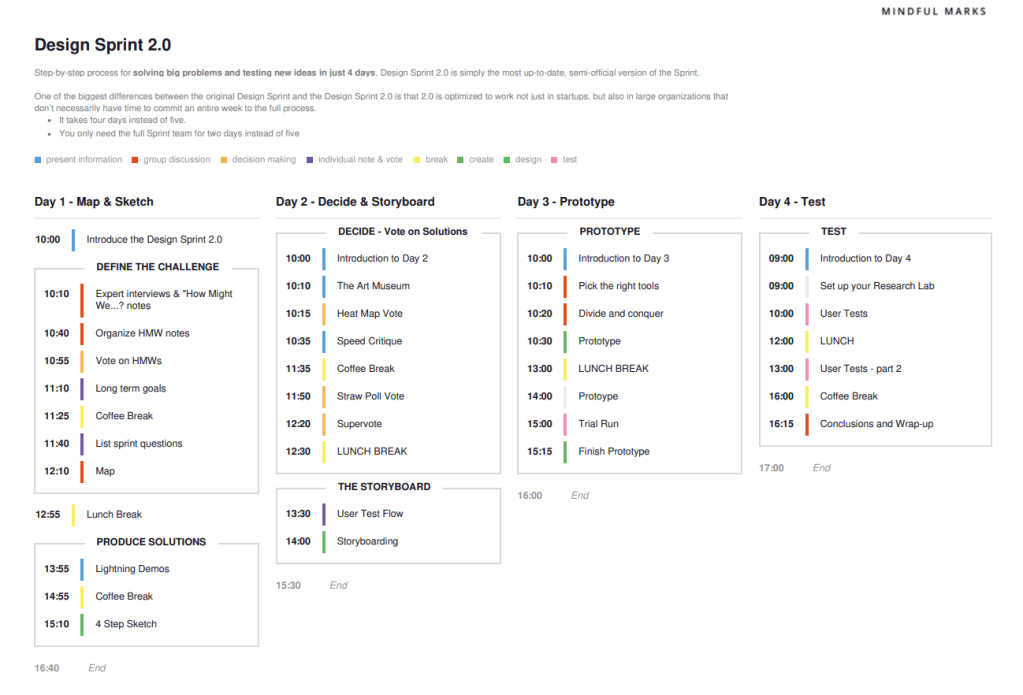
    Image Source: Mindful Marks


    Why a Craftsman Needs to Sharpen Their Tools


    Before you, your team, and client begin the first day of the Sprint, make sure you have all the supplies all of you will need for the next four to five days. If you are running the sprint virtually and everyone is remote, you can rely on tools like Miro for digital whiteboarding, otter.ai to transcribe notes from each day of the workshop, and Zoom to host the meetings virtually and record all of them. If you are doing the workshop in-person instead, you’ll need to have lots of office supplies to whiteboard and brainstorm in-person including but not limited to stickie notes, sharpies/markers, masking tape, and time (to name a few).
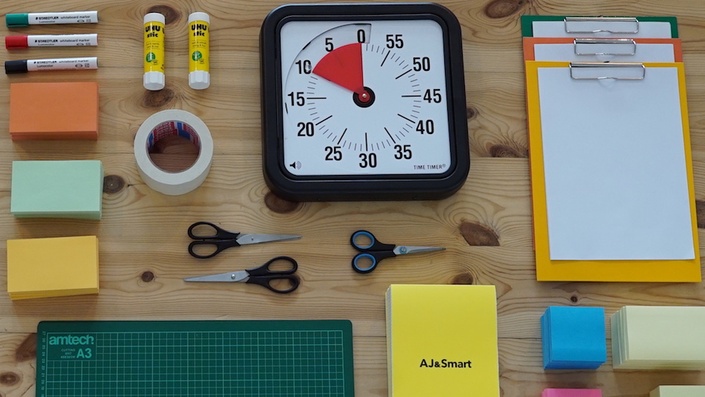
    Image Source: AJ & Smart


    Roles & Responsibilities: Everyone Has One


    I’m sure you’ve heard the phrase teamwork, makes the dream work. As cliché as it may be, this is especially true when you’re working with a group to facilitate a sprint. Everyone’s role and the responsibilities that come with it need to be decided ahead of time for the Sprint to run smoothly. As explained in the Sprint Handbook: a step-by-step guide to planning and running innovation sprints, each of these roles play a unique and critical part in the success of a Sprint. See below for just a few!

    • Notetaker:  Captures essential information during interviews and discussions.
    • Lead Facilitator: Guides the overall direction and maintains focus of the sprint.
    • Sprint Host: Ensures a comfortable and productive environment for everyone.
    • Prototyper: Translates ideas into tangible prototypes.
    • Interviewer: Conducts user interviews to gain insights.


    Image Source: Workshopper


    There’s No “I” in Team: How to Compromise


    The most impactful concept I learned in this stage of Design Sprints is the importance of creating Team Agreements. During the mini workshop we conducted this week as a team, this was one of the three exercises we had to complete together. Doing this collaboratively, enabled each one of us to learn more about what each person in the group enjoys about teamwork, what they find challenging, and then create several agreements that we can all use to bring clarity, focus and good vibes for the next 6 weeks of work we will do together. Here’s a few of the agreements we made.


    Team Agreements

    1). Be on time to our weekly Friday meetings starting at 1 p.m. ET and let the group know by Wednesday if you can’t make it due to an extenuating circumstance.

    2). Keep phone on silent and/or do not disturb during our team meetings.

    3). Dedicate the first five minutes of the team meeting to “catching-up.”

    It’s not possible to over prepare for a Sprint Workshop. Preparing for a sprint Workshop is just like walking to warm up before running a race. Walking before running is often overlooked and an afterthought, but without it you’re ten times more likely to cramp up or maybe even pull a muscle. Metaphorically speaking, the same goes for preparing for a Sprint. Without all these layers of preparation you, your team, and client aren’t going to have a successful sprint. After preparation is complete, it’s time to move into the first phase of the sprint. Map + Sketch.

    Sources

    Belle Hastings, P. (n.d.). The Sprint Handbook: a step-by-step guide to planning and running innovation sprints.

    Knapp, J., Zeratsky, J., & Kowitz, B. (2016). Sprint: How to solve big problems and test new ideas in just five days. Bantam Press.

  • The Infinite Iterative Loop

    Image Source: Generated by Google Gemini


    When it comes to problem-solving, regardless of the issue, you must think creatively to come up with a solution. Usually, your first step is to get a grasp of the situation. After that, you move on to creating a hypothesis. Once you’ve created a hypothesis, you start generating ideas. Next, you develop a demo of what you are trying to produce, and lastly, you release a version out into the world for a set audience to test and utilize.

    These steps I just listed are the core components of Design Thinking, a type of problem-solving that focuses on human-first design using an iterative process. To better understand Design Thinking, we are going to look at its origins, examine the guiding principles of the sprint process, and uncover what types of problems sprints are great at solving.


    Where it all Started


    The roots of Design Thinking go back to the 1960s. What started as a novel concept grew into a widely embraced strategy that could not stop accelerating. Design Thinking became mainstream and solidified as an approach to innovation in the late 20th century. Several people and institutions played a role in its mass adoption. David Kelley, the founder of IDEO, a global design company, is credited for shaping and promoting the version of Design Thinking that millions of people use today.

    This new movement sought to redefine the design process, including how interdisciplinary creatives collaborated, the emphasis on empathy, and shifted focus on iterative problem-solving. After Design Thinking had proven its value through popularization and widespread usage, companies and individuals at the cutting edge of technology and innovation created the “Sprint.”


    This Time it’s a Sprint, not a Marathon


    One of the biggest byproducts of Design Thinking is the Sprint, a method that solves problems quickly and validates ideas in a compressed timeline of five days instead of several months. A Sprint is comprised of four guiding principles.

    • Working Together Alone: Sketch, ideate, and create on your own, then come back together.
    • Tangible Things Over Discussion: Focus on discerning, deciding, and getting ideas into the world as tests.
    • Getting Started Over Being Right: Embrace ambiguity. Become risk-tolerant.
    • Don’t Rely on Creativity: Leverage time-based exercises that use frameworks to ideate and create.


    When at a Crossroad, Which Path to Take


    When it comes to developing innovation and solving problems, many companies struggle with deciding when to run a Sprint or if it’s even worth doing so from a timing and resources perspective. The best thing to do, is remind yourself that running a Sprint allows you and your team to test ideas and learn quickly while minimizing the risk.

    Here are a few examples of when it’s best to run a Sprint!

    1. When starting a new project.
    2. When seeking to improve an existing product or process.
    3. When seeking user validation.
    4. When fostering collaboration and team alignment.


    Design Thinking and the facilitation of a Sprint are iterative processes that are infinite, just like a loop. Even after you launch your product to market, even if you solved the original problem that was defined, it’s more likely than not you’ll have a new problem to solve or a specific thing your users want to see improved. Starting the Design Thinking and Sprint process all over again.


    Sources

    Belle Hastings, P. (n.d.). The Sprint Handbook: a step-by-step guide to planning and running innovation sprints.

    Knapp, J., Zeratsky, J., & Kowitz, B. (2016). Sprint: How to solve big problems and test new ideas in just five days. Bantam Press.

  • Why Social Media is The Best Trailer for Writers

    Image Source: Generated by Google Gemini

    If a tree falls in the forest and no one is around to hear it, does it make a sound? This metaphor can also be applied to releasing a long-form article on your blog.

    All great writers build a reputation on social media to connect with their audience and promote their work. Social media is part of the marketing mix and a necessary level of the funnel to get your customer (reader) to land on your website and read your article.

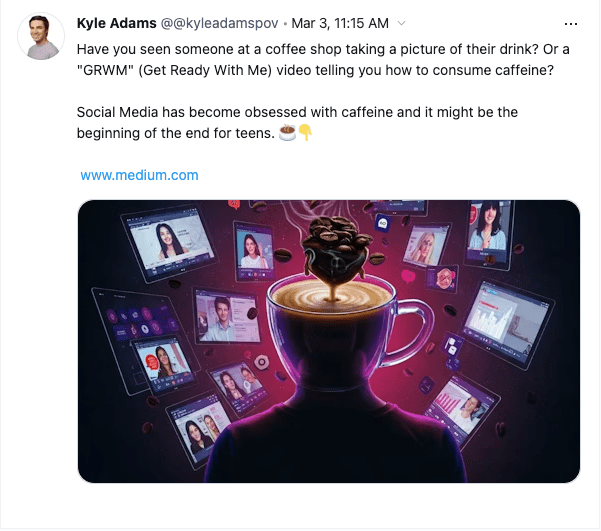
    Here are three social media post mock-ups teasing my upcoming article, “Social Media’s Obsession With Caffeine: The Reality of Consumption & Its Effects.”


    Instagram


    As attention spans shrink and more people are interested in entertaining and educational content that will stop them in their scroll, it’s vital to have eye-catching visuals for your Instagram post.

    In addition to using a futuristic dramatic visual that’s almost dystopian in some ways, I focused on making my caption short and pithy to motivate my followers to engage with the content.

    I encouraged them to read the article through the link in my bio since you can not hyperlink websites in Instagram captions.

    Now, I want to show you how I will promote this content through X.


    X

    For this post on X, I kept the tone very conversational by asking my followers a relatable question to start the post. After I posed the question, I transitioned to making a bold claim that poses a statement I know people will have different opinions on.

    The end of this post has several emojis to add some emotion and keep it casual. I used a pointing down finger emoji to act as a clear CTA. My followers can click that to read the article or click on the asset, the header image pre-populating my article.


    LinkedIn


    When I went to create this post for LinkedIn, I knew the tone of my copy would have to be slightly more serious. I wanted to focus on educational content that adds value while creating a hook that is a personal and relatable experience many of us have gone through.

    This hook is intriguing. Most people have had this thought. And if they haven’t, they are immediately curious to figure out what I’m talking about.

    Quantifying your opinions and research is popular on LinkedIn. When you have a number attached to your post, it validates you as a thought leader and trusted source.

    Social media posts are one of the most effective tools in the marketing mix to lead readers to long-form articles.

    I hope this encouraged you to read my long-form article, and I look forward to hearing your thoughts about it!