Tag: innovation

  • From Flip Phones to Fiction: Why Storytelling is the Most Powerful Tool We Have

    Image Source: Generated by CoPilot


    What if your Oura ring could predict your emotions before you even felt them? Or, what if you had a tattoo that was your biometric access to take public transit? Design Fiction is a concept that enables creators to make products that are future-forward. This is an opportunity to tap into your imagination, whether it’s envisioning a utopia or dystopia. Using design fiction, combined with visual storytelling, you create a catalyst for social and technological evolution that challenges the present world as we know it. Let’s first look at how design fiction is a proponent of change.


    Design Fiction as a Catalyst for Change

    Image Source: CNET


    Persuasion is most powerful when it’s grounded in a narrative context. You can have the most stunning visual, but beauty without a compelling narrative doesn’t convince policymakers or anyone in a position of power to execute real change. Richard Buday, the author of the article The Reality of Design Fiction: How Storytelling Can Save The World,” references a proverb that supports the previous statement perfectly. “What is truer than the truth? A Story.” Buday goes on to offer several pop culture examples that capture the essence of how films, stories, and novels that employed this philosophy moved the needle forward. My favorite example is how Star Trek showed us flip phones in 1964, and three decades later, Motorola sold its first flip phone, the StarTac. After understanding design fiction and how it’s a catalyst when it’s rooted in storytelling to persuade people, you can use a framework to create story-driven design.


    Story-Driven Design: A Framework for Visual Coherence
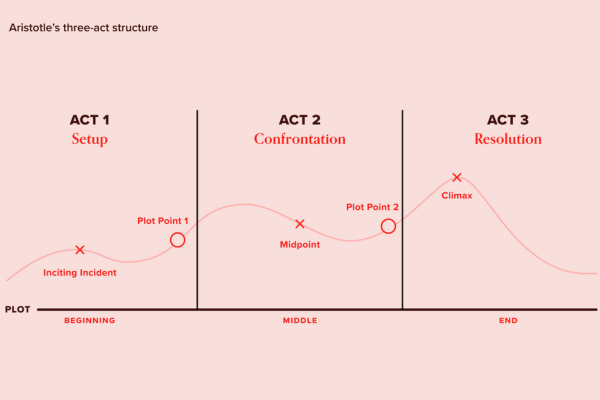
    Image Source: Smashing Magazine


    More often than not, people think writers are the only creators who need to rely on a narrative to connect with an audience. This is false. Designers use storytelling to create meaningful user experiences that are memorable. Award-winning designer Chiara Aliotta has trademarked a five-step framework to enable designers to create visual coherence.


    1. Understand Your Protagonist And The Purpose Of The Product

    2. Define the Structure of Your Narrative

    3. The Beginning

    4. The Middle

    5. The End


    The second step of this framework supports the idea that combining Aristotle’s three-act concept with the “StoryBrand Structure” by Donald Miller, a philosophy that stories must be a chain of cause-and-effect moments, creates the most clear sense of continuity throughout any narrative.


    One of the best examples I can think of to reference that supports this is the first season of the Netflix Original, “Stranger Things.” This is a sci-fi series based on a series of supernatural events that happen in a small town in Indiana, following a group of young friends who discover one mystery after another involving the government and supernatural forces.


    The first season of Stranger Things is a perfect example of combining Aristotle’s three-act concept with the StoryBrand Structure because there are three clear acts with a cause-and-effect narrative.


    • Act I: One of the main characters, Will, disappears and initiates the first mystery (Setup)
    • Act II: The group of children meets Eleven, a child with psychic abilities who is a government experiment, and eventually discovers the “Upside Down.” (Confrontation)
    • Act III: The group of children confronts the Demogorgon (monster) and saves their friend Will, who went missing (Resolution).


    Despite the fact that this is fiction, you can still leverage the hero’s journey to anticipate change and design future experiences that are a reality.


    The Hero’s Journey as a Tool for Designing a New Reality

    Image Source: TedEd


    The hero’s journey is one of the most popular concepts that is not only a storytelling tactic but also used in design thinking and trend predicting. It’s a great tool for innovation in the design process because it grounds very abstract and complicated ideas into simpler stories that are relatable and puts the user in the spotlight.

    Leah Zaid, an award-winning futurist, authored an article, How to Use the Hero’s Journey as a Design-Thinking + Foresight Tool, that details a simplified version of how you can conceptualize the hero’s journey as a designer to better understand your customers and target audience.

    Learning about patterns in action to understand what a narrative arc, hero’s journey, and how to storyboard taught me how design fiction can be a catalyst for change. Once I knew more about the why behind this, I was able to shift my attention to story-driven design, specifically how to use it to turn speculation into a narration that’s compelling and emotionally relatable. Lastly, I reframed the hero’s journey and learned about its relationship with change and how to tap into it for user journeys to design future experiences that can become reality.

    All of this leads me to believe that in our world of uncertainty, maybe the most powerful design tool we have is knowing how to tell a good story.


  • How Small Details Tell Big Stories

    Image Source: Generated by ChatGpt


    From the loud sirens, car horns, and hustle and bustle of working all day trying to grab a quick bite to eat at a street vendor outside of your city office, to the warmth of family laughter, smell of tomato sauce, and sitting at table bumping elbows waiting for an Italian family-style meal, food is a universal love language and no matter where you are, what you are eating, and who you are doing it with, there’s a story to tell.


    Stillness at Midnight After Meals

    Image Source: Pikwizard


    Restaurants serve as windows into culture, emotion, and authentically show us who people are and what they value.  When it comes to diners, they serve as an American cultural icon of escapism. Maybe you’ve had a long night and want to indulge in that big omelet breakfast you couldn’t have because your boss needed you in the office early this morning, or you’re looking for somewhere to go on a Saturday night with your high school friends after the movies. The ambience of diners and this specific image lean into the second principle of visual storytelling, sensory. In a world that’s moving at a million miles a minute, the soft lights, cushioned booths, and brightly colored interiors create a sense of safety and reprieve. Let’s juxtapose this by looking behind the scenes of a restaurant.


    Behind the Pass: Pressure Meets Precision

    Image Source: Bon Appétit


    It’s the responsibility of a restaurant’s staff to control the chaos by orchestrating a perfect culinary symphony. Customers don’t see the grueling number of hours line cooks and their teams put in to unpack deliveries, prep all day, do research and development to refine a menu, and everything else in between to create magical memories for patrons. This is a glimpse of the culmination of all those hours of grit, sweat, tears, laughter, and smiles. What you see in this image is a dramatic storytelling technique. There isn’t much to interpret, and we are completely absorbed in the action, the line cooks prepping food. Shifting gears, it’s time to look at another image that evokes a different feeling.


    Pausing Before Pouring: A Morning Routine

    Image Source: SIPTHESTYLE


    Finding your version of peace and quiet to start your day is one of the best things you can do to boost your mood. For lots of people, that’s grabbing a cup of coffee or tea at a café like this one. Designing a café with large windows to let lots of natural sunlight in and outfitting its interior with plants and warm earth tone colors creates a cozy mood. This is the kind of space someone would want to work remotely from. In visual storytelling, creating and capturing a “moment,” a fleeting bit of time that creates emotion and empathy, is one of the toughest things to do. This picture is focused on a very specific moment, the opening of this café.


    The Theatrics of Taste


    Image Source: Kobé Ichiban


    A restaurant experience can be make or break based on the taste of your food and the service. Something that’s often forgotten about or pushed aside? The entertainment factor. Hibachi is one of those restaurant experiences that zeroes in on this. Whether it’s your birthday, a graduation, or maybe an anniversary, this type of restaurant’s main goal is to make you laugh, smile, and take a picture or video to show your friends what you did. The chef’s facial expression and the flame flaring up from the grill capture this emotion perfectly.


    Sizzling Sounds Underneath Street Lights


    Image Source: Eater


    Grit and drive. Those are the first two words that come to mind when you see food vendors on popular boulevards in the downtown of a densely populated city or urban neighborhood. The composition of this picture goes beyond telling a story of just this woman grilling meat. The image gives you contextual clues that she’s in downtown Los Angeles based on following the rule of thirds. You can see the Roosevelt Hotel sign in the upper middle grid and a Hollywood star on the lower right-hand grid.


    Conversations Can Come in Small Plates


    Image Source: Visit Philadelphia


    One of the most important visual storytelling concepts is to show, don’t tell. This picture is doing that perfectly. I immediately hear many conversations happening and the noise of a tin shaker pouring a new cocktail into a glass. The yellow, orange, and green colors exude a warm and approachable atmosphere that’s still chic. This picture gives enough context to viewers to think of what type of archetype would dine here. Someone who values higher quality food and beverage experiences, who is maybe trying to get away from their child to have a date night with their significant other. Turning the page, let’s look at one more restaurant picture.


    Generations Around the Table: Tradition in Every Fold


    Image Source: Cincinnati Magazine


    Generational depth and legacy are woven into the DNA of family-style Italian restaurants. The candles lit at each table, the red plaid tablecloth folded perfectly, this scene represents casual dining that evokes a friendly and homey feeling. This image follows a non-dramatic storytelling framework, created from different perspectives, and requires the audience to complete the picture themselves.


    Restaurants, cafes, and food vendors around the world all carry human stories behind every meal and interaction. The smallest details, like the position of someone’s body, where their eyes are looking, and what’s on the table, are visual cues to what the mood of the moment is. When you consider elements of visual storytelling, including composition, sensory feelings, and whether it’s dramatic or non-dramatic storytelling, your connection to that photo is stronger, and you can create a full story to tell.

  • The Key to Becoming a Flower that Flourishes Through Concrete

    Image Source: Generated by Copilot


    When you gain enough self-awareness to realize that it’s your job to create an environment that meets your needs, it lights a new fire in you. Being imprisoned in a culture that pushes you to primarily interact with screens instead of using your imagination is ruining your attention.


    There’s a strong body of evidence that supports this claim as one of the biggest problems for children. I am going to spend a few minutes taking it one step further by explaining how this applies to anyone and why you need to demystify motivations and be wary of becoming a jack of many trades, but master of none.


    Demystifying Motivations


    Decades of research and thousands of studies have proven there are two types of primary motivation. Intrinsic and Extrinsic. Johann Hari, author of “Stolen Focus: Why You Can’t Pay Attention – How to Think Deeply, uses a great metaphor of a runner to explain the contrast of these two motivations.


    “If you go running in the morning because you love how it feels, the wind in your hair, the sense that your body is powerful, that’s an intrinsic motivation. Now, imagine you go running because you have a drill sergeant dad who forces you to go with him. Or you go running to post a shirtless video on Instagram for the likes. This is an extrinsic motivation. You are not doing it because the act itself gives you pleasure or fulfillment.”


    Image Source: NPR


    The author and researchers he’s interviewing about this concept conclude that it’s easier to focus and stick with it when your motivations are intrinsic.


    When I think about my extrinsic and intrinsic motivations, I couldn’t agree more. One of my intrinsic motivations is playing Pickleball. I play regularly, not to impress anyone specifically or get something out of it, but because I truly enjoy the game. I’ve noticed my attention on the court is very sharp, and I am steadily improving over time because I am focused. In contrast, one of my extrinsic motivations is going to the gym. I don’t go out of pure joy of working out; my main motivation to go is to get in better shape and stay healthy. During the digital detox experiment several weeks ago, I really noticed the contrast when I would find myself on my phone in the gym with minimal attention and focus on the exercises.


    I believe creating a balance of intrinsic and extrinsic motivations is one of the best ways to regain your attention and focus.  


    Jack of Many Trades, Master of None


    Throughout life, you’re exploring hobbies to develop passions, and just like how seasons come and go, so do your hobbies – especially throughout childhood as you’re establishing an identity.


    When thinking about how to regain focus and attention while reducing anxiety and stress, regardless of age, one thing comes to mind for me. Setting attainable goals. According to an article from NPR, practicing these skills can help build a reservoir of positive energy that you can draw on when it’s time to cope with challenges or annoyances.


    Image Source: NPR


    This article cites further evidence from neuroscience research that shows repeated practice of certain positive emotions can even change our brains.


    Although the idea of freedom and confinement mentally and physically is one of the biggest challenges children face today regarding their attention and focus, I believe it’s something impacting people of all ages.


    One of the best things you can do is take a step back and demystify intrinsic and extrinsic motivations to understand how to harness the positivity of both types in your life. Also, avoiding falling into the trap of letting an environment convince you that you’re a jack of many trades, master of none, will help you get one step closer to regaining your attention, deepening your focus, and not letting anyone or anything hinder your creativity, social bonds, or lust for life.

  • How Orchestrating Organized Chaos Frees up 99% of Your Headspace

    Image Source: Generated by Copilot


    Developing a process to capture your thoughts, turn them into actionable tactics, and streamline working with a team to achieve a shared outcome are a few of the backbone principles of project management. Regardless of your job, industry, and experience, good project management compared to poor project management can make or break the success of your work, and overall joy of a job or project.


    After learning about some of the history and methodologies, and creating a project management workspace for myself, I have two pieces of advice for how anyone can orchestrate organized chaos to overall improve processes and collaboration with others.


    Use Kanban to Implement K.I.S.S.


    One of my favorite concepts that my manager at my first full-time job taught me was the K.I.S.S. rule. Keep it simple, stupid. This is a cheeky reminder to avoid unnecessary complexity, whether you’re working with the CEO of your company or explaining to your 5-year-old son what you did at work during the day. It’s a fantastic design principle to remind you that simplicity is a key to success.


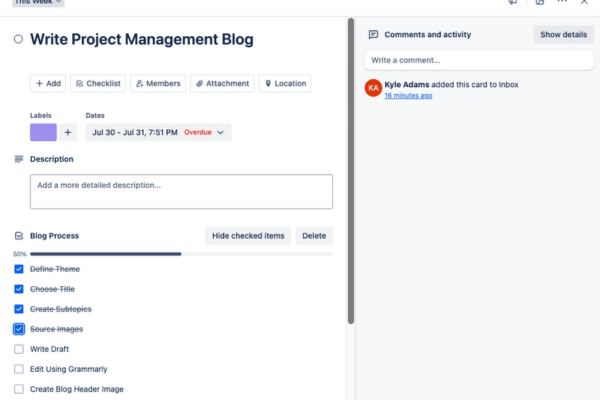
    Creating a Kanban with Trello and using it as a project management tool is one of the best ways to implement K.I.S.S.


    Image Source: Interaction Design Foundation


    As you can see in the two pictures below, I stayed true to the roots of a Kanban by designing a system with three stages that tracks how my tasks (parts) need to move through stages to completion (production within the factory).


    Image Source: Created by Author


    Image Source: Created by Author


    Reality is a Roller Coaster: How to Make the Ride Smoother


    One of the biggest upsides I found with creating this Trello board and learning about project management is that it’s not a linear process. Implementing Trello as a project management method is a low-effort, high-impact strategy. It enables you to quickly get organized and move through your work with minimal confusion, and creates more efficiency for yourself and your team.


    Something that stuck with me regarding the general and historical overview of project management is the fact that the common, clear indicators of a successful project are determined by factors like:


    • Completion on schedule.
    • Staying within budget.
    • Producing work aligned with agreed upon quality standards.


    Using a Kanban in Trello as an agile project management method gave me instant flexibility, was easy to control how much work is in progress and how granular I want to go with tasks so I could improve my overall focus and avoid overload, and has a visual display that uses colored labels to organize and create easy associations in my head for me to better remember and prioritize, almost like a version of a mind map in some ways.


    Whether you start using Trello for your project management, or another popular platform like Basecamp, learning about the history of project management, doubling down on a Kanban as an agile method, and implementing it to get organized, focused, and make your roller coaster ride smoother is one of the best ways you can free up headspace and orchestra whatever organized chaos is in your life.

  • Eyes Wide Shut: Why Technology is a Hidden Blindfold

    Image Source: Generated by Copilot


    The immediacy of access to information and connections with people is an expectation in 2025. Technology firms and parent holding companies creating these products are at a point where there are stakeholder demands and pressure to keep users’ attention, almost always putting profits over people. Yes, I won’t deny the fact that there are great outcomes made possible because of technology and social media connecting people, but after learning more about the humane aspects of technology from the Center for Humane Technology and additional research, my perspective has evolved.


    I’m going to take a few minutes to explain what persuasive technology is and unpack some of its implications on attention and cognition, as well as social relationships.


    Attention: The Most Precious Resource


    Society is moving at a pace where the “instant economy” is the new normal. Whether it’s getting an item only two days later thanks to Amazon Prime, no longer having to wait for the next episode of your favorite television show to air, and spending hours of your day after working your 9-5 scrolling an infinite feed watching short-form videos, our brains are being rewired to crave dopamine and immediate gratification through all these forms of entertainment powered by persuasive technology, devices that use tested design strategies to manipulate human behavior towards a desired goal.


    Nicholas Carr, author of the New York Times Bestseller, The Shallows: What the Internet is Doing to our Brains, describes this phenomenon perfectly.


    “What the net seems to be doing is chipping away my capacity for concentration and contemplation. My mind now expects to take in information the way the net distributes it: in a swiftly moving stream of particles.”


    Image Source: Full Focus


    According to Science News Today, research indicates that attention is deeply linked to emotional and spiritual well-being. If you have shallow attention, it fragments your emotional life. This article references studies that prove constant switching, especially during childhood and adolescence, is detrimental to brain functions such as impulse control, delayed gratification, and sustained attention.


    I notice myself struggling a ton with sustained attention, especially at work, when I am put into certain situations forcing me to multitask. If I am creating a website registration page for a new event my department is hosting, I can’t have my email window open to see a new message about an alumni profile I should add to our social media queue. Whiplash between tasks makes it tough for me to stay in flow state and puts unnecessary pressure and anxiety on myself to dive into non-urgent work that doesn’t have my sustained attention.


    Image Source: Science News Today


    The Paradigms Isolating Instead of Uniting Us


    To better understand why technology companies are under pressure to capture engagement and prioritize growth, we need to start by examining the negative implications on people, communities, and societies.


    The Center for Humane Technology created the Ledger of Harms, a report of facts supported by citations to explain what some of these paradigms are and how they are affecting all of us.


    One specific example that I believe will resonate with anyone, regardless of your profession, gender, ethnicity, or location, is social relationships. It’s important to acknowledge and not refute the fact that social networks do connect us, but they also distract us from connecting with the people right in front of us.


    The Center for Humane Technology references evidence of this from a long-term study of 11,000 people, with strong results concluding that people with higher social media use had a direct correlation with a higher level of neuroticism and anxiety only one year later.


    As I reconsider my habits, uses, and the time I spend on these platforms, I hope these insights provide some new perspectives on how to harness technology and leverage its positive attributes instead of the persuasive ones that create more harm than benefits.

  • The Devil is in the Details: How Data Offers Answers

    Image Source: Generated by Copilot


    For the first time in my life, I tried something new to think more clearly and gain time. I attempted to complete a digital detox. As I am reading “Stolen Focus: Why You Can’t Pay Attention – How to Think Deeply Again,” by Johann Hari, I’ve been challenged to change my perspective on attention, focus, and thinking deeply. So, I chose to give up the app Facebook Messenger for five days for this digital detox.


    Although I admittedly broke this digital detox several times during the five days, I felt a newfound sense of calm, clarity, and focus, whether it was more energy after I ate lunch at the office, or an increase in joy from focused time spent at the gym, not checking my phone in between sets.


    I’m going to explain two key lessons this experiment taught me, and why I recommend that anyone try doing one to improve their relationship with technology and social media.


    Creating Your Own Sunshine


    Almost all my days typically start with a blaring alarm, light flooding into my room, and rolling over to check messages I have from my friends. From a literal perspective, changing this routine to have my phone out of arm’s reach forced me to get up, turn the alarm off, and get ready for the day.  


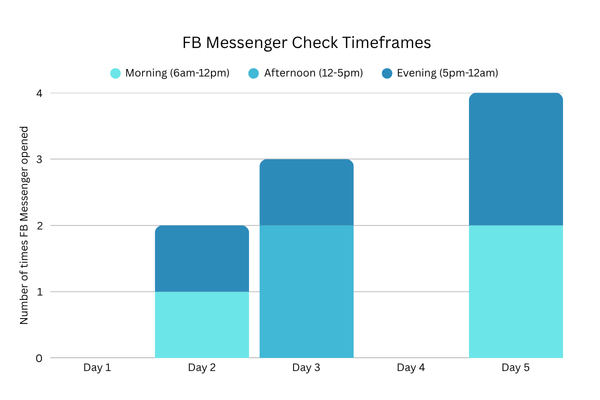
    The three out of five days of this experiment that I didn’t check Facebook Messenger in the morning resulted in:


    • Getting to work earlier.
    • Having fewer headaches from screen time after I immediately woke up.
    • Increased focus while building a to-do list.


    Image Source: Created by Author

    Image Source: Created by Author


    As seen in the two graphs pictured above, I checked Facebook Messenger on the second and the fifth day in the morning during this digital detox. Both mornings, I arrived at work around 9 am instead of 8:30 am and felt more fatigued earlier in the day.


    Johann Hari’s conversation with Google and Facebook data strategists about Send the Sunshine, an app to cure seasonal depression, was built on the belief that to shape behavior, you make sure users get hearts and likes right away.


    The immediacy of this dopamine is a psychological motivator for me to check Facebook Messenger. Breaking away from it was one of the best habits I could consider building at the start of each day.


    The Invisible Force Pulling the Puppet Strings

    Social media algorithms are complex data formulas that keep us on our screens and create attention atrophy. This article from Science News Today explains the influence of algorithms well:


    “Algorithms are designed to keep you scrolling. They do this by identifying patterns in the content you engage with most – be it cat videos, political memes, or fitness tips, and showing you more of the same.”


    Image Source: Science News Today


    Although this isn’t directly applicable to my intrinsic motivation to check Facebook Messenger, explore pages on apps like Instagram and TikTok do this with their algorithms to keep me on their apps in an unproductive way.


    Setting app screen time limits, or using any of these third-party apps to help manage your digital wellbeing, have been great tactics for me to test and implement after this digital detox.


    If you are interested in doing a digital detox, I highly recommend you consider a short-term one. You’ll learn how to create sunshine and better understand how to not let algorithms pull your strings, making you a helpless puppet to these apps.

  • Why You Shouldn’t Underestimate the Power of Doing Nothing

    Image Source: Generated by Copilot


    The year is 2025. You wake up, immediately check your phone, rush to get to work, spend the day sitting at your desk typing away, scroll through your phone at lunch with your eyes glued to the screen, come home and unwind by watching Netflix while texting your friends, go to bed, and repeat it all over again the next day.


    When was the last time you started the morning with a walk without your phone? Or went to a nearby deli for lunch to enjoy a meal by yourself, sitting at the table outside, staring at the clouds.


    As pressure continues to pile up on all of us every day to stay connected with the world and stimulated by all the noise that comes with it, I would love to have just a few minutes of your time to explain to you why doing nothing can sometimes be the best reset for you.


    Decoding the Message & Deciphering the Medium


    We are regularly communicating with tons of people in several ways. Texting, phone calls, emails, social media direct messages and comments, Snapchat, to name a few. Johann Hari, author of “Stolen Focus: Why You Can’t Pay Attention – How to Think Deeply Again,” tries to make sense of this concept and provides a clear metaphor to understand how you can decode messages and decipher which mediums they’re coming from. “Every time a new medium comes along, whether it’s the invention of the printed book, TV, or Twitter, and you start to use it, it’s like you are putting on a new kind of goggles with their own special colors and lenses.” I believe Johann is right. Once you develop self-awareness and understanding of what someone is communicating to you and know why they chose to deliver it in that way, you will strengthen your relationships with others.  


      Image Source: Remark


      Haste Makes Waste: Mind Wander Instead


      There’s an overarching fear amongst most people that boredom is a waste of time and useless. What if I told you that’s wrong and there are clear benefits you are missing out on? One easy way to think about this is to look at the animal kingdom. Naturebang, a radio show by BCC, partnered with psychologists and professors to explain why we should be doing a whole lot more… nothing.  “The natural world seems like a busy place. But the truth is that most animals spend most of their time doing nothing. We’ve created a society where we fear boredom and we’re afraid of doing nothing. But in trying to avoid boredom, we miss out on its benefits. When we’re bored, we daydream, and that has been linked to creativity.”


      Whether you are an ant watching others in your colony forage, or you’re a 20-year-old in college studying for your physics final, something all forms of life have in common is the inability to create time. None of us should fear this; instead, we should embrace it by doing nothing and taking a step back to understand the different messages we receive, the mediums they go through, and let our minds wander.


      Image Source: BBC


      I’m excited to learn more about the data associations and specific techniques I can use to think deeply and regain my attention.

    1. Finding Your Flow: Uncovering Where Focus is Hiding From You

      Image Source: Generated by Copilot


      With peeling an onion, you realize how many layers there are until you reach its core. Just like an onion, when you consider the crises of our diminishing collective ability to hold attention, there are many layers to understand it. The concept of “stolen focus” goes far beyond an individual’s personal relationship with technology. It has been accelerated by the ecosystem of our world.


      Johann Hari, an accomplished author, explores this topic deeply in his book “Stolen Focus: Why You Can’t Pay Attention – How to Think Deeply Again.”  As Johann chronicles his pursuit of a digital detox and discusses what the first month is like, there are two core concepts that stand out to me as potential explanations as to why we can’t hold our attention anymore and what we can do to improve our focus.


      Why Your Word Means Everything


      A universal truth proven by social scientists is that whenever someone wants to overcome a destructive habit, one of the most effective methods is pre-commitment. According to Johann Hari, this is when “the you that exists in the present right now wants to pursue your deeper goals and wants to be a better person. But you know you’re fallible and likely to crack in the face of temptation. So, you bind the future version of you. You narrow your choices.” Pre-commitment manifests in several areas of my life, but one that comes most to mind is my connections, like my bond with my brother. When I make a promise to my brother or confirm I’ll do something with him, I mindfully create space in my calendar and organize my other social activities, career commitments, and personal chores using a calendar and planning system to pre-commit to him. Doing this with him and several of my other friends has greatly improved my relationships.


      Listen to Understand, Not to Reply


      It’s easier than you think to fall into the trap of conversing and connecting with people in a way that’s only self-serving. One of the most common ways this shows up is through narcissism, a corruption of attention where it’s turned in only on yourself and your ego. When I think about how listening with intention shows up for me in my life, especially at work, a few of these tips from Harvard Business Review are ideas I practice to do my best at becoming a better listener.


      1. Give 100% of your attention.
      2. Do not interrupt.
      3. Do not judge or evaluate.
      4. Do not impose your solutions.
      5. Ask more (good questions)

      Image Source: Harry Haysom Getty Images


      As I start to consider how I can strengthen my ability to focus, I have several ideas about simple lifestyle changes I can make, like setting app limits to reduce my screen time, minimizing distractions, and piloting learning methods like the Pomodoro technique to try to improve my focus and memory. I’m looking forward to learning more about what’s causing these diminishing returns and what other areas of life are most impacted.


      Image Source: verywellmind


    2. PennyPal: Case Study


      A team of product designers, researchers, and communication strategists assembled to create PennyPal, a personal finance app targeting Generation Z to empower individuals with knowledge and skills to confidently manage their money, learn how to budget, and plan for a long-term, successful financial future. Over six weeks, we created PennyPal using the Design Sprints frame­work founded by Jake Knapp, a Designer who worked for Google Ventures. We completed the five Design Sprint phases as weekly workshops over Zoom. Using the visual whiteboard tool Miro and the design platform Figma, five of us collaborated successfully to define Design Sprint questions and long-term goals, assess the landscape and source inspiration, come to a consensus as a group, build a prototype of PennyPal, and connect with our target users to determine its viability and an answer to our question(s).


      Sprint Overview


      The Design Sprint methodology we followed is the Google Ventures framework that I mentioned above. This process guided our team through the following five phases.


      1. Phase 1: Map & Sketch – Understanding and defining what the problem(s) are that we’re trying to solve.
      2. Phase 2: Decide & Storyboard – The transition of ideas becoming actionable plans to progress solving the previously identified problem(s).
      3. Phase 3: Prototype & Refine – The creation of a tangible, clickable form of an idea that functions for real-world testing.
      4. Phase 4: Test & Collect – The moment of “truth” to gather real feedback for the first time.
      5. Phase 5: Reflect & Report – Reviewing and charting a course forward after analyzing all the data.


      Problem Statement & Research


      A person categorized in Generation Z (Ages 13-28) should use the educational smartphone app PennyPal to discover the ins and outs of financial literacy, improve their long-term bud­geting habits, understand best practices for saving, and learn how to build an investing plan.


      Sprint Activities


      1). Map & Sketch


      Creating a user map was a stand-out moment in this phase. Designing this after we selected the Sprint questions and long-term goals we are focusing on enabled the team to create a shared understanding of what a typical user would experience using PennyPal.

      We focused on a couple major features like starting with a sur­vey about the user, having a fun learning system about finances, and rewards to encourage the user to continue consuming the content. Our goal for the map was to make sure that once the Gen Z user learned everything, they would be proficient and confident in managing their finances.


      2). Decide & Storyboard


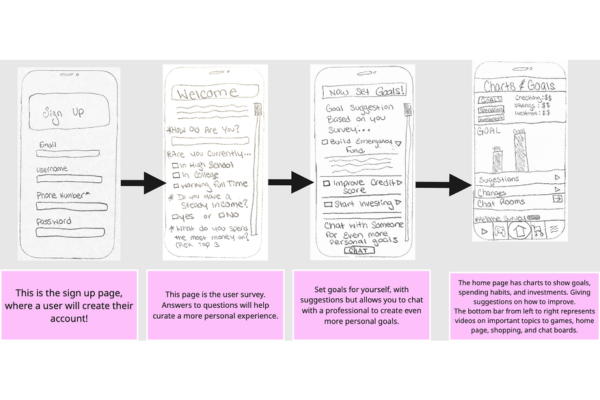
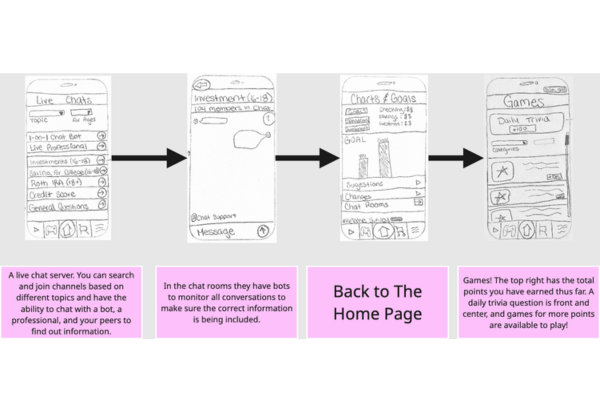
      With Storyboarding, you create a step-by-step visual plan that outlines what your prototype will look like and how a user will interact with it. Something that resonated with the team from Storyboarding is how going back to the home page is accounted for in the beginning, middle, and end of the Storyboard. That’s a very typical interaction to have with an app. It’s like a soft reset, where once a user has explored a specific feature of the app, they’re very likely to go back to the home page to see any new announcements and go to another feature. One more aspect of our Storyboard that the team thinks is strong is the overall singular focus and clarity. This process set our team up well for the next phase of the Design Sprint, prototype & refinement.


      3). Prototype & Refine


      After our team had a strong understanding of what the PennyPal app product breakdown is, knew their task assignments, and built wireframes, it was time to build a high-fidelity prototype. We chose to first create an “App Map” in a platform named Marvel to understand what the hierarchy of PennyPal would be, and then transitioned to using Figma to create a high-fidelity version of PennyPal. We built out five sections: Homepage, Video, Chat, Games, and Rewards. The features were each designed and worked on by two group members. Once completed, the prototype was ready for user testing.


      4). Test & Collect


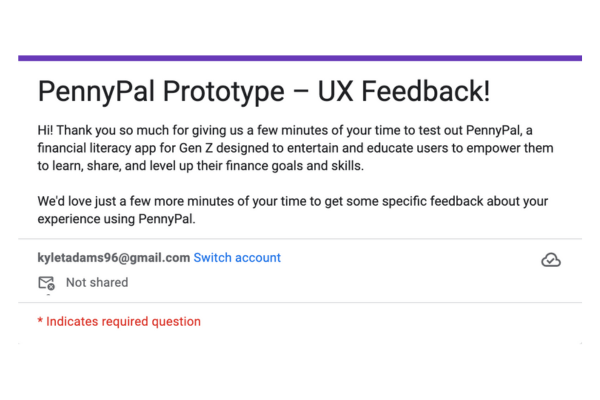
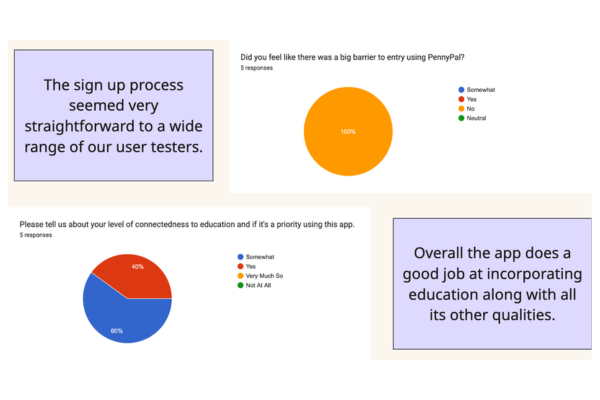
      To develop our insights, data was collected at the end of user testing. Each tester expressed their opinions and thoughts on the app throughout the survey and gave the team rich insights to inform PennyPal’s future development. A few of these insights were:

      • Overall, the app does a good job of incorporating education along with all its other qualities.
      • PennyPal’s core features, including Daily Trivia and Goal Setting, prioritize Gen Z’s key traits and needs.
      • There’s a resounding connectedness to education, but room for improvement on the entertainment side of things.


      These rich insights connect directly back to the Design Sprint questions and long-term goals we established at the beginning of the process.


      Results and Outcomes


      After completing the Design Sprint and having built the PennyPal prototype, which went through user testing with five participants, we learned several things. Users would love it if we refined core features to create a smoother experience. The goal tracking feature was one that multiple participants suggested. Our analysis of the feedback we received also revealed that potential future PennyPal users want more interactive, community-driven features focused on friends-first before they connect with strangers about personal finance. PennyPal is poised to grow with our users throughout their major life transitions and can become a trusted tool to take control of your finances.


      Learnings and Reflection


      The biggest overarching challenges during this Sprint were getting all team members on the same page about work allocation and everyone joining our weekly workshops consistently. By the fourth phase of the Sprint, we were able to adjust our task division and allocation to make the team dynamic smoother and still give key contributors the best opportunity to tap into their strengths to make this Design Sprint as impactful and enjoyable as possible. The most unexpected design insight we learned was the overall desire from users to have a “friend-first” emphasis in features like the chat room, and one of the largest takeaways from working with a team throughout this entire Design Sprint is not underestimate the power of “working together alone” and how putting effort into that can improve the overall phase of a Sprint exponentially.


      Conclusion and Next Steps


      This team of product designers, researchers, and communication strategists learned over seven weeks that the agility and definitive structure of a Design Sprint was exactly what we needed to create a MVP of a financial literacy app targeting Gen Z. Leveraging the Design Sprint framework by Google Ventures, we developed translated ideas into reality through planning, research, teamwork, design, and analysis. Based on the final feedback and key takeaways from external user testing, we have several ideas to implement to refine PennyPal and bring this app to market to transform the lives of users in a unique way that blends education and entertainment to improve anyone’s personal finance literacy.


    3. X is Where The Treasure Lies!

      Image Source: Generated by Copilot


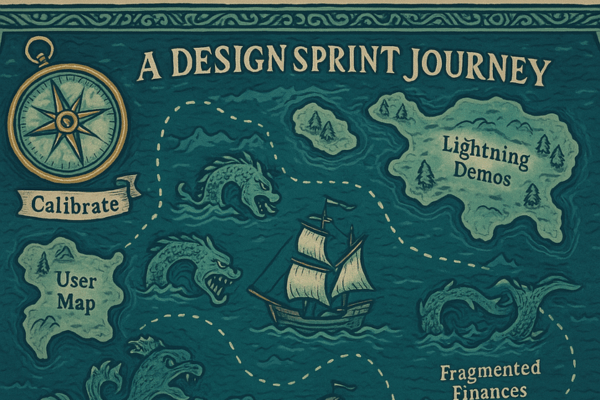
      The Design Sprint is officially underway. Before this journey continues, we must create a plan that outlines where we are headed and what we are trying to achieve. That’s why the first phase of the Design Sprint is Map & Sketch, a dedicated time for our team to calibrate our compass. We will assess the landscape to determine the problems and challenges we might run into building a personal finance education app for young Gen Z adults. This phase also creates the opportunity to chart our course to define aspects of our app, including a user map, visual brand, and run lightning demos to brainstorm. After all of this, we’ll be ready to set sail by selecting the app features we want to explore and creating 4-step sketches.


      Calibrating Our Compass


      A core component of success for this phase is taking time to assess the landscape by getting on the same page with your team about what problems and challenges users face in this industry. Outlining this as a team gave us perspective on what type of Design Sprint questions and long-term goals we’d have to create later. Trust and privacy, and market fit are two of the problems that our team believes act as a barrier to entry or pain point for Gen Z users when using personal finance apps. We also thought that these users typically have short attention spans and high UX expectations and understand they have a fragmented financial life, which will make it difficult to come up with features that can grow with our users through their life transitions.


      One of the most helpful mindset shifts our team had during this phase came from completing the “How Might We?” (HMW) exercise. This was dedicated time together to intentionally shift our perspective from viewing the challenges and problems we identified as pain points to thinking of them as opportunities we can capitalize on for our users. NN/g, a global team of UX experts, wrote five simple tips on how to create good how might we questions.


      1. Start with the problems or insights you’ve uncovered.
      2. Avoid suggesting a solution in your HMW question.
      3. Keep your HMW broad .
      4. Focus your HMW on the desired outcome.
      5. Phrase your HMW questions positively.


      Image Source: NN/g


      Now that we’ve calibrated our compass, it’s time to chart a course before we set sail.


      Charting a Course


      I believe the User Map exercise in this phase will be one of the most influential exercises later in the Design Sprint when it comes to creating our prototype. Similarly to charting a course before setting sail, creating a user map was a way for our team to see a visual and understand how our app users will interact with the app from start to finish. This exercise was valuable because it gave our team an understanding of the key moments we can focus on for the customer journey to determine what app features we want to prioritize. It also gave all of us perspective on the scope of the original problem and the challenges we identified at the beginning of this phase.


      After this, we moved on to lightning demos, a process where you assess the landscape within the personal finance industry and outside of it to source inspiration, spark creativity, and see what does and doesn’t work within various apps and products. This set us up well to organize ideas for app features into the following categories: user experience, safety and account management, and social and gamification. A few apps our team used for this exercise were Fetch, Bilt, Letterboxd, and Discord. It was a great mix of industries outside of personal finance and gave us inspiration for our 4-step sketches from a feature perspective.


      A principal designer at a digital agency based out of Melbourne describes the benefits of lightning demos perfectly in this Medium article they published.

      “The lightning demo is a fun way to ignite creativity, you can do it as a stand-alone exercise with your team. Its purpose is to share ideas, find a muse and spark everyone’s imagination in an efficient and productive manner – just like a good old show and tell sessions we used to have in schools.”


      Image Source: Medium


      Now that we’ve charted our course, our team is ready to set sail and wrap up the final exercise of this first phase of the Design Sprint.


      Setting Sail


      With a calibrated compass and a charted course, our team is ready to take all this prep work and start generating ideas and solutions for our app. The Design Sprint has a specific exercise in this phase that’s structured to do this, and it’s called the 4-step sketch. This exercise has four individual activities: notes, ideas, crazy 8’s, and solution sketching. Our team’s desirable outcome from the 4-step sketch is to have everyone contribute ideas based on the previous lightning demos and research that we conducted.


      Selecting an idea or two from the rapid ideation step in this exercise was tougher than we thought it’d be. Having only 20 minutes to take notes and draw out our ideas wasn’t too overwhelming, but facilitating the Crazy 8s proved quite challenging because we were all forced to work quickly, rely on intuition, and had to sift through an arrangement of diverse ideas.


      The fluidity and less rigid structure of 4-step sketching reminds me of my experience brainstorming content marketing for an annual event at my job. I work for Quinnipiac University’s Development and Advancement office. My role focuses on digital engagement and content marketing for alumni engagement events and annual giving initiatives across the entire university. Every summer, several months before the event, I get together with my peers to plan Bobcat Weekend, Quinnipiac’s annual alumni and families weekend.


      The brainstorming session for Bobcat Weekend has several parallels with the process of 4-step sketching. Everyone “works together alone” by taking time to create notes and ideas on their own, based on past Bobcat Weekends and inspiration from other universities. Before we do this, we also all have a mutual understanding of what our “problems” and “challenges” are heading into this Bobcat Weekend. The outcome? We each have several fleshed-out ideas and concepts for content marketing (social media posts, emails, print materials), and then we reconvene as a group to make decisions (just like designers do in a Design Sprint in the next phase).


      If you don’t want to take my word for it that the 4-step sketch is one of the best ideation exercises to yield you and your team great progress and results, here’s a brief excerpt from an article written by GitLab about how the process worked for them and how Crazy8’s created progress.


      “After thinking about the problem and potential solutions individually, we began solution-sketching through storyboards. This gave us the chance to further develop the details of a solution we chose through the crazy 8s. We started with a blank sheet of paper, placed three sticky notes on the page to represent three frames, and spent twenty minutes sketching more detailed wireframes. In the surrounding white space, we named our storyboard and wrote a brief explanation of the idea in order to ensure that the frame was understandable without verbal explanation. This helped us prepare for the next step, our silent critique.”


      Image Source: GitLab


      I’m excited to move on to the second phase of the Design Sprint to review everyone’s 4-step sketches in the art museums, create and vote on user flows, and begin storyboarding.