Category: Writing for Interactive Media

  • Walk Before You Sprint: The Overlooked Phase That Makes or Breaks Your Design Sprint

    Image Source: Generated by Google Gemini


    Where it all Started


    Before you and your team begin a Design Sprint, you need to take the necessary measures to make sure everyone is ready. With Design Sprints, there’s no such thing as overpreparation. Connecting with your team and client to onboard each person, define who is doing what, review the “run-of-show,” double check you have all the materials you need, and create several team agreements that are honored through the Sprint will guarantee its overall success.

    Let’s delve into a few of the steps I mentioned above to better understand the role each of these play in the preparation phase of the Sprint and how you and your teammates can contribute to each these tasks to get on the same page before beginning the Sprint itself!


    A Goal Without a Plan is a Wish


    If you want to achieve a certain outcome, you need to have an idea as to what your specific “challenge” is, and understand what and who it is going to take to solve it. With the Sprint process, you and your team use guard rails that serve as ground rules over the course of four days. Each day has several mini workshop sessions and the day itself has a theme, or an even better way to think about it is each day is broken out by one of the steps of the Design Thinking process. See the picture below to better understand what I am talking about.
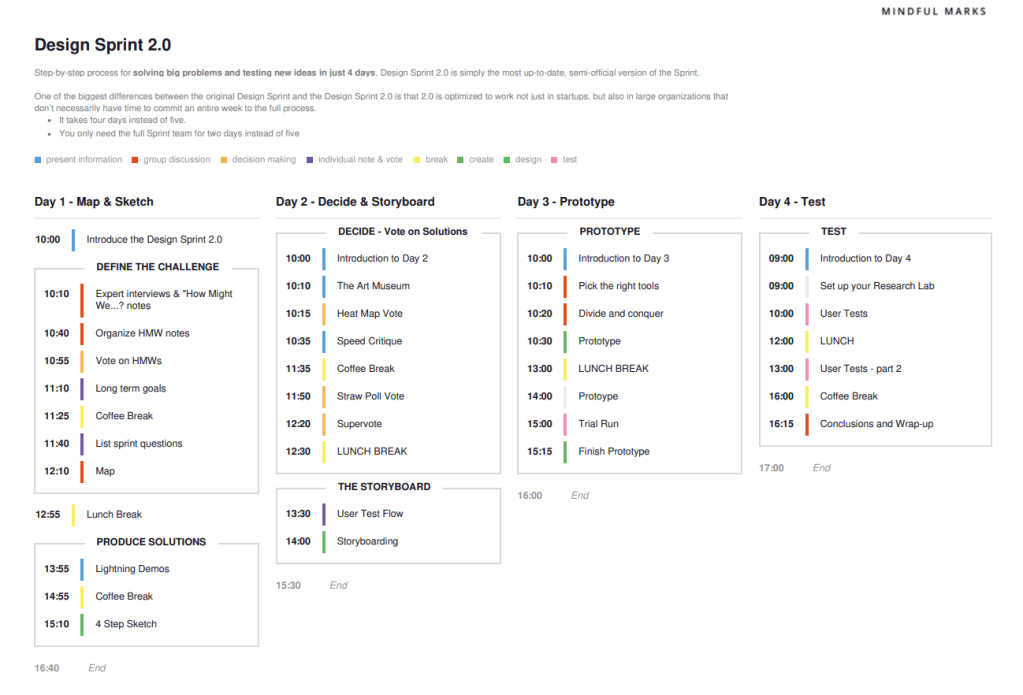
    Image Source: Mindful Marks


    Why a Craftsman Needs to Sharpen Their Tools


    Before you, your team, and client begin the first day of the Sprint, make sure you have all the supplies all of you will need for the next four to five days. If you are running the sprint virtually and everyone is remote, you can rely on tools like Miro for digital whiteboarding, otter.ai to transcribe notes from each day of the workshop, and Zoom to host the meetings virtually and record all of them. If you are doing the workshop in-person instead, you’ll need to have lots of office supplies to whiteboard and brainstorm in-person including but not limited to stickie notes, sharpies/markers, masking tape, and time (to name a few).
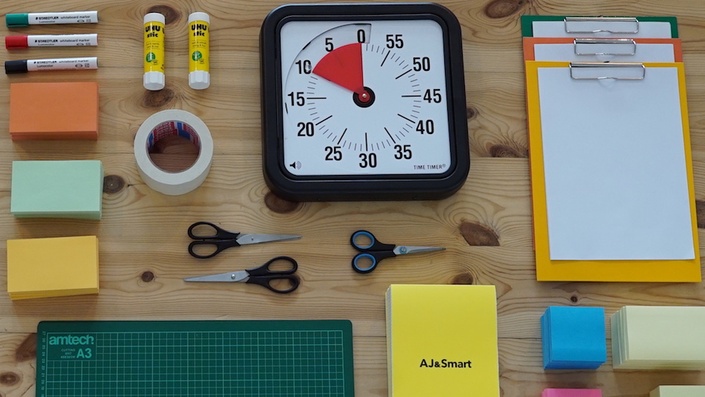
    Image Source: AJ & Smart


    Roles & Responsibilities: Everyone Has One


    I’m sure you’ve heard the phrase teamwork, makes the dream work. As cliché as it may be, this is especially true when you’re working with a group to facilitate a sprint. Everyone’s role and the responsibilities that come with it need to be decided ahead of time for the Sprint to run smoothly. As explained in the Sprint Handbook: a step-by-step guide to planning and running innovation sprints, each of these roles play a unique and critical part in the success of a Sprint. See below for just a few!

    • Notetaker:  Captures essential information during interviews and discussions.
    • Lead Facilitator: Guides the overall direction and maintains focus of the sprint.
    • Sprint Host: Ensures a comfortable and productive environment for everyone.
    • Prototyper: Translates ideas into tangible prototypes.
    • Interviewer: Conducts user interviews to gain insights.


    Image Source: Workshopper


    There’s No “I” in Team: How to Compromise


    The most impactful concept I learned in this stage of Design Sprints is the importance of creating Team Agreements. During the mini workshop we conducted this week as a team, this was one of the three exercises we had to complete together. Doing this collaboratively, enabled each one of us to learn more about what each person in the group enjoys about teamwork, what they find challenging, and then create several agreements that we can all use to bring clarity, focus and good vibes for the next 6 weeks of work we will do together. Here’s a few of the agreements we made.


    Team Agreements

    1). Be on time to our weekly Friday meetings starting at 1 p.m. ET and let the group know by Wednesday if you can’t make it due to an extenuating circumstance.

    2). Keep phone on silent and/or do not disturb during our team meetings.

    3). Dedicate the first five minutes of the team meeting to “catching-up.”

    It’s not possible to over prepare for a Sprint Workshop. Preparing for a sprint Workshop is just like walking to warm up before running a race. Walking before running is often overlooked and an afterthought, but without it you’re ten times more likely to cramp up or maybe even pull a muscle. Metaphorically speaking, the same goes for preparing for a Sprint. Without all these layers of preparation you, your team, and client aren’t going to have a successful sprint. After preparation is complete, it’s time to move into the first phase of the sprint. Map + Sketch.

    Sources

    Belle Hastings, P. (n.d.). The Sprint Handbook: a step-by-step guide to planning and running innovation sprints.

    Knapp, J., Zeratsky, J., & Kowitz, B. (2016). Sprint: How to solve big problems and test new ideas in just five days. Bantam Press.


  • The Infinite Iterative Loop

    Image Source: Generated by Google Gemini


    When it comes to problem-solving, regardless of the issue, you must think creatively to come up with a solution. Usually, your first step is to get a grasp of the situation. After that, you move on to creating a hypothesis. Once you’ve created a hypothesis, you start generating ideas. Next, you develop a demo of what you are trying to produce, and lastly, you release a version out into the world for a set audience to test and utilize.

    These steps I just listed are the core components of Design Thinking, a type of problem-solving that focuses on human-first design using an iterative process. To better understand Design Thinking, we are going to look at its origins, examine the guiding principles of the sprint process, and uncover what types of problems sprints are great at solving.


    Where it all Started


    The roots of Design Thinking go back to the 1960s. What started as a novel concept grew into a widely embraced strategy that could not stop accelerating. Design Thinking became mainstream and solidified as an approach to innovation in the late 20th century. Several people and institutions played a role in its mass adoption. David Kelley, the founder of IDEO, a global design company, is credited for shaping and promoting the version of Design Thinking that millions of people use today.

    This new movement sought to redefine the design process, including how interdisciplinary creatives collaborated, the emphasis on empathy, and shifted focus on iterative problem-solving. After Design Thinking had proven its value through popularization and widespread usage, companies and individuals at the cutting edge of technology and innovation created the “Sprint.”


    This Time it’s a Sprint, not a Marathon


    One of the biggest byproducts of Design Thinking is the Sprint, a method that solves problems quickly and validates ideas in a compressed timeline of five days instead of several months. A Sprint is comprised of four guiding principles.

    • Working Together Alone: Sketch, ideate, and create on your own, then come back together.
    • Tangible Things Over Discussion: Focus on discerning, deciding, and getting ideas into the world as tests.
    • Getting Started Over Being Right: Embrace ambiguity. Become risk-tolerant.
    • Don’t Rely on Creativity: Leverage time-based exercises that use frameworks to ideate and create.


    When at a Crossroad, Which Path to Take


    When it comes to developing innovation and solving problems, many companies struggle with deciding when to run a Sprint or if it’s even worth doing so from a timing and resources perspective. The best thing to do, is remind yourself that running a Sprint allows you and your team to test ideas and learn quickly while minimizing the risk.

    Here are a few examples of when it’s best to run a Sprint!

    1. When starting a new project.
    2. When seeking to improve an existing product or process.
    3. When seeking user validation.
    4. When fostering collaboration and team alignment.


    Design Thinking and the facilitation of a Sprint are iterative processes that are infinite, just like a loop. Even after you launch your product to market, even if you solved the original problem that was defined, it’s more likely than not you’ll have a new problem to solve or a specific thing your users want to see improved. Starting the Design Thinking and Sprint process all over again.


    Sources

    Belle Hastings, P. (n.d.). The Sprint Handbook: a step-by-step guide to planning and running innovation sprints.

    Knapp, J., Zeratsky, J., & Kowitz, B. (2016). Sprint: How to solve big problems and test new ideas in just five days. Bantam Press.

  • New Haven Pickleball’s Brand Promise: More Than Just a Game

    Image Source: Photograph taken by Steve Walter

    At its core, all brands are a promise. Usually, the first thing that people picture when they hear the word “brand” is a logo, colors and some type of slogan. Gathering all these components together to tell people a story and effectively communicate whatever good or service you are selling is how you succeed in creating a successful brand that changes someone’s life. Taking this visual design course taught me to think about branding holistically from the perspective of a designer. Specifically, how every little decision whether it’s using a chunky serif font to evoke an assertive tone, choosing a balanced trio of colors, or creating a certain style of illustration on product packaging to target an audience; all these decisions add up to the total sum of what makes a brand memorable.  

    The culmination of these design skills I learned over the last seven weeks is on display in the new brand guidelines I designed for New Haven Pickleball. This is a community to connect with local, fellow pickle-ballers. No matter if you are brand new to this brilliant game or prepping for the day it is in the Olympics, you are welcome! I discovered this community in the summer of 2024 and almost one year later, have met many incredible people that I play Pickleball with regularly. Creating brand guidelines for New Haven Pickleball was a fun, yet challenging process since the brand had no foundation to work off besides a name and a few social media pages. I’m going to take you through an aspect of the brand guidelines that is one of the most vital components to making this brand what it is.

    Verbal Brand

    Regardless of the company or organization, the anatomy of all brands has a verbal brand component. For New Haven Pickleball, all it had was name. When you really think about it, a verbal brand is so much more than a name, it’s your company’s slogan, personality, tone of voice, and style of language.

    After reading a chapter on branding from the book “Graphic Design For Everyone” by Cath Caldwell, I understood what all of these parts of a verbal brand meant. After thinking, research, and some trial and error, I decided to change the name of this company to NHV PB, created the slogan “Community > Competition”, and established its values are inclusivity, positivity, learning and passion.

    These decisions about NHV PB’s verbal brand set the tone moving forward for the copy I used on marketing collateral including an event poster, brochure about the spring league, and a home page design comp for a website mockup.

    The slogan, “Community > Competition” might be the most important aspect of NHV PB’s verbal brand. This company is mainly a community. The “good” it sells is the sense of belongingness, camaraderie, and the opportunity to consistency play pickleball. Using this phrase as a slogan that appears on print collateral, merchandise, and digital properties echoes inclusivity as a brand value and welcomes players at all levels while still validating the legitimacy and opportunity to progress and get better at pickleball.

    I look forward to learning more about visual design and the opportunity to potentially work with the league manager who created New Haven Pickleball to implement some of these brand guidelines.


    Sources

    Caldwell, C., & Skene, R. (2019). Graphic design for everyone: Understand the building blocks so you can do it yourself. Dorling Kindersley Limited.

  • From Lens to Canvas: Crafting Emotional Connections in Design

    Image Source: Generated by Google Gemini

    Conveying information to elicit an emotional response is one of the most powerful skills a designer can master. From photos to hand-drawn illustrations and even digital artwork, each form of imagery is a core component of graphic design. Something that stood out to me in this learning module is the juxtaposition of Illustration and Photography. Specifically, what illustrators can convey vs. photographers, the factors in the decision process illustrators go through when choosing a style, and the intersection of goals illustrators and photographers share. Let’s dive in!


    Photography: Capturing the Moment

    Photography is your best friend if you are trying to visually depict a product, establish a mood, and ultimately build a relationship with your target audience. A few of the most practical outcomes that photography creates for graphic designers are the ability to sell a product, establish trust, tell a story, or teach a technique.

    For my semester-long brand project, I am working on creating a visual and verbal “Brand DNA” for New Haven Pickleball, a local pickleball community I am part of. Using photography that captures pictures of people serving, dinking (a light touch hit in pickleball), and drop shots can showcase the wide variety of shots in pickleball and teach members of this community proper form for these different types of shots.


    Illustration: Carefully Crafted

    Illustration is typically a form of art that depicts a product or location. One of the most valuable aspects of illustration is its ability to convey abstract concepts. Because of its versatility, illustration usually enables designers to reach their target audience in ways that photography typically can’t. A few of the best examples are creating reality with personality, showing how, revealing what lies beneath, imagining prehistory and fantasy, and visualizing a complex idea.

    Continuing with the example of the New Haven Pickleball organization that I am doing my “Brand DNA” project on, creating an illustration to showcase different types of paddles and the various materials that make up a pickleball paddle and how they impact the type of play style it favors, would be a great example of how an illustration would work best instead of a photo.


    The Decision Tree: Differences & Similarities

    If you’ve identified wanting to use or create an illustration for your brand/company, there are a few essential things to consider. The purpose of the illustration, its overall brand (mood, tone of voice, being reflective of the brand’s personality), understanding who your audience is, and the medium that your illustration is being designed for (where most of your audience is viewing it). I would likely choose a freehand digital style for any illustrations for New Haven Pickleball because it would enable me to use the brand colors freely which range the spectrum from bright to dark. This would also help me evoke the brand’s chatty and informative personality without being forced to use an illustration style that comes off as childish, luxurious, or serious, which wouldn’t appeal to most of my target audience.

    For photographers, the decision-making process looks a bit different. After a photographer decides what they’re shooting as a subject and are ready to go, they need to consider the following factors to get the best composition that’s appealing and impactful; fitting the format to the subject (deciding if horizontal or portrait format makes sense), using the rule of thirds, considering the background, and using lines to lead the eye. If I were shooting some pictures for New Haven Pickleball, I would use a portrait or vertical frame for photos of a pickleball paddle to capture its entire length. I would also capture some low-angle shots from the ground and use the court lines to lead the viewer’s eye to showcase some photos of people playing a game of pickleball in an interesting way.

    Anyone can take a photo or create an illustration, but getting the most out of either form of imagery is crucial to being a successful designer who knows how to tell a brand’s story and convey its emotion. I hope you learned a bit about the differences between photography and illustration and how both can elevate your brand and take it to the next level.


    Sources

    Caldwell, C., & Skene, R. (2019). Graphic design for everyone: Understand the building blocks so you can do it yourself. Dorling Kindersley Limited.

  • Why Social Media is The Best Trailer for Writers

    Image Source: Generated by Google Gemini

    If a tree falls in the forest and no one is around to hear it, does it make a sound? This metaphor can also be applied to releasing a long-form article on your blog.

    All great writers build a reputation on social media to connect with their audience and promote their work. Social media is part of the marketing mix and a necessary level of the funnel to get your customer (reader) to land on your website and read your article.

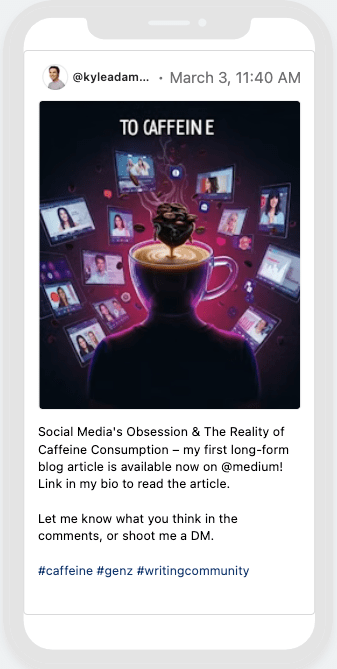
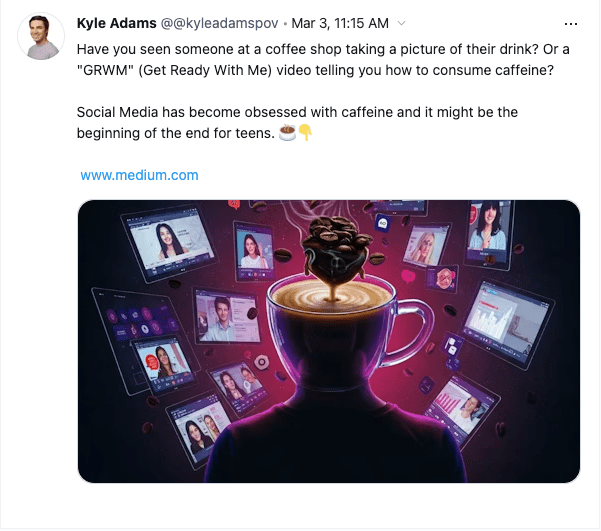
    Here are three social media post mock-ups teasing my upcoming article, “Social Media’s Obsession With Caffeine: The Reality of Consumption & Its Effects.”


    Instagram


    As attention spans shrink and more people are interested in entertaining and educational content that will stop them in their scroll, it’s vital to have eye-catching visuals for your Instagram post.

    In addition to using a futuristic dramatic visual that’s almost dystopian in some ways, I focused on making my caption short and pithy to motivate my followers to engage with the content.

    I encouraged them to read the article through the link in my bio since you can not hyperlink websites in Instagram captions.

    Now, I want to show you how I will promote this content through X.


    X

    For this post on X, I kept the tone very conversational by asking my followers a relatable question to start the post. After I posed the question, I transitioned to making a bold claim that poses a statement I know people will have different opinions on.

    The end of this post has several emojis to add some emotion and keep it casual. I used a pointing down finger emoji to act as a clear CTA. My followers can click that to read the article or click on the asset, the header image pre-populating my article.


    LinkedIn


    When I went to create this post for LinkedIn, I knew the tone of my copy would have to be slightly more serious. I wanted to focus on educational content that adds value while creating a hook that is a personal and relatable experience many of us have gone through.

    This hook is intriguing. Most people have had this thought. And if they haven’t, they are immediately curious to figure out what I’m talking about.

    Quantifying your opinions and research is popular on LinkedIn. When you have a number attached to your post, it validates you as a thought leader and trusted source.

    Social media posts are one of the most effective tools in the marketing mix to lead readers to long-form articles.

    I hope this encouraged you to read my long-form article, and I look forward to hearing your thoughts about it!

  • Everything Good Doesn’t Have to Come to an End: Want to Know Why?

    Everything Good Doesn’t Have to Come to an End: Want to Know Why?

    Image Source: Generated by Google Gemini

    You’ve probably heard the phrase, everything good must come to an end. But what if I told you I disagree with that phrase? This famous proverb is an undertone used often in movies and television to express regret when something that brings you happiness ends. It’s also used to accept that even enjoyable experiences cannot last forever.

    When it comes to writing well, I believe there’s an exception to this proverb. Instead of focusing on the proverb’s literal meaning, the best writers take it one step further.

    The best writers prioritize leaving their readers with one provocative thought. Even if that “good” thing does end, writers cleverly do two things to get to this point with their readers.

    It’s as Easy as ABC

    Good writing knows how to spot the difference in scenarios with writing for the ear vs. writing for the eye. Writing for the Ear Instead of the Eye, an article by Jill Swenson, explains this concept perfectly.

    “Writing for print addresses the intellect: the intent is to communicate an idea or present the facts and let the reader infer the meaning and significance of the words. When you write for the ear, you want to evoke an experience, a set of sensations in the listeners.”

    Rhythm and alliteration matter for every sentence. As soon as you incorporate these things into your writing, you’re one step closer to having your readers hooked. There’s one more thing that can help you as a writer.

    Everyone Needs an Anchor

    Using unity to keep the reader from straggling off and satisfying their subconscious for order is the foundation of good writing. There are lots of variables you can choose as a writer to infuse unity into your writing. William Zinsser in his book, On Writing Well, explains this with the example of the unity of mood.

    “You might want to talk to the reader in the casual voice that The New Yorker had strenuously refined. Or you might want to approach the reader with a certain formality to describe a serious event. Both tones are acceptable. In fact, any tone is acceptable. But don’t mix two or three.”

    Everything good does come to an end, but that doesn’t mean you can’t harness the power of good writing to leave people wondering. Wondering about that new, provocative thought you left them. And wanting to read the next thing you write. Knowing how to write for the eye vs. ear and using unity are the first two steps. 

  • Don’t Look Into the Mirror For Too Long

    Don’t Look Into the Mirror For Too Long

    Image Source: Generated by Microsoft Copilot

    One of the easiest things to do is react before thinking. This goes for conversation, and even more so for writing.

    The words you say to someone or write in a communication must be chosen carefully. But there’s something equally important when it comes to writing.

    Understanding that if you write for yourself, there’s an inherent tradeoff.

    William Zinnser, author of On Writing Well, explores this and makes you ponder a complex contradiction. Zinnser argues that you need to simplify and shorten to remove clutter, but you also need to write in your own style that’s for yourself.

    Let us examine two issues he dives into that led me to my conclusion above.

    Zinnser says writers need to consider craft and attitude.

    Practice Makes Perfect

    Becoming a subject matter expert is important to build a foundation that turns into a reputation, but you need to have a realization first.

    Another article that explains this piece of this puzzle perfectly is The Source of Bad Writing by Steven Pinker.

    Pinker explains a concept called “The Curse of Knowledge.”  This is the belief that leads writers to assume readers know everything they know. He gives a great example of a speaker at a biology conference falling into this trap by giving a presentation packed with technical jargon geared to fellow scientists only.

    The speaker knew this presentation was being filmed and distributed to millions of people who aren’t scientists.

    Initial Impressions

    How you use a skill to express your personality defines how someone perceives you. In this case, it’s how your reader sees you as a writer.

    As a writer, an interesting and important consideration is giving the reader enough valuable information right away. Amy Schade, author of an article named, The Fold Manifesto: Why the Page Fold Still Matters, discusses the importance of this initial impression.

    “When users fail to see information of value, they stop scrolling. In usability testing, the occasional user does a “lay of the land” scroll to get a sense of what’s on a page before engaging, but this behavior is far from standard. Users scroll when there is reason to.”

    Writing for yourself has an inherent tradeoff if you don’t consider your craft and attitude as separate issues. Once you do and focus on reducing clutter, letting your style lead your writing, and following key principles, your writing will improve drastically.

  • Degrees and Detours: Using Empathy & Curiosity to Tell Stories

    Degrees and Detours: Using Empathy & Curiosity to Tell Stories


    Origins

    Kyle Adams is a 28-year-old who loves storytelling via writing and visuals. He graduated from Quinnipiac in 2018 with a bachelor’s in public relations and a minor in Marketing. After working in agency environments for several years and gaining skills in traditional PR, content marketing, business development, and project management, he transitioned to higher education.

    For the last year and a half, Kyle has been working for the development department at Quinnipiac University, focusing on digital engagement. Kyle utilizes email marketing, social media, and web design to engage with Quinnipiac alumni, whether it’s event marketing, annual fundraising, or storytelling opportunities.

    Image Source: Quinnipiac Alumni Association


    The Quinnipiac Interactive Media and Communications graduate program interested Kyle because of the depth of its curriculum. He has a strong background in research, writing, and content marketing, but Kyle does not have a formal education in design, UI/UX, and other visual storytelling practices. He wants to develop and use these skills to engage and inspire people.


    Inspiration

    Image Source: Crocs

    One of Kyle’s favorite interactive media projects is a campaign created by the designer/artist Salehe Bembury. Specifically, his partnership with the footwear brand Crocs and his project, which released a brand-new Croc called the Croc Pollex.

    His social media promotions, activations in cities, and other marketing collateral grabbed Kyle’s and millions of others’ attention because it is ground-breaking work that goes against the grain.


    Aspirations

    Kyle wants to become more adept in digital writing and UI/UX work. He wants to grow into a career role focused on managing a university website. He wants to be responsible for the design and maintenance of a website’s content management system.

    Kyle is excited to learn from his peers in an immersive setting where everyone creates tangible work. He is especially looking forward to his classmates and instructors reviewing, critiquing, and offering new perspectives that will help him improve anything he creates.

    Something Kyle wants his classmates to know about him is that he’s passionate and curious. Both in his work and relationships, he leads with empathy and wanting to uncover the why behind someone’s opinion or the reason something works the way it does.

    Kyle is excited to take this Writing for Interactive Media course to sharpen his writing skills, learn from others, and get a chance to share his perspective on topics he hasn’t explored before.

  • Why Writing Well Can Be Your Road Map to Navigate Through the Instant Economy

    Why Writing Well Can Be Your Road Map to Navigate Through the Instant Economy

    Image Source: Generated by Google Gemini

    In 2025, we are living in a world known as the instant economy.

    Whether ordering your lunch with just one click, rescheduling an appointment through the voice technology of your phone, or even taking a picture of your check to deposit it directly into your bank account, all these actions have one thing in common.

    They are instant and frictionless.

    With the development and mainstream adoption of AI, delivery of news through social media, and connectivity of people through digital worlds, there is an expectation that everything will be instant.


    What is the bad thing about all of this?

    It is not as simple as categorizing this as a bad thing but rather an observation of a direct correlation.

    The rise of the instant economy has directly resulted in the regression of deep thinking and the ability to understand what we read and see online.


    What is the solution behind all of this?

    It is not a solution per se, but there is something you can practice to make sense of a topic and establish a clear perspective.

    Writing well.

    After I read an article titled 16 Rules of Blog Writing and Layout. Which Ones Are you Breaking?, I had a better understanding of the importance of incorporating things into your writing like:

    • Using images like that one at the beginning of this piece of writing
    • Having short paragraphs that are typically 2-3 sentences long
    • Using lists to create more white space and help people find information quickly

    Another article titled Is Google Making Us Stupid by Nicholas Carr has a quote from a playwright named Richard Foreman that captures the essence of this instant economy dilemma.

    “As we are drained of our inner repertory of dense cultural inheritance; we risk turning into pancake people-spread, wide and thin as we connect with that vast network of information accessed by the mere touch of a button.”

    The instant economy is here to stay, and there’s no argument about it or against it.

    Writing well, creating an environment conducive to deep thinking, and applying the principles of readability are just a few simple steps you can take to thrive in this new world we live in.