The idea of sitting in silence scares most people. Until sound or music is taken away from a piece of art of setting, you don’t realize how big its impact really is. Sound is a medium that transforms ideas into immersive worlds. It elevates concepts into unforgettable stories. Animators and filmmakers can take the sound of heavy footsteps paired with a high-pitched violin to create the sense of fear or use laughter and a soft whispering voice to create the feeling of comfort. The addition of intentional sound effects and music in animation is what separates masterful from mediocre projects.
Animated Storytelling by Liz Blazer puts into perspective how important sound is to animation. “The notion of sound is that it’s reactive, almost obedient, to action. All sounds are the result of objects vibrating. Sound alone can propel a story forward.” Blazer goes on to define the difference between diegetic and non-diegetic sounds. Diegetic comes from sources visible on the screen that come from the physical world. In my stop motion animation project, I added sounds of coffee grinding, coffee pouring into a cup, and a skateboard pushing away. All these sounds matched the visuals viewers were seeing on screen and added to the immersion of my story. Non-Diegetic sounds come from sources that are neither visible on screen nor have been implied to be present in the action. This includes sound effects that are not natural to objects in the scene. I added a lo-fi jazz soundtrack to my stop motion animation because this non-diegetic sound enhanced the cozy mood a café wants to emulate.
The collection of examples below showcases how powerful and effective audio and text animation are when it comes to creating masterful projects, and as Liz Blazer says, designing “wonderland.”
Research
Spirited Away (Audio)
This film by legendary director Hayao Miyazaki is one of my favorites for its world-building, immersion, and reflection on some of life’s biggest questions and conflicts. Spirited Away really leans on atmospheric soundscapes like windy weather, distant chatter in a busy marketplace, eerie footsteps, and lots of other diegetic sounds to make viewers feel certain emotions at specific points in the movie. The music does an excellent job of progressing the story and seamlessly shifts from tender, heated exchanges to surreal, peaceful moments. Lastly, it’s quite impressive that Miyazaki and his sound engineer traveled to hot springs in the real world to record authentic bathhouse noises for sound effects, including water movement, steam, and bubbles. See below for a great analysis of how sound enhances storytelling!
Severance (Audio)
One of my favorite television series, Severance, a dystopian sci-fi thriller about workers who undergo a procedure to separate their work life from their personal life, is a masterclass in using sound. Through both seasons of the show, ambient sound was used to build an unsettling corporate world with long, windy echoing hallways, low mechanical ambience humming in the background, and keyboard clicks as Lumon workers completed their tasks in macrodata refinement. A core concept of the show that was driven by sound was the characters shifting from their “innie” to “outtie” every time they went up and down the elevator leading to their workplace at Lumon. As a worker goes down the elevator, a g note on the keyboard plays to indicate the shift has started, then a lower tone plays once the transition is complete. This convention is used throughout the show and is used to drive the plot (don’t watch the video linked below if you don’t want any spoilers).
Napoleon Dynamite (Text Animation)
One of the most iconic indie comedy movies that is considered a cult-classic is Napoleon Dynamite, the story of a goofy, awkward teenager living in rural Idaho. Often overlooked, the title sequence of this movie sets the tone and is quite unique, turning everyday objects into animated typography. The title sequence uses a myriad of simple meals arranged on colored plates using sauces to spell out phrases. For example, a burrito and rice sit on a plate with mustard spelling out “and Paramount Pictures Present.” These hand-crafted title cards, created from items that are essential to the film’s setting, immediately establish a quirky tone and offbeat personality, which is central to this film. See it for yourself through the video below!
Catch Me If You Can (Text Animation)
A top-tier example of effective text animation is the title sequence from Steven Spielberg’s movie, Catch Me If You Can. The silhouette animation, combined with smooth motion that’s also paired with text that moves in a playful, narrative-driven way, is why this is impeccable. The theme of deception and pursuit is quietly introduced here through visual rhythm. I highly recommend watching the video below to see what I mean! As well as the movie, if you haven’t seen it.
Create
Smiski Café: Grand Opening Stop Motion Animation Video
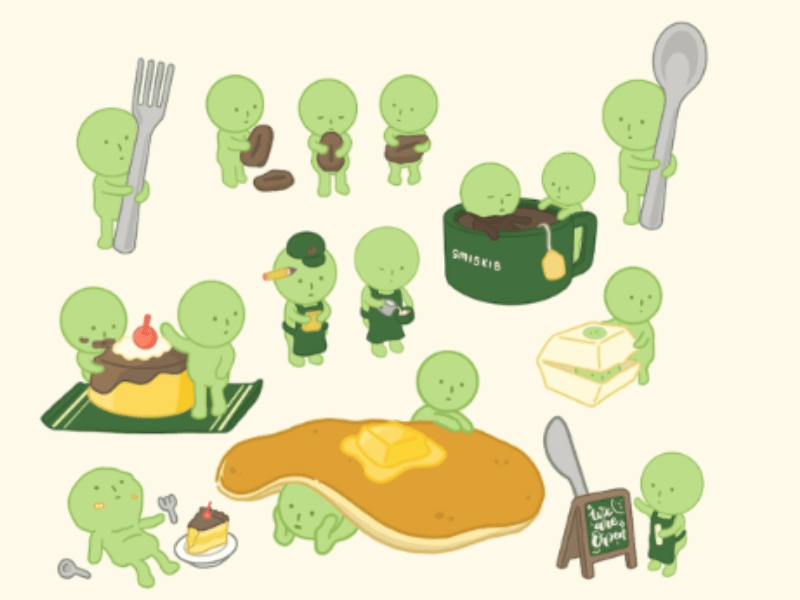
Week four was a continuation of the foundational pre-production work done last week. It was time to create a stop motion animation video! I decided to choose my linear idea, “A Day in the Life at the Smiski Café.” I rented a tripod and lighting from Quinnipiac, set up my scene, changed my phone settings to shoot in the correct format, and created an audio command via Siri to take pictures hands-free.
This was challenging! Because I knew my project would be 12 frames per second, I needed to take a minimum of 12 pictures for every one second of video. That’s at least 360 pictures in total. After I reviewed my storyboard from last week and realized what items in my café were and were not movable, I had to pivot a couple of my scenes. Instead of “A Day in the Life at the Smiski Café,” I pivoted to make this story the “Smiski Café: Grand Opening.”
The original scene was going to be more about a single incident, coffee and food falling, and then a barista getting the customer new food. I realized my food and coffee cup that was part of the café set, were glued onto the table. There also wasn’t enough space to make this work and take enough varied pictures. I pivoted the story to the customer getting their order successfully, enjoying some live music, and leaving the café happy.
Despite the challenges, this was an enjoyable project! If I had more time, I would’ve loved to think of a longer story and potentially reshoot the pictures to fit the 16:9 aspect ratio perfectly.
Works Cited
Blazer, Liz. Animated Storytelling: Simple Steps for Creating Animation & Motion Graphics. Peachpit Press, 2020.
 Kyle Adams POV
Leave a comment