Amid the business of everyday life, when attention feels scattered, there are still moments when time slows down, and you start to see specific patterns. Between the errands you have to run and your daily rituals that act as an escape, the noise eventually becomes a quiet pause, giving you space to be present and wonder.
Abrupt Endings
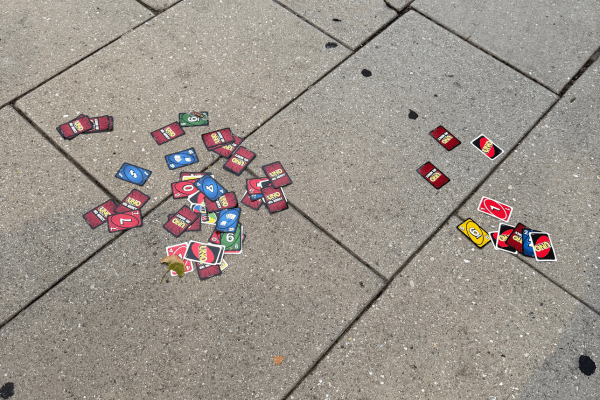
Caption: A game finished before it could even start. You can feel the pulse of the city in each step you take on the sidewalk.
Repetition Finds Rhythm

Caption: Walking alongside a corridor of expression. Color fills this path and there’s a rhythm everyone follows on this walk.
It’s The Real Thing

Caption: This is a mural that remembers. It’s seen people across eras and all weather you can think of. But despite the passing days, this is where stories started.
A Crafted Pause

Caption: The aroma of caramel and chocolate overpower you with the first warm sip and you are able to return to a single breath in this moment.
Rituals are Priceless

Caption: A set of instructions on how to experience joy one bite at a time.
Precision Meets Perfection

Caption: Readiness is traced in stripes and movement is waiting.
Finding Calm in The Perfect Escape

Caption: A moment away from sirens, car horns, and laughter. All you can hear is the crunching of the ground.
Savoring Every Bite

Caption: A sweet sugary delight. With every bite you take a breath of fresh air.
Just Keep Swimming

Caption: Light is radiating from the ceiling above as patterns emerge above you following their own path.
A Quiet Flame

Caption:The journey ends not in silence, but through signals that offers a different type of serenity.
The goal of this photo essay is to illustrate how everyday rituals and the environments that surround us may appear to be full of disorder, but the reality is there’s an aspect of calm in all of them. Starting with 100 photos, narrowed down to just 10, the photos you see were chosen because of their strong focal points, contrasting environments, and smooth overarching narrative coherence that’s rooted in visual diversity.
The sequencing of the photos is designed to tell a narrative arc that starts with urban chaos, moves to daily rituals, transitions to play in dynamic places, and ends at home calmly.
Between Chaos and Calm: The Intersection of Stillness, curates a selection of photos that demonstrate visual storytelling concepts like storyboarding, utilizes Don Norman’s Emotional Design Framework in several images, and taps into gestalt principles.
From Street Marks to Pictorial Storytelling
Storytelling is used in design to help customers emotionally connect with a product or service through a narrative. Five Steps To Design Your Product with Powerful Storytelling by Chiara Aliotta outlines the importance of the hero and their journey, identifies what the problem is, and showcases the transformation that design solves. The photo essay and its 10 images mirror this structure. The “hero” who is the viewer in this case is experiencing bits and pieces of urban life and rituals. The “problem” is the chaos and overstimulation that’s overwhelming in day-to-day environments. Lastly, the “transformation” is the transition to calm spaces and rituals, including visiting a coffee shop and ending the day at home.
This photo essay also taps into the four principles of visual storytelling, specifically the sensory pillar to hit viewers in their feelings. Images like the third image of the Coca-Cola mural art on an almost century-old building is shot in a way to stop users in their scroll and make them taste and smell a crisp Coca-Cola.
Patterns in Action
Don Norman’s Emotion Design framework, as described by Ellen Lupton in Design is Storytelling, offers a lens for analyzing these photos. The fourth image of the East Pole Coffee cup is a perfect example because it evokes all three emotional responses. On the visceral level, there’s a sensory appeal from the bold red cup with an elegant font. On a behavioral level, the cup captures the familiar experience of pausing and sipping a warm coffee. On a reflective level, it can evoke personal connections with coffee culture and community to viewers who might have a similar lifestyle.
Another pattern in these pictures is the presence of the Gestalt Principles, specifically continuation, similarity, and Figure-Ground. Looking at continuation as an example, both the second image of the tunnel with graffiti and the sixth image of the pickleball paddle and sneakers in the parking lot use continuation with a tunnel perspective and parking lot stripe to guide the viewer’s eyes.
The Role of Visual Perception + Color Psychology
Between Chaos and Calm: The Intersection of Stillness, draws on visual perception and color psychology to influence the viewer’s emotions and where their attention is directed. As stated in the 8 Ways to Use Color Psychology in Marketing (With Examples) article by Céillie Clark-Keane, learning and applying fundamental color associations to elicit specific emotions is one of the most powerful techniques a visual storyteller has. In the first image of this photo essay, the red tones in the UNO cards create a sense of energy and urgency that straddles chaos and play.
In addition to color, people interpret visual information using visual perception theories like bottom-up and top-down processes. Bottom-up relies on sensory input, including color, shape, contrast, and other features, while top-down channels prior context and knowledge to depict what we are seeing. This same image of the UNO cards uses the bottom-up visual perception theory by contrasting the bright card colors against the gray pavement. It’s also using the top-down theory since some viewers can interpret disarray from the cards left scattered everywhere.
Using authenticity to build an emotional connection through a cohesive narrative is what makes visual storytelling so important (HubSpot). The images captured and curated in this photo essay follow this same intention.
The order of these photos conveys a story about how isolated moments can be strung together into a story about the human experience. That’s the beauty of a photo essay. It transforms these ordinary moments into a story worth telling.
Works Cited
Santiago, Erica. “Visual Storytelling: 10 Stunning Examples to Inspire You.” HubSpot Blog, HubSpot, 23 Sept. 2024, blog.hubspot.com/marketing/visual-storytelling-examples.
Simplicity, Symmetry and More: Gestalt Theory and the Design Principles It Gave Birth To, http://www.canva.com/learn/gestalt-theory/. Accessed 3 Dec. 2025.
McLeod, Saul. “Visual Perception Theory in Psychology.” Simply Psychology, 16 June 2023, http://www.simplypsychology.org/perception-theories.html.
Clark-Keane, Céillie. “8 Ways to Use Color Psychology in Marketing (with Examples).” WordStream, 28 Apr. 2025, http://www.wordstream.com/blog/ws/2022/07/12/color-psychology-marketing.
Lupton, Ellen. Design Is Storytelling. Cooper Hewitt, Smithsonian Design Museum, 2021.
Montalto, Mike. “The Four Principles of Visual Storytelling.” Amplifi, 25 Jan. 2024, amplifinp.com/blog/4-principles-visual-storytelling/.
Aliotta, Chiara. “Five Steps to Design Your Product with Powerful Storytelling.” Smashing Magazine, 15 Feb. 2023, http://www.smashingmagazine.com/2023/02/sell-product-powerful-storytelling/.
 Kyle Adams POV
Leave a comment