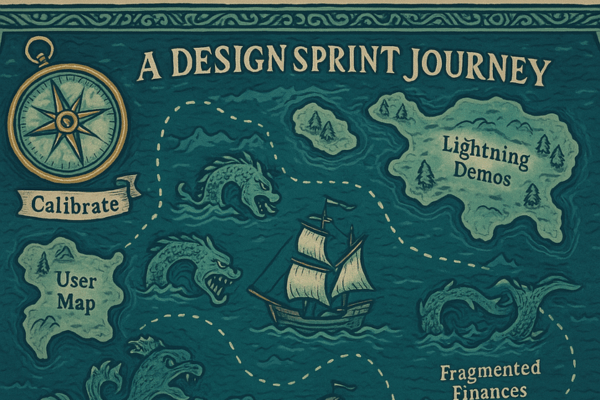
Image Source: Generated by Copilot
The Design Sprint is officially underway. Before this journey continues, we must create a plan that outlines where we are headed and what we are trying to achieve. That’s why the first phase of the Design Sprint is Map & Sketch, a dedicated time for our team to calibrate our compass. We will assess the landscape to determine the problems and challenges we might run into building a personal finance education app for young Gen Z adults. This phase also creates the opportunity to chart our course to define aspects of our app, including a user map, visual brand, and run lightning demos to brainstorm. After all of this, we’ll be ready to set sail by selecting the app features we want to explore and creating 4-step sketches.
Calibrating Our Compass
A core component of success for this phase is taking time to assess the landscape by getting on the same page with your team about what problems and challenges users face in this industry. Outlining this as a team gave us perspective on what type of Design Sprint questions and long-term goals we’d have to create later. Trust and privacy, and market fit are two of the problems that our team believes act as a barrier to entry or pain point for Gen Z users when using personal finance apps. We also thought that these users typically have short attention spans and high UX expectations and understand they have a fragmented financial life, which will make it difficult to come up with features that can grow with our users through their life transitions.
One of the most helpful mindset shifts our team had during this phase came from completing the “How Might We?” (HMW) exercise. This was dedicated time together to intentionally shift our perspective from viewing the challenges and problems we identified as pain points to thinking of them as opportunities we can capitalize on for our users. NN/g, a global team of UX experts, wrote five simple tips on how to create good how might we questions.
- Start with the problems or insights you’ve uncovered.
- Avoid suggesting a solution in your HMW question.
- Keep your HMW broad .
- Focus your HMW on the desired outcome.
- Phrase your HMW questions positively.

Image Source: NN/g
Now that we’ve calibrated our compass, it’s time to chart a course before we set sail.
Charting a Course
I believe the User Map exercise in this phase will be one of the most influential exercises later in the Design Sprint when it comes to creating our prototype. Similarly to charting a course before setting sail, creating a user map was a way for our team to see a visual and understand how our app users will interact with the app from start to finish. This exercise was valuable because it gave our team an understanding of the key moments we can focus on for the customer journey to determine what app features we want to prioritize. It also gave all of us perspective on the scope of the original problem and the challenges we identified at the beginning of this phase.
After this, we moved on to lightning demos, a process where you assess the landscape within the personal finance industry and outside of it to source inspiration, spark creativity, and see what does and doesn’t work within various apps and products. This set us up well to organize ideas for app features into the following categories: user experience, safety and account management, and social and gamification. A few apps our team used for this exercise were Fetch, Bilt, Letterboxd, and Discord. It was a great mix of industries outside of personal finance and gave us inspiration for our 4-step sketches from a feature perspective.
A principal designer at a digital agency based out of Melbourne describes the benefits of lightning demos perfectly in this Medium article they published.
“The lightning demo is a fun way to ignite creativity, you can do it as a stand-alone exercise with your team. Its purpose is to share ideas, find a muse and spark everyone’s imagination in an efficient and productive manner – just like a good old show and tell sessions we used to have in schools.”

Image Source: Medium
Now that we’ve charted our course, our team is ready to set sail and wrap up the final exercise of this first phase of the Design Sprint.
Setting Sail
With a calibrated compass and a charted course, our team is ready to take all this prep work and start generating ideas and solutions for our app. The Design Sprint has a specific exercise in this phase that’s structured to do this, and it’s called the 4-step sketch. This exercise has four individual activities: notes, ideas, crazy 8’s, and solution sketching. Our team’s desirable outcome from the 4-step sketch is to have everyone contribute ideas based on the previous lightning demos and research that we conducted.
Selecting an idea or two from the rapid ideation step in this exercise was tougher than we thought it’d be. Having only 20 minutes to take notes and draw out our ideas wasn’t too overwhelming, but facilitating the Crazy 8s proved quite challenging because we were all forced to work quickly, rely on intuition, and had to sift through an arrangement of diverse ideas.
The fluidity and less rigid structure of 4-step sketching reminds me of my experience brainstorming content marketing for an annual event at my job. I work for Quinnipiac University’s Development and Advancement office. My role focuses on digital engagement and content marketing for alumni engagement events and annual giving initiatives across the entire university. Every summer, several months before the event, I get together with my peers to plan Bobcat Weekend, Quinnipiac’s annual alumni and families weekend.
The brainstorming session for Bobcat Weekend has several parallels with the process of 4-step sketching. Everyone “works together alone” by taking time to create notes and ideas on their own, based on past Bobcat Weekends and inspiration from other universities. Before we do this, we also all have a mutual understanding of what our “problems” and “challenges” are heading into this Bobcat Weekend. The outcome? We each have several fleshed-out ideas and concepts for content marketing (social media posts, emails, print materials), and then we reconvene as a group to make decisions (just like designers do in a Design Sprint in the next phase).
If you don’t want to take my word for it that the 4-step sketch is one of the best ideation exercises to yield you and your team great progress and results, here’s a brief excerpt from an article written by GitLab about how the process worked for them and how Crazy8’s created progress.
“After thinking about the problem and potential solutions individually, we began solution-sketching through storyboards. This gave us the chance to further develop the details of a solution we chose through the crazy 8s. We started with a blank sheet of paper, placed three sticky notes on the page to represent three frames, and spent twenty minutes sketching more detailed wireframes. In the surrounding white space, we named our storyboard and wrote a brief explanation of the idea in order to ensure that the frame was understandable without verbal explanation. This helped us prepare for the next step, our silent critique.”

Image Source: GitLab
I’m excited to move on to the second phase of the Design Sprint to review everyone’s 4-step sketches in the art museums, create and vote on user flows, and begin storyboarding.
 Kyle Adams POV
Leave a comment