
Image Source: Generated by Copilot
The imaginative process of Storyboarding created progress for PennyPal. It enabled our team to think through “what if” possibilities for our app and set us up to transition to the next stage of the Design Sprint that will address our goals and define how we can meet the wants and needs of our users. This next stint of our Design Sprint explores how we leveraged these storyboards to create PennyPal’s blueprint, defines what conditions we carefully curated as we move into user testing, and gives our team more clarity on why change is the only constant.
Creating the Blueprint
It was time to move on to the most difficult phase so far: Prototyping and Refinement. We needed to divide and conquer tasks as a team and ultimately build a realistic and clickable version of PennyPal. The prototype will have several user flows to showcase how various features work, including account sign-up, goal tracking, daily trivia, and the chat room. Our two designers, Chloe and Andrea, chose the suite of software to use to build this prototype, selected fonts that capture the brand’s ethos, found simple iconography, and stuck with PennyPal’s color palette to make sure everything was on-brand.
Being crystal clear about design decisions, what the product breakdown is for key features of a prototype, and delegating tasks for each person on your team reminds me of Gemma Lord’s (a Design Director at IDEO) reflections on how the changing nature of design has given designers a seat at the top table. One specific point Gemma makes that resonated with me during this phase of our Design Sprint is:
“I wasn’t there to design a product. My role, instead, was to shape the conversation itself – to ensure these leaders understood the trade-offs they were making, to help them see the long-term implications of their choices, to make sure that, somewhere amid the graphs and growth projections, the people their business serves were not forgotten.”

Image Source: Design Week
I noticed that these exact same reflections and feelings were top of mind for my team and I during this phase of the Design Sprint.
Carefully Curated Conditions
After our designers completed the prototype, it was finally time to test PennyPal for the first time. PennyPal’s main goal is to improve Gen Z users’ personal finance literacy in a compelling way that makes them want to come back to the app because of its entertaining and educational features. Facilitating a user test simulation internally helped the team identify what to fix within the prototype, test our moderator script to make sure any user would understand the three scenarios we want them to go through, and ensure the testing results are actionable insights to move forward.
For user testing, I was the internal user test subject because I didn’t participate in designing the PennyPal prototype. I tried my best to stick to the three scenarios and remember the “prototype mindset,” a concept introduced to me by the book Sprint: How to Solve Big Problems and Test New Ideas in Just Five Days.
“Building a façade may be uncomfortable for you and your team. To prototype your solution, you’ll need a temporary change of philosophy: from perfect to just enough, from long-term quality to temporary simulation.”
The prototype mindset is something I use at my job regularly as well. One of my responsibilities is analyzing digital engagement metrics for social media and email marketing to understand what is and isn’t working. I use these insights to make and implement recommendations on how to market more effectively. I created a report share-out using the prototype mindset that it didn’t need to be perfect, but built out just enough to share data insights with my extended team. Doing this helped my manager and me understand how we can create a long-term quality solution over time that will be useful for everyone.
The prototyping phase of a Design Sprint and completing an internal user test reveals the importance of the role UX plays in building brand consistency. Don Norman, a pioneer in UX design, said it best in his book The Design of Everyday Things. “When you have to explain how something works, it is a failure of design.”
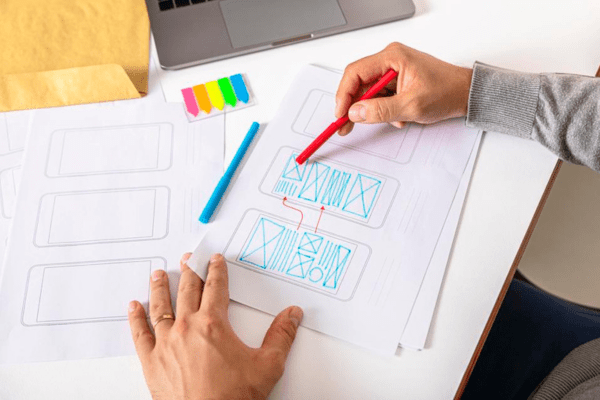
Image Source: Forbes
Change is the Only Constant
After we completed internal user testing, it was time to take these insights and learnings from our trial run findings to external user testing. Our trial run findings created the opportunity to refine our three scenarios and informed our team on how to complete external user testing to validate the prototype, test our original hypothesis, and collect usable data. The process of internal user testing and the insights that surfaced afterwards reminded me that change is the only constant.
The Design Sprint is structured so that all stakeholders who participate in it experience iterative learning. This makes the sprint agile and productive. You and a team of people can define a problem, establish an environment to sketch solutions to that problem, design a prototype to test these solutions, and connect with a user base to gather real-world data to decide if you have answers to that original problem and can move forward.
This phase of the Design Sprint showed me how user interface design and human behavior are both multidimensional. Jakob Nielsen, an author and pioneer of UX, stated it perfectly in an article titled The Usability Scaling Law: Death of User Testing?: “The complexity is immense; think of all the variables: user goals, prior experience, cognitive load, cultural context, device characteristics, and the sheer variety of tasks and information domains.”

Image Source: Jakob Nielsen on UX
I’m looking forward to the rich data we’ll collect from our external user testing in the next day of the Design Sprint to answer some of our challenges and really see how usable PennyPal is.
 Kyle Adams POV
Leave a comment