
Image Source: Generated by Google Gemini
Where it all Started
Before you and your team begin a Design Sprint, you need to take the necessary measures to make sure everyone is ready. With Design Sprints, there’s no such thing as overpreparation. Connecting with your team and client to onboard each person, define who is doing what, review the “run-of-show,” double check you have all the materials you need, and create several team agreements that are honored through the Sprint will guarantee its overall success.
Let’s delve into a few of the steps I mentioned above to better understand the role each of these play in the preparation phase of the Sprint and how you and your teammates can contribute to each these tasks to get on the same page before beginning the Sprint itself!
A Goal Without a Plan is a Wish
If you want to achieve a certain outcome, you need to have an idea as to what your specific “challenge” is, and understand what and who it is going to take to solve it. With the Sprint process, you and your team use guard rails that serve as ground rules over the course of four days. Each day has several mini workshop sessions and the day itself has a theme, or an even better way to think about it is each day is broken out by one of the steps of the Design Thinking process. See the picture below to better understand what I am talking about.
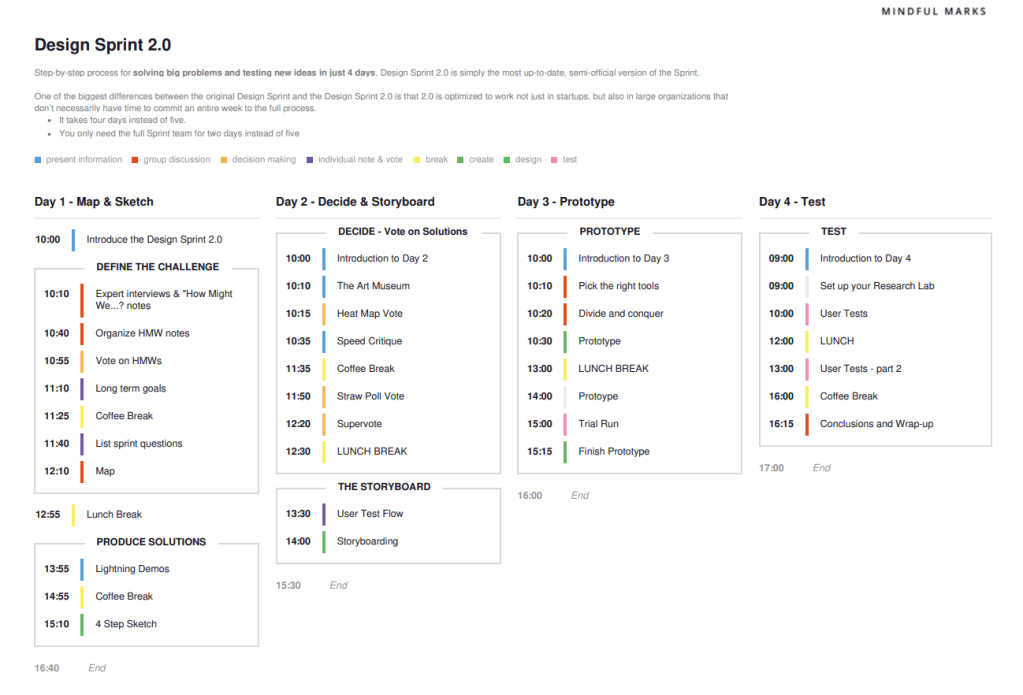
Image Source: Mindful Marks
Why a Craftsman Needs to Sharpen Their Tools
Before you, your team, and client begin the first day of the Sprint, make sure you have all the supplies all of you will need for the next four to five days. If you are running the sprint virtually and everyone is remote, you can rely on tools like Miro for digital whiteboarding, otter.ai to transcribe notes from each day of the workshop, and Zoom to host the meetings virtually and record all of them. If you are doing the workshop in-person instead, you’ll need to have lots of office supplies to whiteboard and brainstorm in-person including but not limited to stickie notes, sharpies/markers, masking tape, and time (to name a few).
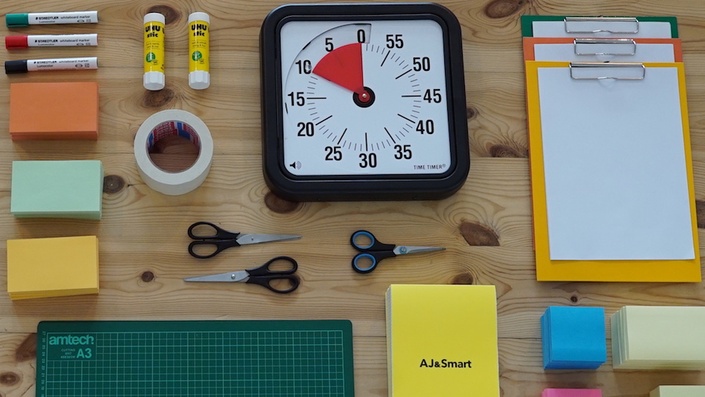
Image Source: AJ & Smart
Roles & Responsibilities: Everyone Has One
I’m sure you’ve heard the phrase teamwork, makes the dream work. As cliché as it may be, this is especially true when you’re working with a group to facilitate a sprint. Everyone’s role and the responsibilities that come with it need to be decided ahead of time for the Sprint to run smoothly. As explained in the Sprint Handbook: a step-by-step guide to planning and running innovation sprints, each of these roles play a unique and critical part in the success of a Sprint. See below for just a few!
- Notetaker: Captures essential information during interviews and discussions.
- Lead Facilitator: Guides the overall direction and maintains focus of the sprint.
- Sprint Host: Ensures a comfortable and productive environment for everyone.
- Prototyper: Translates ideas into tangible prototypes.
- Interviewer: Conducts user interviews to gain insights.

Image Source: Workshopper
There’s No “I” in Team: How to Compromise
The most impactful concept I learned in this stage of Design Sprints is the importance of creating Team Agreements. During the mini workshop we conducted this week as a team, this was one of the three exercises we had to complete together. Doing this collaboratively, enabled each one of us to learn more about what each person in the group enjoys about teamwork, what they find challenging, and then create several agreements that we can all use to bring clarity, focus and good vibes for the next 6 weeks of work we will do together. Here’s a few of the agreements we made.
Team Agreements
1). Be on time to our weekly Friday meetings starting at 1 p.m. ET and let the group know by Wednesday if you can’t make it due to an extenuating circumstance.
2). Keep phone on silent and/or do not disturb during our team meetings.
3). Dedicate the first five minutes of the team meeting to “catching-up.”
It’s not possible to over prepare for a Sprint Workshop. Preparing for a sprint Workshop is just like walking to warm up before running a race. Walking before running is often overlooked and an afterthought, but without it you’re ten times more likely to cramp up or maybe even pull a muscle. Metaphorically speaking, the same goes for preparing for a Sprint. Without all these layers of preparation you, your team, and client aren’t going to have a successful sprint. After preparation is complete, it’s time to move into the first phase of the sprint. Map + Sketch.
Sources
Belle Hastings, P. (n.d.). The Sprint Handbook: a step-by-step guide to planning and running innovation sprints.
Knapp, J., Zeratsky, J., & Kowitz, B. (2016). Sprint: How to solve big problems and test new ideas in just five days. Bantam Press.
 Kyle Adams POV
Leave a comment